

On this page
Suppose every aa individual dies before it can reproduce. You might expect the recessive allele to vanish in a few generations. It does not. It falls fast while common, then crawls once rare, and one short formula tells you how slowly.
How fast does selection remove a recessive allele?
Call the recessive allele a and its frequency q. When selection against aa is complete (aa leaves no offspring; AA and Aa are unaffected), the frequency after one generation is q′ = q/(1 + q), the textbook relation used by Waxman and Overall in Frontiers in Genetics (2020).
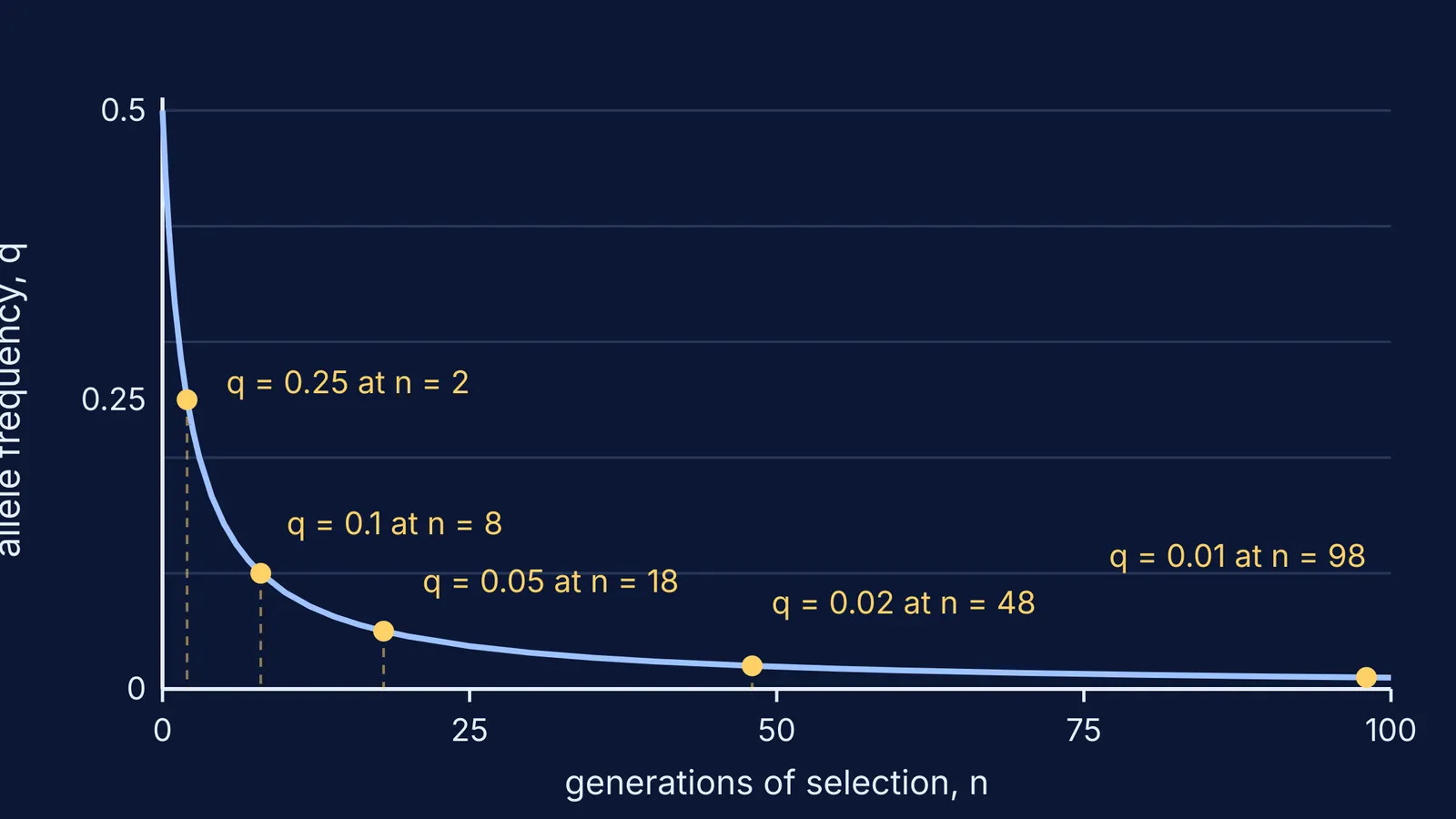
Repeat that step n times and you get the standard result: q(n) = q0/(1 + n·q0), where q0 is the starting frequency, as given in the Universidade de Vigo population genetics notes.
Rearranged, the number of generations needed to move from q0 to q(n) is n = 1/q(n) − 1/q0, as shown in animal-breeding course notes from the Royal Veterinary and Agricultural University, Copenhagen.
To see why, flip q′ = q/(1 + q) upside down: 1/q′ = 1/q + 1. Each generation adds exactly 1 to 1/q. When q is 0.5, 1/q is 2; when q is 0.01, 1/q is 100. Climbing from 2 to 100 one step at a time takes 98 generations.
How many generations to go from q = 0.5 to q = 0.01?
Here is n = 1/q(n) − 1/q0 from the Copenhagen notes, worked out with q0 = 0.5:
q = 0.5: 0 generations
q = 0.25: 2 generations
q = 0.1: 8 generations
q = 0.05: 18 generations
q = 0.02: 48 generations
q = 0.01: 98 generations
The first halving, 0.5 to 0.25, takes 2 generations; the halving from 0.02 to 0.01 takes 50. Halving again from 0.01 to 0.005 takes another 100, which is the worked example in the Copenhagen notes. The Vigo notes put the pattern in one line: the time to halve the frequency is t = 1/q0 generations.
You can check the top of the list by hand. A University of Washington genetics lecture starts at q = 0.5, removes the aa newborns and gets q = 0.333 after one generation, which is exactly 0.5/(1 + 0.5). Starting from q = 0.1, it gets 0.091, which matches 0.1/1.1.
Why does selection slow down when the allele is rare?
Selection can only see aa individuals, and a rare allele almost never sits in one. The University of Washington lecture shows this at q = 0.1: genotype frequencies are 0.81 AA, 0.18 Aa and 0.01 aa, so 18 of every 20 copies of a, or 90%, sit in healthy-looking Aa carriers. In the lecture's words, rare harmful recessives “hide” in heterozygotes, and selection cannot eliminate them easily.
The same arithmetic in general says the share of a copies held by carriers is 1 − q. At q = 0.01 that is 99%: only one copy in a hundred is ever exposed to selection.
In human terms the wait is long. Wang and colleagues, writing in Science Advances (2023), estimated the average human generation time over the past 250,000 years at 26.9 years. At that pace, the 98 generations from q = 0.5 to 0.01 would take about 2,600 years, and the 100 generations to halve 0.01 about 2,700 more.
The formula assumes a large population, random mating, no new mutations and a constant environment, as the UW lecture states. If aa is only partly harmed, the lecture shows the fall is slower still. For carrier numbers in a real disorder, read our explainer on carrier frequency for a rare recessive disorder; for why cousin marriage raises the risk, see how inbreeding exposes recessive alleles.
How do you solve an exam question on selection against a recessive?
Worked example: a recessive lethal allele has frequency 0.04. What is it after 25 generations, and how many generations does it take to reach 0.01?
Check the conditions. aa has fitness 0; AA and Aa have fitness 1. If aa is only partly harmed, this shortcut does not apply.
After 25 generations: q(25) = 0.04/(1 + 25 × 0.04) = 0.04/2 = 0.02.
Generations to 0.01, by the Copenhagen notes formula: n = 1/0.01 − 1/0.04 = 100 − 25 = 75.
Check with the halving rule. From 0.04, halving takes 1/0.04 = 25 generations. From 0.02, halving takes 1/0.02 = 50. Total 75.
Three common slips:
Tracking p instead of q. The formula follows the recessive allele.
Treating the share of affected individuals as q. If a question says 1 in 10,000 people are aa, take the square root first: q = 0.01. Our Hardy-Weinberg numericals guide walks through this step.
Dividing q0 by n instead of by 1 + n·q0.
If set-ups keep tripping you, the Fermi Problem Library has worked problems with a step-by-step solver that explains the reasoning rather than printing an answer. If Hardy-Weinberg itself still feels shaky, the Fermi Concept Library gives every concept in biology its own lesson and its place in the map.
Next time a question says “selection against a recessive”, write down 1/q, add one per generation, and flip it back.


