

On this page
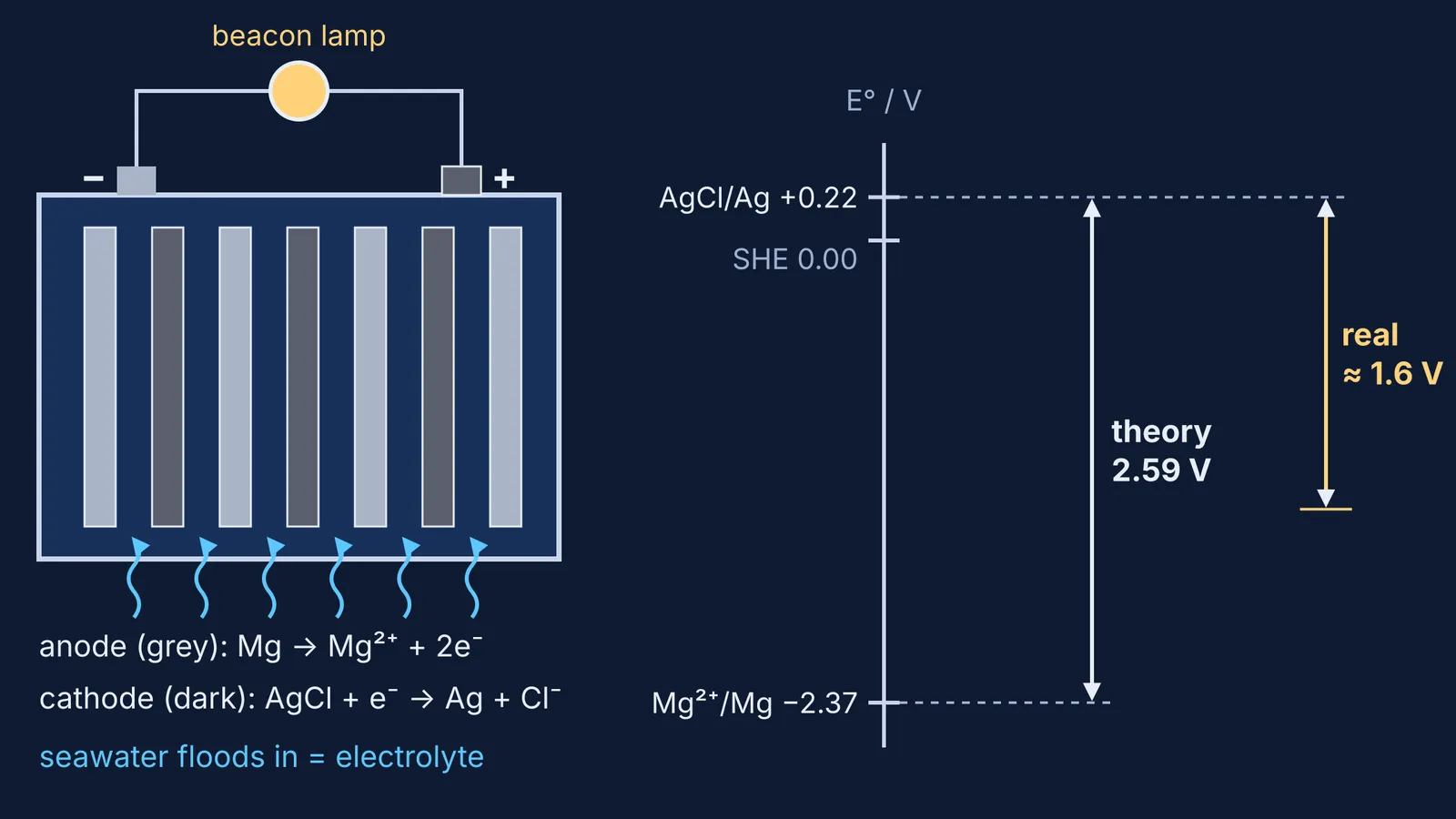
Some batteries are built to do nothing for years. They sit dry in a store, and when they are dropped into the sea, the seawater floods between the plates, becomes the electrolyte, and the battery switches on. The classic version pairs a magnesium anode with a silver chloride cathode. It is a neat exam case because its cathode potential comes straight from the Ksp of AgCl, and because the real voltage is far below the textbook E°. Working out why is good practice in electrochemistry.
What is a seawater-activated battery used for?
It is a reserve battery: the electrolyte is left out until the moment of use, so almost nothing happens inside during storage. A Chinese patent on magnesium seawater batteries lists uses including marine observation instruments, navigation marks, distress and rescue equipment and torpedo power supplies (CN1543001A). A US patent on the same Mg–AgCl system says such batteries are used "particularly, as power sources in torpedoes" (US3941616A).
Seawater is already there, and a dry battery has no electrolyte to leak or react with the plates.
What reactions happen in a magnesium–silver chloride cell?
Magnesium is oxidised at the anode, and silver chloride is reduced to silver at the cathode.
Anode (oxidation): Mg → Mg²⁺ + 2e⁻
Cathode (reduction): AgCl + e⁻ → Ag + Cl⁻ (twice, to take both electrons)
Overall: Mg + 2AgCl → MgCl₂ + 2Ag
Check the balance: one Mg, two Ag and two Cl on each side. The charge is zero on both sides, and two electrons pass per Mg. The MgCl₂ actually stays dissolved as Mg²⁺ and Cl⁻ in the seawater, but writing MgCl₂ keeps the equation tidy.
Silver chloride works well here because it hardly dissolves, so it stays on its plate as a solid.
How do you find E° for AgCl/Ag from Ksp?
The AgCl/Ag electrode is really the Ag⁺/Ag electrode with almost no free Ag⁺, because solid AgCl keeps [Ag⁺] tiny. You can calculate its standard potential from two numbers you already know: E°(Ag⁺/Ag) = +0.80 V and Ksp(AgCl) = 1.8 × 10⁻¹⁰ at 25 °C.
Write the Nernst equation for Ag⁺/Ag. E = 0.80 + 0.0591 log [Ag⁺] (one electron, so n = 1).
Set the standard state of the new electrode. For AgCl/Ag, standard means [Cl⁻] = 1 M. Then [Ag⁺] = Ksp / [Cl⁻] = 1.8 × 10⁻¹⁰ M.
Substitute. log(1.8 × 10⁻¹⁰) = −9.74, and 0.0591 × (−9.74) = −0.576 V.
Result. E°(AgCl/Ag) = 0.80 − 0.576 = 0.224 V. Data tables give 0.222 V, so the estimate is close.
This is the reverse of the problem in how to find solubility product from cell EMF, where the same electrodes are used to get Ksp from a measured potential. The same couple also serves as a lab reference electrode, as explained in why silver–silver chloride replaced the calomel electrode. In a seawater battery it does a different job: it carries the full working current.
Seawater is not 1 M in chloride. Its [Cl⁻] is about 0.55 M, so the cathode sits a little above E°: E = 0.222 − 0.0591 log 0.55 = 0.222 + 0.015 = 0.237 V. That shift of about 15 mV is small next to the losses at the anode, which come next.
What are E°cell and ΔG° for the Mg–AgCl cell?
Use NCERT's value E°(Mg²⁺/Mg) = −2.37 V.
E°cell = E°cathode − E°anode = 0.222 − (−2.37) = 2.59 V.
Electrons. n = 2 per Mg.
ΔG° = −nFE°cell = −2 × 96 485 × 2.59 = −5.00 × 10⁵ J, or about −500 kJ per mole of Mg.
The patent above gives the theoretical EMF as 2.585 V, which matches this calculation to within rounding.
How much silver chloride does a battery need?
Capacity follows from Faraday's law. One mole of AgCl (143.3 g) takes one mole of electrons, 96 485 C.
AgCl: 96 485 / 143.3 = 673 C per gram. Divide by 3600 to get 0.187 Ah, or 187 mAh per gram.
Mg: one mole (24.3 g) gives two moles of electrons, so 2 × 96 485 / 24.3 = 7940 C per gram, or about 2205 mAh per gram.
Gram for gram, magnesium stores almost twelve times as much charge as silver chloride. The cathode limits the capacity, and since it is made of silver, it also sets most of the cost.
Worked example. A small rescue beacon draws 0.10 A for 10 hours. How much AgCl and Mg must react?
Q = 0.10 A × 10 × 3600 s = 3600 C.
n(e⁻) = 3600 / 96 485 = 0.0373 mol.
AgCl: 1 mol per mol e⁻, so 0.0373 × 143.3 = 5.35 g.
Mg: ½ mol per mol e⁻, so 0.0187 × 24.3 = 0.45 g.
The beacon needs over 5 g of silver chloride and less than half a gram of magnesium. Real designs add extra of both, partly because some magnesium is lost without making any current, which leads to the next question.
Why does a real seawater cell give only about 1.6 V?
The same patent gives the actual voltage of an AgCl seawater cell as 1.6 V, against the 2.585 V theoretical figure (CN1543001A). Most of the missing voltage is lost at the magnesium.
Magnesium reacts with water directly. Mg + 2H₂O → Mg(OH)₂ + H₂. (Check: one Mg, four H and two O on each side.) This self-corrosion uses up magnesium and gives off hydrogen without pushing any electrons through the circuit. A 2022 study of magnesium anodes in seawater notes that Mg undergoes strong pitting corrosion accompanied by the formation of hydrogen gas (Abarro, Ocon and del Rosario, Chemical Engineering Transactions).
A surface film forms. Mg²⁺ meets OH⁻ at the surface and leaves a layer of Mg(OH)₂ that hinders further reaction. So the working potential of the magnesium is far less negative than −2.37 V.
Current costs voltage. Drawing a large current adds more losses at both electrodes and across the seawater between them.
At 1.6 V, the useful electrical work is about 2 × 96 485 × 1.6 = 309 kJ per mole of Mg, roughly 62% of ΔG°. Once the cell is wet, self-corrosion keeps going whether or not the light is on, so the battery is used once and thrown away. It is a primary cell and cannot be recharged. Compare the zinc–silver oxide button cell in silver oxide watch battery: E°cell, ΔG° and why it stays flat, where the real voltage sits close to the calculated one.
If you want to see how the Nernst equation shifts an electrode potential as concentrations change, the Concept Library covers every concept in chemistry, with electrochemistry linked to equilibrium and Ksp.
Quick checklist
Seawater battery: Mg anode, AgCl cathode, seawater electrolyte added only at the moment of use.
Overall: Mg + 2AgCl → MgCl₂ + 2Ag, with n = 2 per Mg.
E°(AgCl/Ag) = 0.80 + 0.0591 log Ksp = 0.224 V (table 0.222 V).
E°cell = 0.222 − (−2.37) = 2.59 V; ΔG° ≈ −500 kJ per mol Mg.
AgCl gives 187 mAh per gram and Mg about 2205 mAh per gram, so AgCl limits capacity and cost.
Real voltage is about 1.6 V because of Mg self-corrosion, the Mg(OH)₂ film and losses under load.
Primary cell: once wet, it runs until it is used up.


