

On this page
The small flat battery in a quartz watch or a calculator is usually a silver oxide cell. NCERT's Class 12 electrochemistry exercise gives you its reaction and two electrode potentials and asks for E°cell and ΔrG°. That takes three lines. This post works it, then goes two steps further: why the cell's voltage stays almost level until it suddenly dies, and how many milligrams of zinc each milliamp-hour costs.
What reaction runs inside a silver oxide button cell?
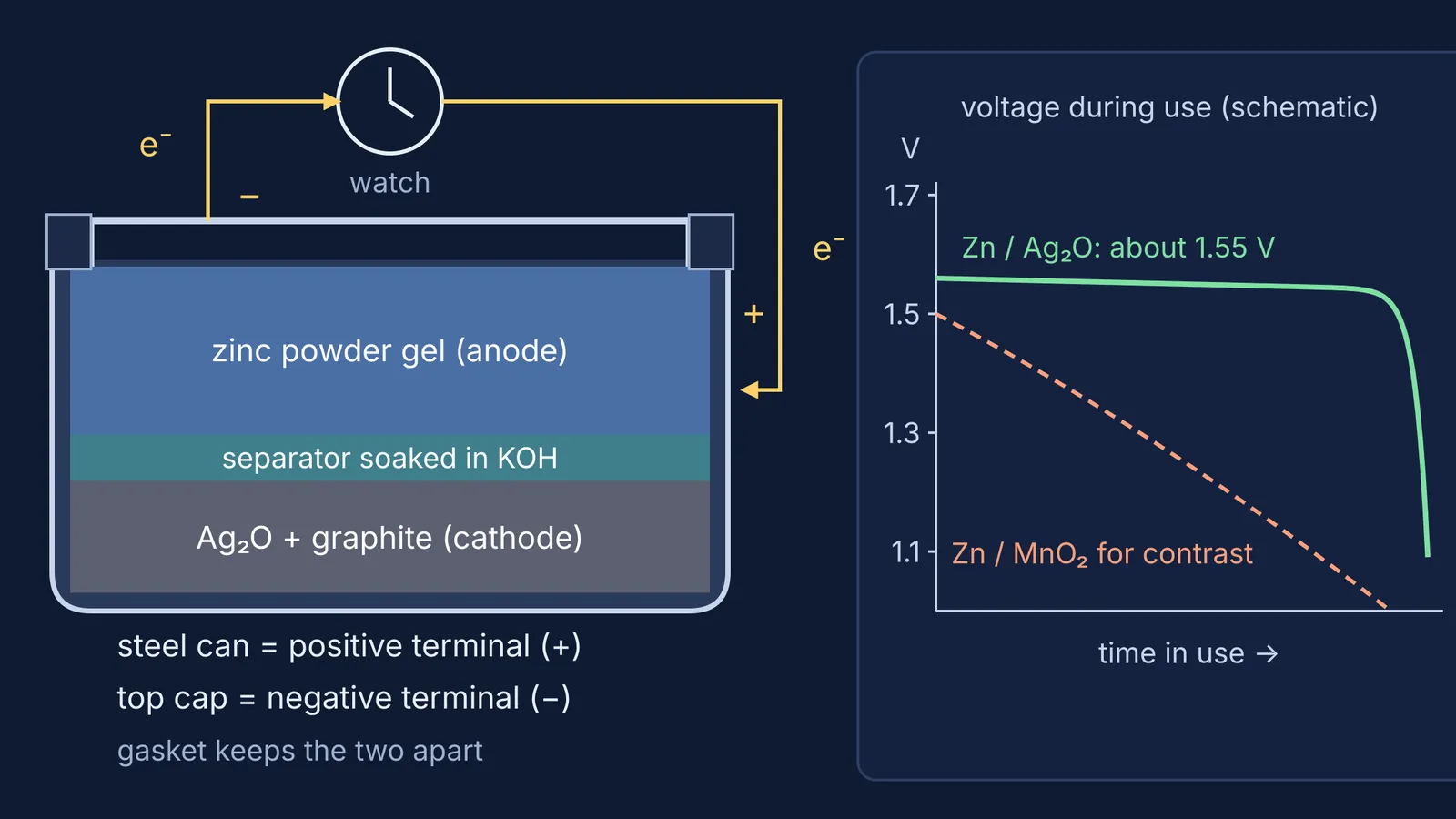
A button cell is a short steel can with a cap pressed on top. The parts, from the bottom up:
Cathode: a pressed pellet of silver(I) oxide, Ag₂O, mixed with a little graphite so it conducts. It sits against the steel can, which is the positive terminal.
Separator: a thin porous layer soaked in concentrated KOH (some cells use NaOH). Ions pass through it; the two electrodes never touch.
Anode: zinc powder held in a gel, under the top cap. The cap is the negative terminal, and a plastic gasket keeps it insulated from the can.
In alkaline electrolyte the half-reactions are:
Anode (oxidation): Zn + 2OH⁻ → ZnO + H₂O + 2e⁻
Cathode (reduction): Ag₂O + H₂O + 2e⁻ → 2Ag + 2OH⁻
Overall: Zn + Ag₂O → ZnO + 2Ag
Zinc goes from 0 to +2 and each silver from +1 to 0, so n = 2. Check the balance: one Zn, two Ag and one O on each side, and zero charge on each side.
NCERT writes the reaction as Zn + Ag₂O + H₂O → Zn²⁺ + 2Ag + 2OH⁻. That also balances and transfers the same two electrons, but it is a simplification. In strong KOH the zinc does not stay as free Zn²⁺ ions: it ends up as ZnO, or as zincate, [Zn(OH)₄]²⁻, while the electrolyte can still dissolve it.
How do you calculate E°cell and ΔG° for the silver oxide cell?
Use NCERT's data: E°(Zn²⁺/Zn) = −0.76 V and E°(Ag⁺/Ag) = +0.80 V, with F = 96487 C mol⁻¹.
Pick the electrodes. Zinc is oxidised, so zinc is the anode. Silver is reduced, so silver is the cathode.
Cell potential. E°cell = E°cathode − E°anode = 0.80 − (−0.76) = 1.56 V.
Count electrons. From the half-reactions, n = 2 per mole of zinc.
Gibbs energy. ΔrG° = −nFE°cell = −2 × 96487 × 1.56 = −3.01 × 10⁵ J mol⁻¹.
Convert and read it. That is −301 kJ mol⁻¹. The sign is negative, so the reaction is spontaneous, and at most 301 kJ of electrical work is available per mole of zinc that reacts.
The units work because one volt times one coulomb is one joule. If you want the general version of this formula next to the others in the chapter, see Electrochemistry Class 12 formulas with units and worked examples.
Which electrode potentials are the real ones?
The Ag⁺/Ag and Zn²⁺/Zn couples are the ones NCERT gives, but they describe each metal dipping into a 1 M solution of its own ions. The real cell runs in alkali, where the couples that matter are approximately:
Ag₂O/Ag in base: about +0.34 V against SHE
ZnO/Zn in base: about −1.26 V against SHE
The difference is about 0.34 − (−1.26) = 1.60 V, which is close to what a fresh cell reads with nothing connected. Manufacturers label it with a nominal 1.55 V. Both half-reactions use or release 2OH⁻ per 2e⁻, so both potentials shift by the same amount if the KOH concentration changes, and the difference stays put.
Do not mix the two sets. 0.34 − (−0.76) or 0.80 − (−1.26) gives a number that belongs to no real cell. In an exam, use the data the question gives you, which will be NCERT's 1.56 V.
Why does a silver oxide cell's voltage stay flat until the end?
Write the Nernst equation for the real overall reaction, Zn + Ag₂O → ZnO + 2Ag:
E = E° − (0.0591/2) log Q
Every species in that equation is a pure solid, and a pure solid has activity 1. So Q = 1 at the start, halfway through and near the end, and E = E° the whole time. The OH⁻ and H₂O made at one electrode are used up at the other, so the electrolyte does not change overall either. The same argument explains the steady 1.35 V of the mercury cell, covered in batteries and fuel cells: dry cells to lithium-ion.
Real cells droop slightly under load because of internal resistance, and as the zinc surface becomes coated with oxide. When one reactant is nearly used up, the voltage falls steeply.
Notice what NCERT's simplified equation would predict instead. If the product really were Zn²⁺(aq) and OH⁻(aq), then Q = [Zn²⁺][OH⁻]², which grows as the cell runs, and E would drift down steadily. The flat curve is evidence that the product is solid ZnO.
Compare an alkaline AA. Its Zn/MnO₂ cathode changes composition gradually as manganese is reduced, so its voltage slides down from about 1.5 V through the cell's life, as explained in why AA batteries are 1.5 volts. A watch, a hearing aid or a calculator wants a steady voltage, which is why they use silver oxide.
How much zinc does a button cell use per mAh?
Capacity is printed in milliamp-hours, so convert that to charge first.
Charge. 1 mAh = 10⁻³ A × 3600 s = 3.6 C.
Moles of electrons. 3.6 / 96485 = 3.73 × 10⁻⁵ mol.
Moles of zinc. Each Zn gives 2 electrons, so 1.87 × 10⁻⁵ mol.
Mass of zinc. 1.87 × 10⁻⁵ × 65.38 g mol⁻¹ = 1.22 × 10⁻³ g, or 1.22 mg per mAh.
Mass of Ag₂O. The same 1.87 × 10⁻⁵ mol × 231.74 g mol⁻¹ = 4.32 mg per mAh.
So a cell rated at, say, 150 mAh needs at least 183 mg of zinc and 648 mg of silver oxide. Real cells hold more than this, because not every grain reacts. The total charge is 540 C, and at 1.55 V that is about 840 J of electrical energy. Silver oxide is the heavier and more expensive reactant, which is why these cells are small.
If you want more Faraday's-law conversions like this one, the Fermi Problem Library has a step-by-step solver that explains the reasoning at each step.
Is a silver oxide cell the same as a mercury cell?
No. The mercury cell uses HgO instead of Ag₂O and gives about 1.35 V. It has the same flat discharge for the same reason, but mercury is toxic, and mercury cells have been phased out in many countries. The silver oxide cell gives a slightly higher voltage with the same flat curve. If any of these cells still feels like a list of reactions to memorise, the Concept Library maps each idea in electrochemistry to the ones it depends on.
Quick checklist
Overall reaction in KOH: Zn + Ag₂O → ZnO + 2Ag, n = 2.
NCERT data: E°cell = 0.80 − (−0.76) = 1.56 V.
ΔrG° = −2 × 96487 × 1.56 = −3.01 × 10⁵ J mol⁻¹ = −301 kJ mol⁻¹.
Real alkaline couples give about 1.60 V open circuit; nominal 1.55 V. Never mix the two sets.
All solids, so Q = 1 and the voltage stays flat.
1 mAh = 3.6 C = 1.22 mg Zn = 4.32 mg Ag₂O.


