

On this page
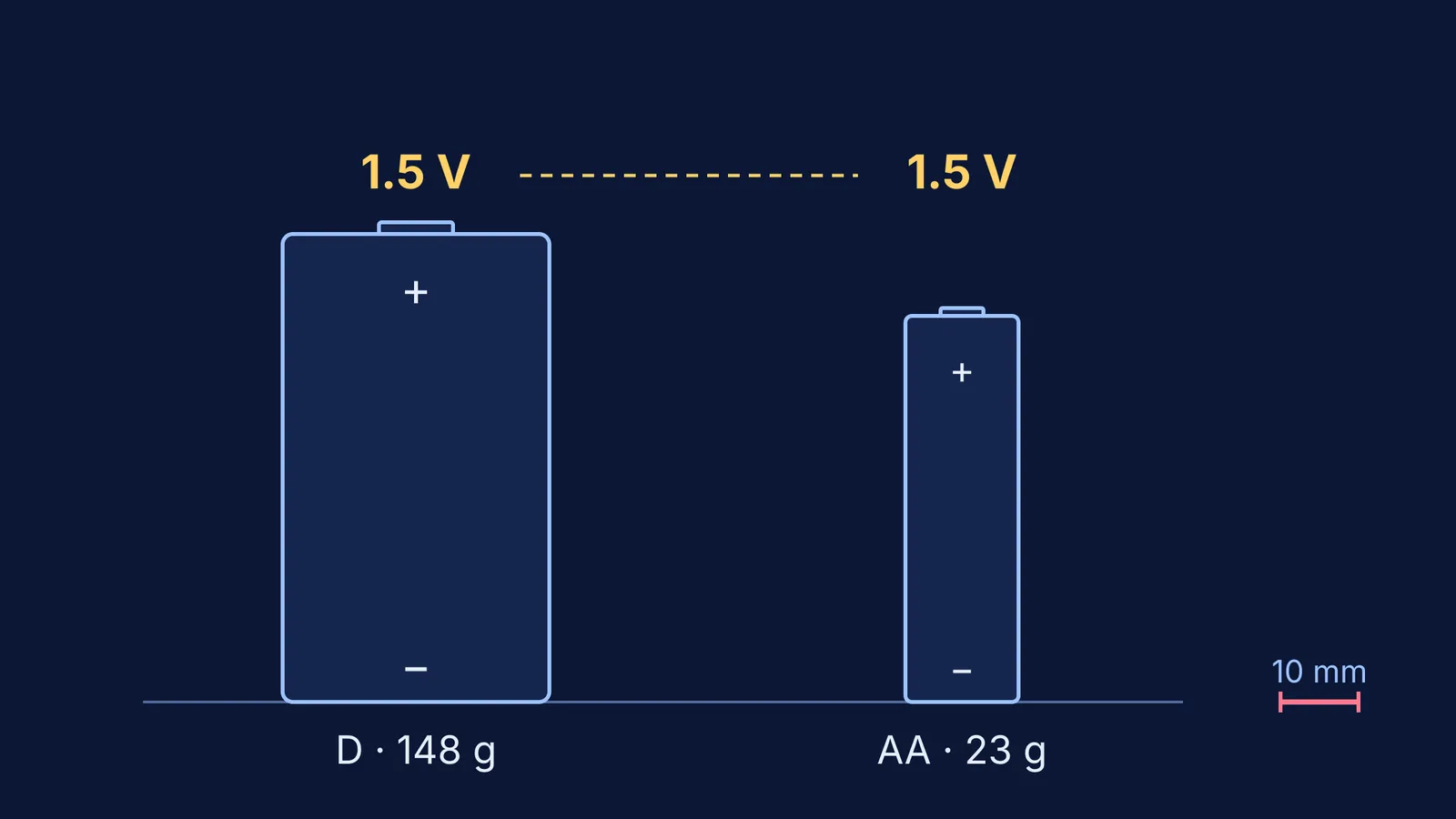
Pick up any alkaline AA, AAA, C or D cell and the label says the same thing: 1.5 V. Going by Energizer's D-cell and AA datasheets, a D cell weighs about six times as much as an AA, yet it gives no bigger push. The reason is one of the most useful ideas in Class 12 electrochemistry: a cell's voltage is set by which chemicals react, not by how much of them there is.
What is inside an AA battery?
Energizer's E91 AA datasheet lists the chemical system as zinc-manganese dioxide (Zn/MnO₂), a nominal voltage of 1.5 volts and a typical weight of 23.0 grams. The zinc, as a powder, is the anode. Manganese dioxide mixed with graphite is the cathode. The electrolyte is potassium hydroxide, which conducts well and keeps the cell's internal resistance low, according to these materials-science notes on alkaline cells.
The two half-reactions, as given in OpenStax Chemistry 2e/17%3A_Electrochemistry/17.05%3A_Batteries_and_Fuel_Cells), are:
Anode (oxidation): Zn + 2OH⁻ → ZnO + H₂O + 2e⁻
Cathode (reduction): 2MnO₂ + H₂O + 2e⁻ → Mn₂O₃ + 2OH⁻
Zinc gives up electrons easily; manganese in MnO₂ takes them, dropping from oxidation state +4 to +3. The voltage measures that difference in pull.
Why are AA batteries 1.5 volts and not some other number?
The standard cell potential is the difference between two reduction potentials: E°cell = E°cathode − E°anode (LibreTexts, standard electrode potentials). The same page shows how it works for the zinc-copper Daniell cell: 0.34 V − (−0.76 V) = 1.10 V.
For the zinc-manganese dioxide pair, OpenStax/17%3A_Electrochemistry/17.05%3A_Batteries_and_Fuel_Cells) gives a cell potential of +1.43 V. Manufacturers label the cell with a rounded nominal 1.5 V, and a new alkaline cell with nothing connected reads 1.50 to 1.65 V (Wikipedia: Alkaline battery). The reading falls as the reactants are used up, and Energizer's AA datasheet measures capacity down to a cut-off of 0.8 volts. Why voltage drifts as concentrations change is the job of the Nernst equation, covered in our guide to cell notation, EMF and the Nernst equation.
Change the chemistry and the number changes. OpenStax/17%3A_Electrochemistry/17.05%3A_Batteries_and_Fuel_Cells) gives about 1.2 V for a nickel-cadmium cell and about 3.7 V for a lithium-ion cell. That is why a rechargeable NiCd cell in the AA size reads lower than an alkaline AA of exactly the same shape.
Does a bigger battery give more voltage?
No. Energizer's EN95 D-cell datasheet lists the same Zn/MnO₂ chemistry and the same 1.5-volt nominal voltage, in a cell of 148.0 grams and 56.0 cubic centimetres, against 8.1 cubic centimetres for the AA. What the extra material buys is charge: at a steady 25 mA draw, the datasheet bar charts show just under 3,000 mAh for the AA and roughly 20,000 mAh for the D.
OpenStax/17%3A_Electrochemistry/17.05%3A_Batteries_and_Fuel_Cells) puts it plainly: all sizes of dry cell have the same components, so they show the same voltage, but larger cells hold more reactants and can transfer more charge. We go through the textbook version of this exam question in does the EMF of a cell depend on its size?
To get more voltage, you add cells in series: two AAs end to end in a TV remote give about 3 V.
Worked example: why doubling the zinc does not double the voltage
Cell potential links to Gibbs energy through ΔG° = −nFE°cell, where F is the Faraday constant, 96,485 C/mol (OpenStax via LibreTexts/17%3A_Electrochemistry/17.05%3A_Potential_Free_Energy_and_Equilibrium)).
One mole of zinc reacting gives n = 2 moles of electrons. With E = 1.43 V: ΔG = −2 × 96,485 × 1.43 ≈ −276 kJ.
Double everything: two moles of zinc, n = 4. Now ΔG ≈ −552 kJ. The energy doubled.
Work back to voltage: E = −ΔG ÷ nF = 552,000 ÷ (4 × 96,485) ≈ 1.43 V. Unchanged.
Energy grows with the amount of reactant, but energy per unit of charge, which is what a volt is, stays fixed. LibreTexts states it as a rule: E° values do not depend on the stoichiometric coefficients because E° is an intensive property.
For a different way into topics like this, the Fermi Simulation Lab has interactive simulations for the ideas that are easier to see than to read.
How do you check a battery's voltage from its label?
Find the chemistry, not the size: "alkaline" or "Zn/MnO₂" means 1.5 V nominal; NiCd about 1.2 V; lithium-ion about 3.7 V (OpenStax/17%3A_Electrochemistry/17.05%3A_Batteries_and_Fuel_Cells)).
Count the cells in series and multiply. Four AAs end to end make 6 V.
If you have a multimeter, measure a new AA and a new D with nothing connected. Both should read close to 1.5 V.
Write the exam line: EMF depends on the electrode materials, the electrolyte, concentration and temperature; size changes only how much charge the cell can deliver.
If terms like reduction potential or oxidation state still feel shaky, the Fermi Concept Library has a lesson for every concept in chemistry, each with its place in the map.
For the story of where the zinc-manganese dioxide pairing began, read about Georges Leclanché and the zinc-carbon cell of 1866.


