

On this page
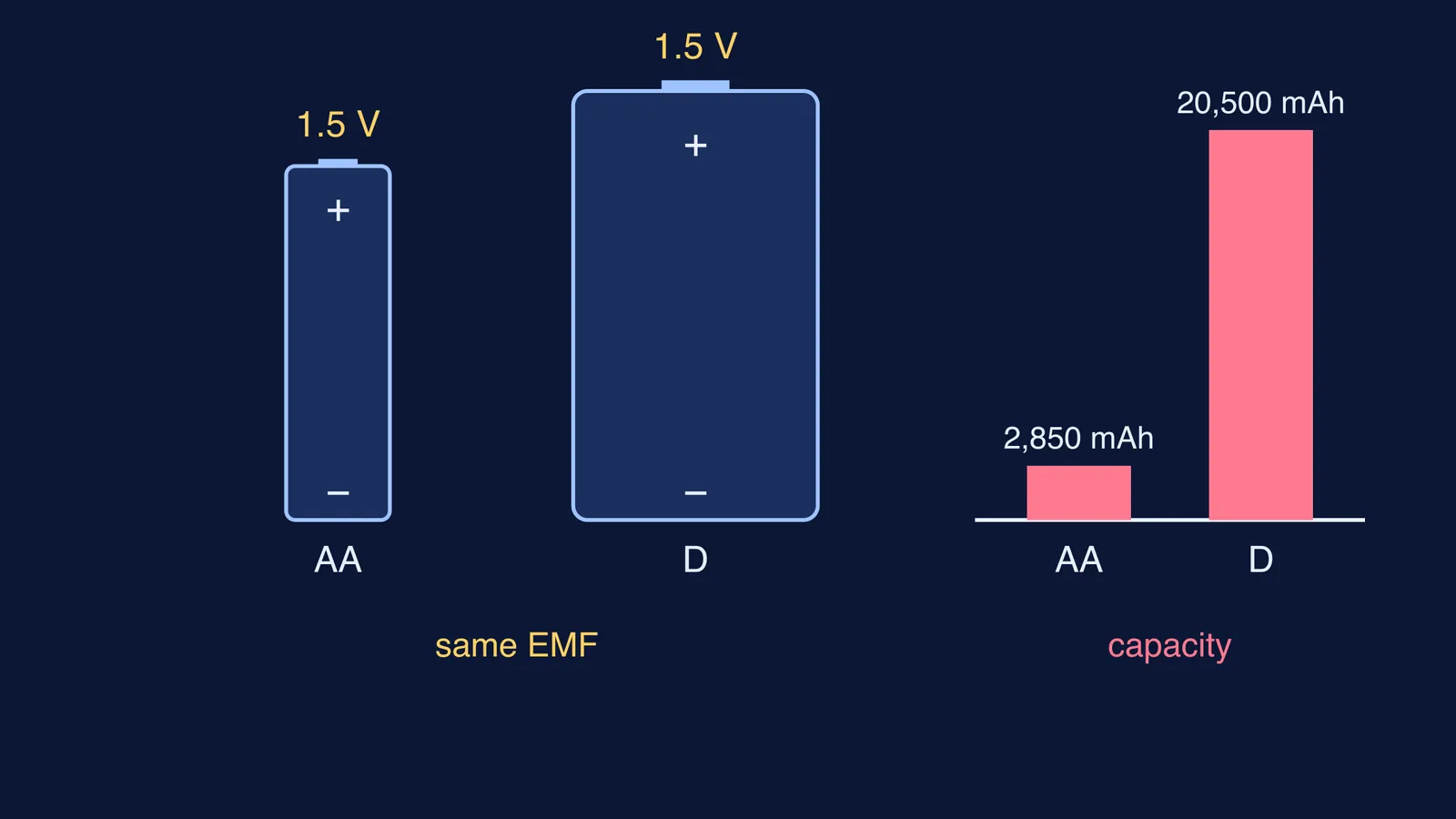
Pick up an AA cell and a D cell. Energizer's datasheets list the D cell at 141.9 g and the AA cell at 23.0 g, yet both are rated 1.5 V. That is no coincidence, and it comes up in board exams, JEE Main and practical vivas.
Why doesn't a bigger cell give a higher EMF?
NCERT's Class 12 chemistry chapter on electrochemistry defines the emf of a cell as the difference between the electrode potentials of the cathode and the anode when no current is drawn. Those potentials depend on which substances meet at each electrode, not on how much of them there is.
The Daniell cell shows it in one line. The same NCERT chapter gives the emf as 0.34 V − (−0.76) V = 1.10 V, from the copper and zinc standard electrode potentials. Nothing in that subtraction mentions the mass of zinc or the volume of solution.
The deeper reason is energy per charge. NCERT writes ΔrG = −nFE(cell) and states that E(cell) is an intensive parameter while ΔrG is an extensive property. Double the reaction and n doubles, ΔrG doubles, and E stays the same. A bigger cell stores more total energy, but the energy per coulomb, which is what EMF measures, is unchanged. We walk through the same equation in how cell EMF connects to Gibbs energy and K.
One caution: the Nernst equation in the same chapter shows E(cell) shifting with ion concentrations. Size alone does not change it.
What does change when a cell is bigger?
Two things: how much charge it can deliver, and how easily current flows inside it. Energizer's datasheets for its E91 AA cell and E95 D cell compare fairly, because both use zinc-manganese dioxide chemistry:
Voltage: 1.5 V for both.
Average capacity at a 25 mA continuous drain: 2,850 mAh for the AA, 20,500 mAh for the D, about 7.2 times more.
Volume: 8.1 cubic centimetres against 55.9, about 6.9 times more.
Internal resistance when fresh: 146 milliohms for the AA, 173 milliohms for the D.
Capacity grows roughly in step with volume, because there is more zinc and manganese dioxide to react. If you want to turn mAh into hours, see how long a 3000 mAh battery lasts.
Internal resistance is subtler. Energizer's technical bulletin on internal resistance says the ionic part depends on electrolyte conductivity, ion mobility and electrode surface area. NCERT's R = ρl/A shows why area matters: a wider path has lower resistance. So for a cell built the same way but larger, internal resistance falls. Real products are not just scaled copies, though. The bulletin puts fresh Energizer alkaline cylindrical cells at roughly 150 to 300 milliohms depending on size, and notes that results depend on the test technique.
How can you prove it with two cells in parallel?
Two identical cells side by side act like one cell with twice the electrode area and twice the chemicals. NCERT's Class 12 physics chapter on current electricity gives the parallel combination as 1/r_eq = 1/r1 + 1/r2 and ε_eq/r_eq = ε1/r1 + ε2/r2. For two identical cells, r_eq = r/2 and ε_eq = ε.
Try practice values (not datasheet figures): ε = 1.5 V, r = 0.2 Ω, external load R = 2.8 Ω. The same chapter gives the terminal voltage as V = ε − Ir.
One cell: I = 1.5 / (2.8 + 0.2) = 0.50 A, so V = 1.5 − 0.50 × 0.2 = 1.40 V.
Two cells in parallel: r_eq = 0.1 Ω, so I = 1.5 / 2.9 ≈ 0.517 A, and V ≈ 1.5 − 0.517 × 0.1 ≈ 1.45 V.
Open circuit (no current): V = ε = 1.5 V in both cases.
The "bigger" cell delivers slightly more current and holds up its terminal voltage better, and it lasts roughly twice as long because it has twice the reactants. Its EMF is still 1.5 V. For series and mixed combinations, see cells, EMF and internal resistance combinations.
How do you avoid the common traps?
Quick true-or-false checks:
"A larger cell has a larger EMF": false.
"EMF depends on the nature of the electrodes and electrolyte": true.
"Moving the electrodes further apart raises internal resistance": true, other things equal, from R = ρl/A.
"mAh is a voltage rating": false; it is charge, the capacity.
"A cell's terminal voltage equals its EMF": only when no current flows.
If the idea of electrode potential still feels shaky, the Fermi Concept Library has a lesson for every concept in physics and chemistry, including electrode potential and Gibbs energy. When you move on to numericals, the Fermi Problem Library has worked problems with a step-by-step solver that explains the reasoning rather than printing an answer.


