

On this page
You have a new power bank, drone, or flashlight, and the battery says "3000 mAh". What does that number mean for the actual time you can use the device? While the basic math is just one step of division, real-world batteries do not always follow the formula. Predicting the true run time requires understanding not just how much energy is in the battery, but how fast you are trying to take it out.
How do you calculate battery run time in mAh?
The basic calculation for battery run time is to divide the battery capacity by the current the device draws.
Run Time (hours) = Capacity (mAh) / Load (mA)
The "mAh" stands for milliampere-hours, which is a measure of electric charge. A 3000 mAh battery holds enough charge to theoretically deliver 3000 milliamps (3 Amps) for one hour. If your device draws less current, the battery lasts longer.
If you have a 3000 mAh battery, here is how long it will power different devices on paper:
Low drain (LED light): An LED pulling 150 mA will run for 20 hours (3000 / 150 = 20).
Medium drain (small motor): A device pulling 500 mA will run for 6 hours (3000 / 500 = 6).
Heavy drain (drone or power tool): A motor pulling 3000 mA will run for 1 hour (3000 / 3000 = 1).
This linear relationship is the best-case scenario. It assumes the battery acts like a perfect tank of water that empties at a steady rate until the very last drop. Learning to predict ideal values mathematically is a great habit for electronics, much like predicting the time constant in an RC circuit simulation before you measure it.
Why does real run time fall short at heavy drain?
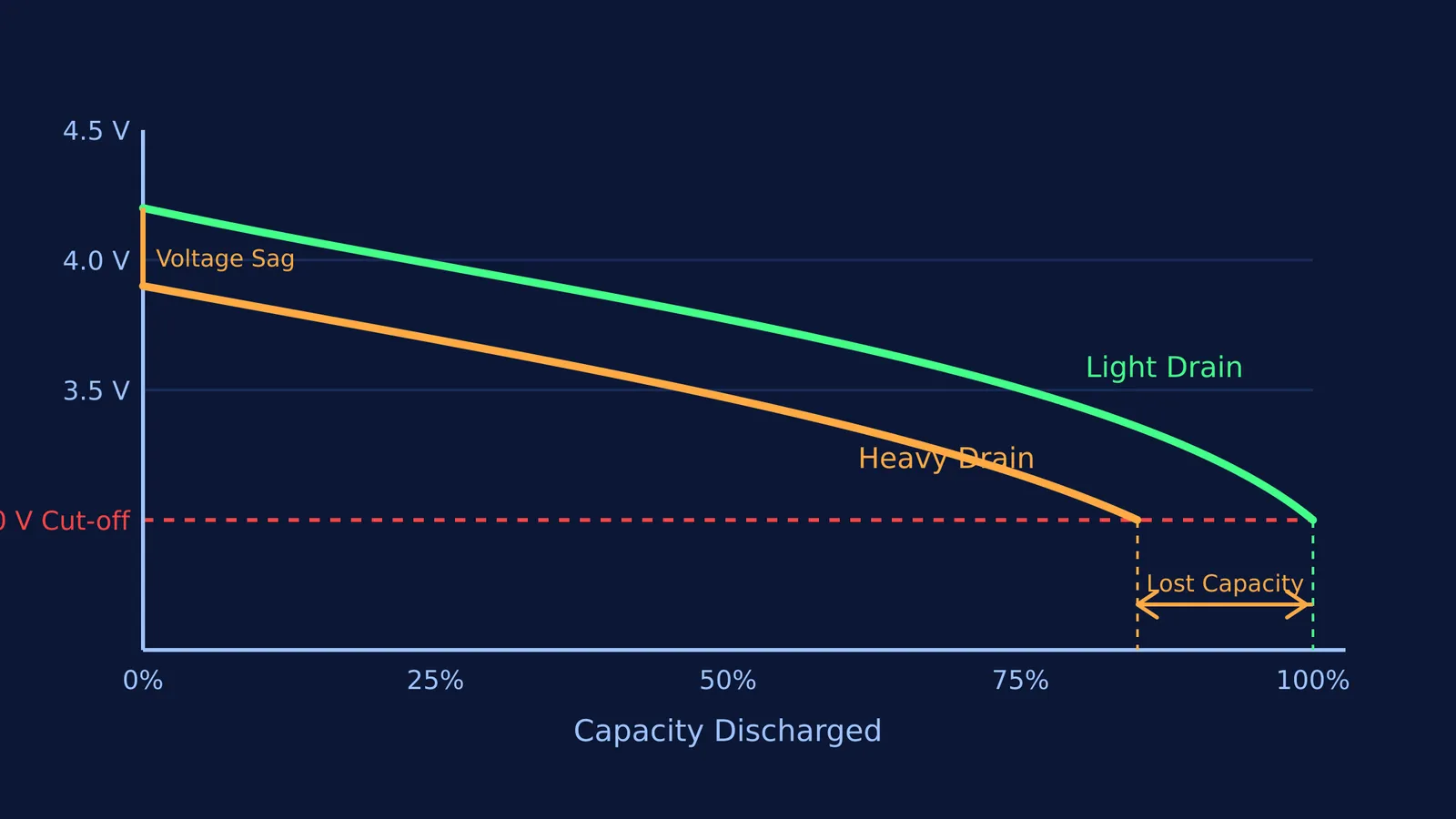
If you attach a 3000 mAh battery to a heavy 3000 mA load, you will almost never get the full hour. The device will likely shut off early. This happens because of two overlapping physical effects: internal resistance and Peukert's law.
First, every battery has internal resistance. When a high current flows through the battery, Ohm's law dictates a voltage drop inside the cell itself. This causes "voltage sag"—the voltage reaching your device is momentarily lower than the battery's actual stored voltage. Modern electronics have a low-voltage cut-off threshold (such as 3.0 V for lithium-ion) to prevent deep discharge damage. Because the voltage sags under a heavy load, the device hits this cut-off and shuts down early, leaving unused energy stranded in the battery.
Second, discharging a battery quickly turns some of its chemical energy into heat rather than usable electricity. According to Battery University, these internal losses mean a battery discharged at a high rate will deliver 95% or less of its nominal capacity. This phenomenon, known as Peukert's law, describes how the available capacity shrinks as the discharge rate climbs.
The chemistry of the battery determines how bad this penalty is:
Lithium-ion: Highly efficient. Even at high drains, they lose very little capacity to heat, delivering near that 95% mark.
Lead-acid and Alkaline: Highly sensitive to the Peukert effect. Manufacturers usually rate these batteries at a very slow 20-hour discharge rate to show the highest possible mAh number on the box. If you drain them in one hour, they deliver significantly less than their rated capacity.
How can you test battery drain with a simulation?
If you want to see how voltage and current behave in a circuit without buying expensive measurement tools, you can test it virtually. The Simulation Lab has interactive simulations for the ideas that are easier to see than to read, letting you watch how voltage drops across a circuit under different loads.
Here is a simple three-step plan to estimate your real-world run time:
Find the load: Check your device's manual for its current draw in mA. (If you are wiring multiple things at home, you might wonder why household appliances are connected in parallel—it ensures each device gets the full voltage, but it also means their current draws add up).
Calculate the ideal time: Divide your battery's mAh by the total load to get the theoretical hours.
Apply the heavy drain penalty: Look at your calculated time. If it is under 2 hours, expect a shorter run time. For lithium-ion, expect to lose at least 5% of your ideal time. For alkaline or lead-acid batteries, expect them to shut down much earlier because they suffer from the Peukert effect more severely.
By factoring in both the load and the battery chemistry, you can predict exactly when your device will power down and avoid getting caught with a dead battery.


