

On this page
Attack certain sea cucumbers and they seem to self-destruct: they squeeze hard and push part of their insides out. The predator gets a tangle of gut or sticky white threads, and the sea cucumber crawls away to regrow what it lost.
Why do sea cucumbers throw out their organs?
Evisceration is the ejection of internal organs, and in sea cucumbers it is a response to danger. A 2022 review in the journal Biology by Fang Su, Hongsheng Yang and Lina Sun lists the triggers: crowding, high water temperature, low oxygen (hypoxia) and meeting predators. Some species, such as Eupentacta quinquesemita and Parastichopus californicus, also eviscerate seasonally.
The same review describes two routes out of the body:
Posterior evisceration, seen mainly in holothuriids and synallactids: the gut between the oesophagus and the cloaca, its blood vessels and one or two respiratory trees leave through the cloaca, the rear opening.
Anterior evisceration, common in dendrochirotids: the body wall tears near the front, and almost all the viscera go, including the feeding tentacles and the whole digestive tract.
How can an animal let go of its gut so quickly? Echinoderms have mutable collagenous tissue, a connective tissue they can stiffen or soften. According to the Su review, evisceration depends on a rapid, irreversible loss of strength in that tissue at a fixed break point called the autotomy plane. It is a planned tear, much like the weak point in a tail you can read about in why a lizard drops its tail and grows it back.
What are Cuvierian tubules?
Cuvierian tubules are fine white tubes attached to the base of the left respiratory tree in some sea cucumbers, and they are a separate defence. The system consists of several hundred tubules, VandenSpiegel, Jangoux and Flammang wrote in The Biological Bulletin in 2000 in their study of Holothuria forskali.
When irritated, the animal turns its rear towards the threat and contracts, the cloaca wall tears, and some tubules shoot out. They lengthen, instantly become sticky and rapidly immobilise most organisms they touch, the 2000 paper reports. Then they break off at their base and the sea cucumber crawls away.
The glue is strong. Flammang and colleagues measured tubule adhesion in seven species and found tenacities (force per unit area) of 30 to 135 kPa, in the range of other sea animals that stick temporarily.
How do sea cucumbers regrow lost organs?
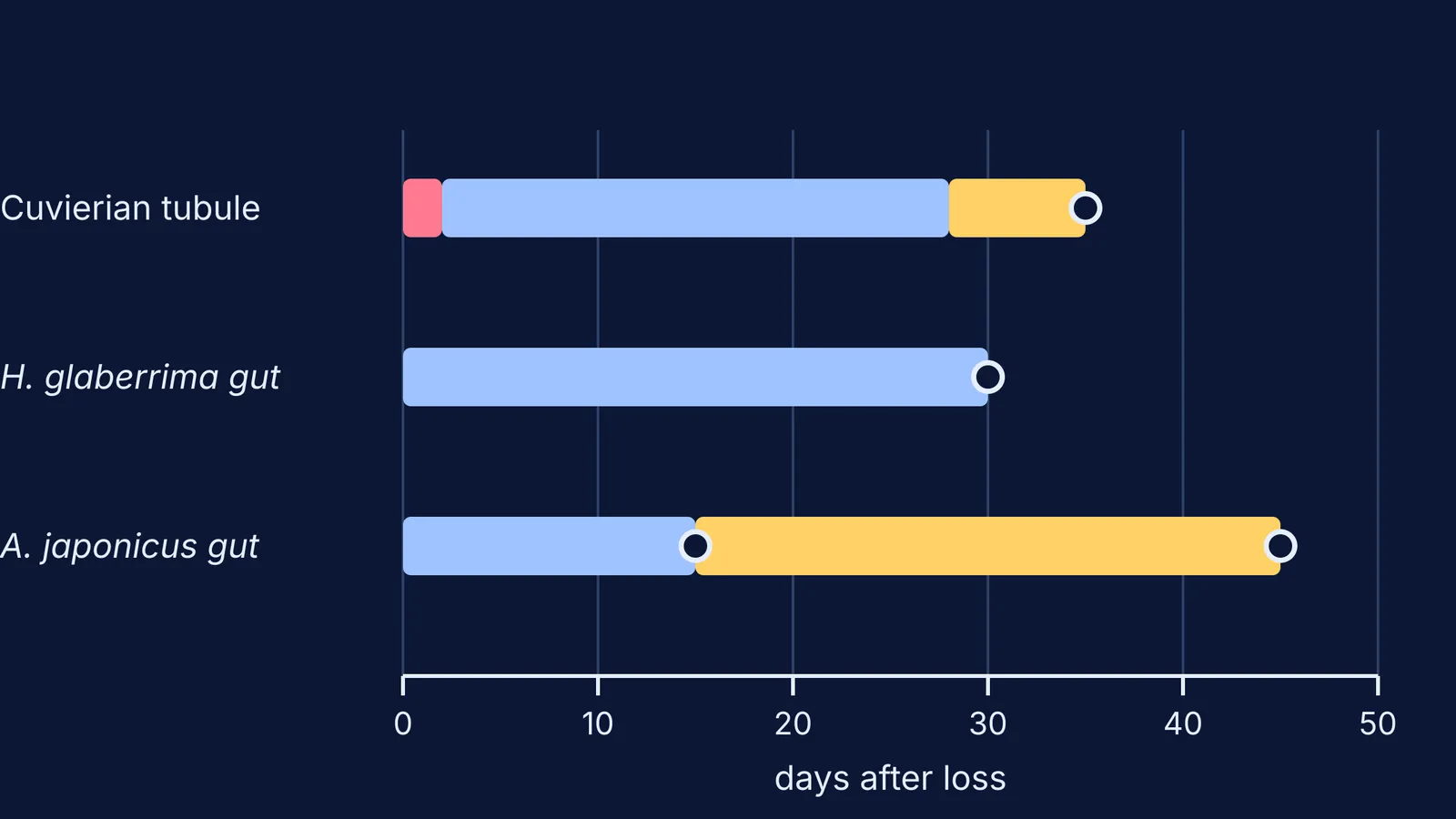
The 2022 Biology review splits gut regrowth into five stages: wound healing, formation of a rudiment (the anlage), lumen formation, intestinal differentiation and growth. Early on, cells in the mesothelium, the lining of the mesentery that held the old gut, dedifferentiate: they give up their specialised identity, move to the torn free edge of the mesentery and start building the new tube.
The review gives these timings:
Apostichopus japonicus: the new intestine digests food again in 15 days and is back to its normal state in 45 days.
Holothuria glaberrima: the new intestine returns to its original shape about one month after evisceration.
Cuvierian tubules regrow too. In H. forskali a single tubule takes about 5 weeks: a repair phase covering the first 48 hours, a true regenerative phase of about 4 weeks, then about a week of growth, according to the Biological Bulletin study. After heavy losses, new tubules start in waves of 10 to 30 at 10-day intervals.
Is evisceration suicide or a defence?
It is a defence. Use this five-question test on any animal that seems to harm itself, whether it is a lizard dropping its tail, a starfish regrowing an arm or a squid releasing ink as a decoy.
Does the animal survive? Yes. The Su review calls evisceration a mechanism that allows sea cucumbers to survive in adverse environments.
Is the loss controlled? Yes. The break happens at the autotomy plane, not at random.
Does the predator lose interest or get stuck? Cuvierian tubules immobilise most organisms they touch.
Is the lost part replaced? Yes: 15 to 45 days for the A. japonicus gut, about 5 weeks per tubule.
Is the cost kept low? H. forskali fires only a few tubules at a time, and VandenSpiegel and colleagues conclude the tubules form "an almost inexhaustible line of defense maintained at limited energy cost."
Suicide would fail the first question. Evisceration passes all five.
How do you explain evisceration in a 3-mark answer?
A strong school-test answer has three parts, one mark each:
Name it: evisceration, a form of autotomy (self-amputation at a set break point) used against predators and stress.
Give the mechanism: connective tissue at the autotomy plane rapidly loses strength, so the gut or Cuvierian tubules come out through the cloaca or a tear in the body wall.
Show it is adaptive: the animal survives and regrows the organs, with the gut working again in about 15 days in A. japonicus.
If words like autotomy, mesentery or dedifferentiation blur together, the Fermi Concept Library gives each biology concept its own lesson and shows its place in the map, so you can see how regeneration links to cell biology.
Next time an animal seems to destroy itself, ask the five questions before you call it a mistake.


