

On this page
If you have watched a squid vanish in a puff of black, you have seen a classic escape trick of the sea. Squids, cuttlefish and octopuses belong to the Coleoidea, a group of about 700 species according to the Tree of Life Web Project, and most of them carry ink. The short answer to why: ink buys time to get away from a predator.
What is squid and octopus ink made of?
The clearest single summary is a review by Charles Derby of Georgia State University, Cephalopod ink: production, chemistry, functions and applications, published in Marine Drugs in 2014. Its main points:
Ink is blackened by melanin, a dark pigment.
In the cuttlefish Sepia, melanin makes up about 15% of the ink's wet weight, and each ink sac holds about 1 g of melanin (Derby 2014).
Proteins make up another 5% to 8% of the weight of Sepia ink.
Ink also carries free amino acids (taurine is about half or more of them in most species tested) and small amounts of DOPA and dopamine.
Sepia melanin is a eumelanin built mainly from two kinds of unit, DHI and DHICA.
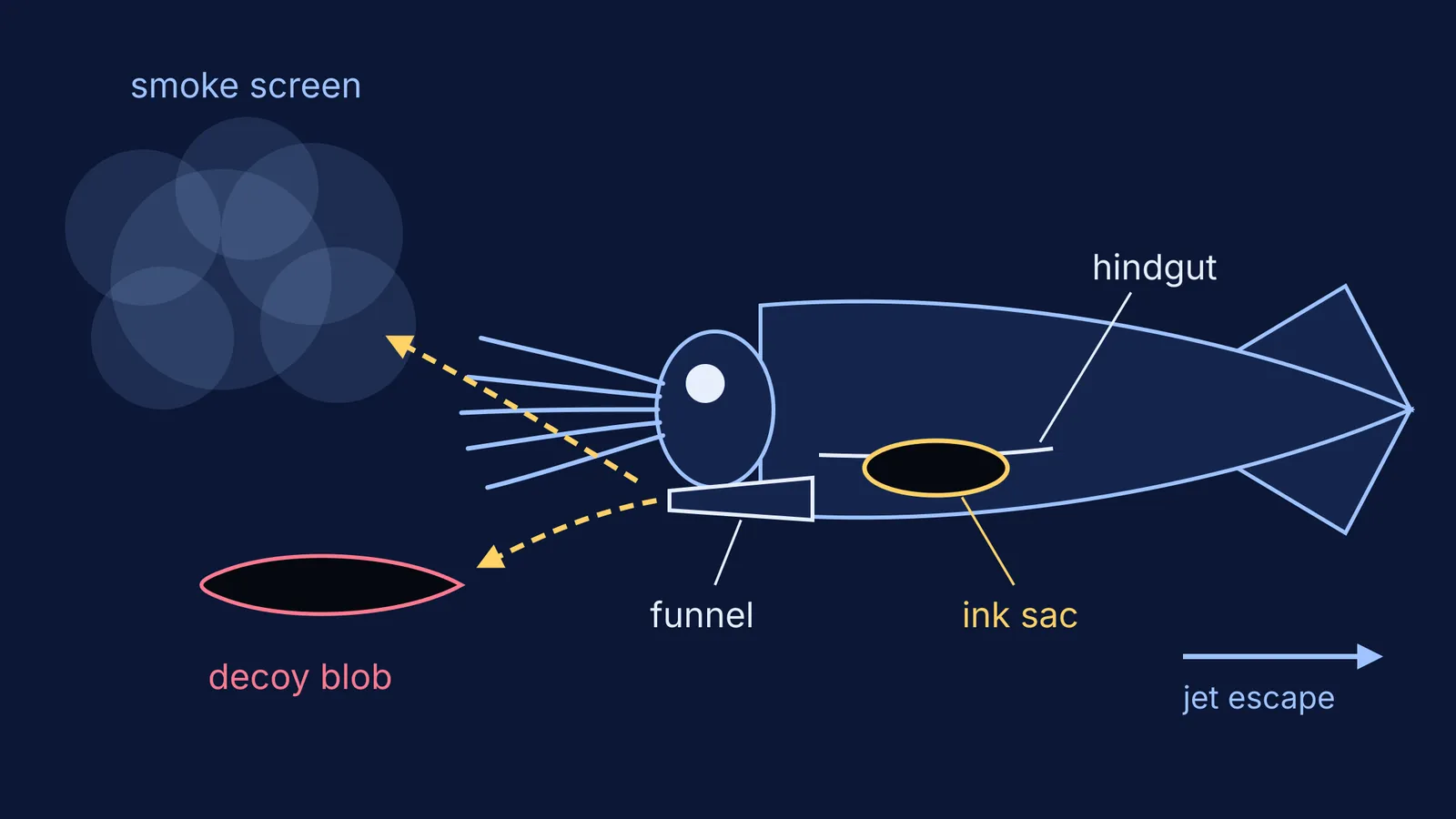
The second ingredient is mucus, and it comes from a separate gland. The funnel organ sits on the funnel near the siphon and makes mucus. Derby notes that several authors have described the combined secretions of the ink sac and funnel organ, "produced in different amounts," as leading to "ink of different forms, ranging from a diffuse cloud to a discrete object." That one idea explains most of what ink does.
Where is the ink sac in a mollusc's body?
Cephalopods are molluscs, so they share the basic plan of mantle, mantle cavity and gills that you see in snails and clams (our guide to the mollusc radula, mantle and gills covers each part). One big change is the funnel, which is thought to come from the molluscan foot or neck region (Tree of Life Web Project). That is also why an octopus is still a mollusc without a shell.
The ink sac forms as an outpocket of the hindgut. According to Derby 2014, it has an ink gland at its base, a storage reservoir, and muscular walls with a pair of sphincters, and it empties through a duct into the hindgut near the anus. Ink then leaves the body through the funnel, and it spreads further when released with a jet of water from the siphon (Wikipedia's summary of the literature).
Not every cephalopod has ink. Nautiluses have no ink sac, and some mostly deep-sea octopods in the suborder Cirrata have lost theirs (Derby 2014).
If the mollusc body plan feels fuzzy, the Fermi Concept Library gives every concept in biology its own lesson and its place in the map.
Why do squids and octopuses release ink?
Stephanie Bush and Bruce Robison studied ink use in deep-sea squid and described six kinds of ink release: pseudomorphs, pseudomorph series, ink ropes, clouds or smokescreens, diffuse puffs and mantle fills (Bush and Robison 2007, Marine Biology, as summarised in Derby 2014). Three defensive uses stand out.
Smoke screen. Ink with relatively little mucus spreads into a diffuse cloud. Derby's review suggests the animal can hide behind it or jet away.
Decoy. Ink with more mucus holds together as a dark blob called a pseudomorph, which roughly resembles the shape of a cephalopod. By drawing the predator's attention, it may buy time to escape. In lab trials by Staudinger and colleagues described in the same review, inking by longfin squid went with more startle behaviour, bluefish abandoning attacks, and flounder aiming their attacks at the wrong place.
Bad taste. In a 2013 study in The Biological Bulletin, Derby and colleagues found that longfin squid ink disrupted summer flounder mainly through sight as the fish approached. Its chemistry also put off both flounder and sea catfish at the biting and eating stage, and most of that deterrent effect was tied to the melanin granules.
For that first layer of defence, read about camouflage in animals.
How do you write this up in an exam answer?
Cover what, where and why:
What: ink is melanin, which makes it black, plus mucus from the funnel organ.
Where: the ink sac is an outpocket of the hindgut that empties into the hindgut near the anus, and ink leaves through the funnel.
Why: a diffuse cloud works as a smoke screen, a mucus-rich pseudomorph works as a decoy, and the ink's chemistry can deter a predator.
Three slips to avoid:
Calling ink venom. It is released into the water, not injected.
Saying all cephalopods ink. Nautiluses do not.
Saying octopuses are not molluscs because they have no shell.
If you would rather be quizzed than reread, Fermi's AI tutor can work out what you already know about molluscs and build a plan for the session, checking your understanding as it goes.


