

On this page
Most people first hear of severe combined immunodeficiency through a nickname. David Vetter, born in Houston in 1971 with X-linked SCID, spent most of his life in a sterile plastic bubble and became known as the "Bubble Boy"; he died in February 1984, aged twelve, after a bone marrow transplant from his sister carried Epstein-Barr virus that progressed to lymphoma (Embryo Project Encyclopedia, Arizona State University). For a Class 12 student, SCID matters for another reason: one form of it is the gene therapy example in NCERT's biotechnology chapter.
What is SCID, the bubble boy disease?
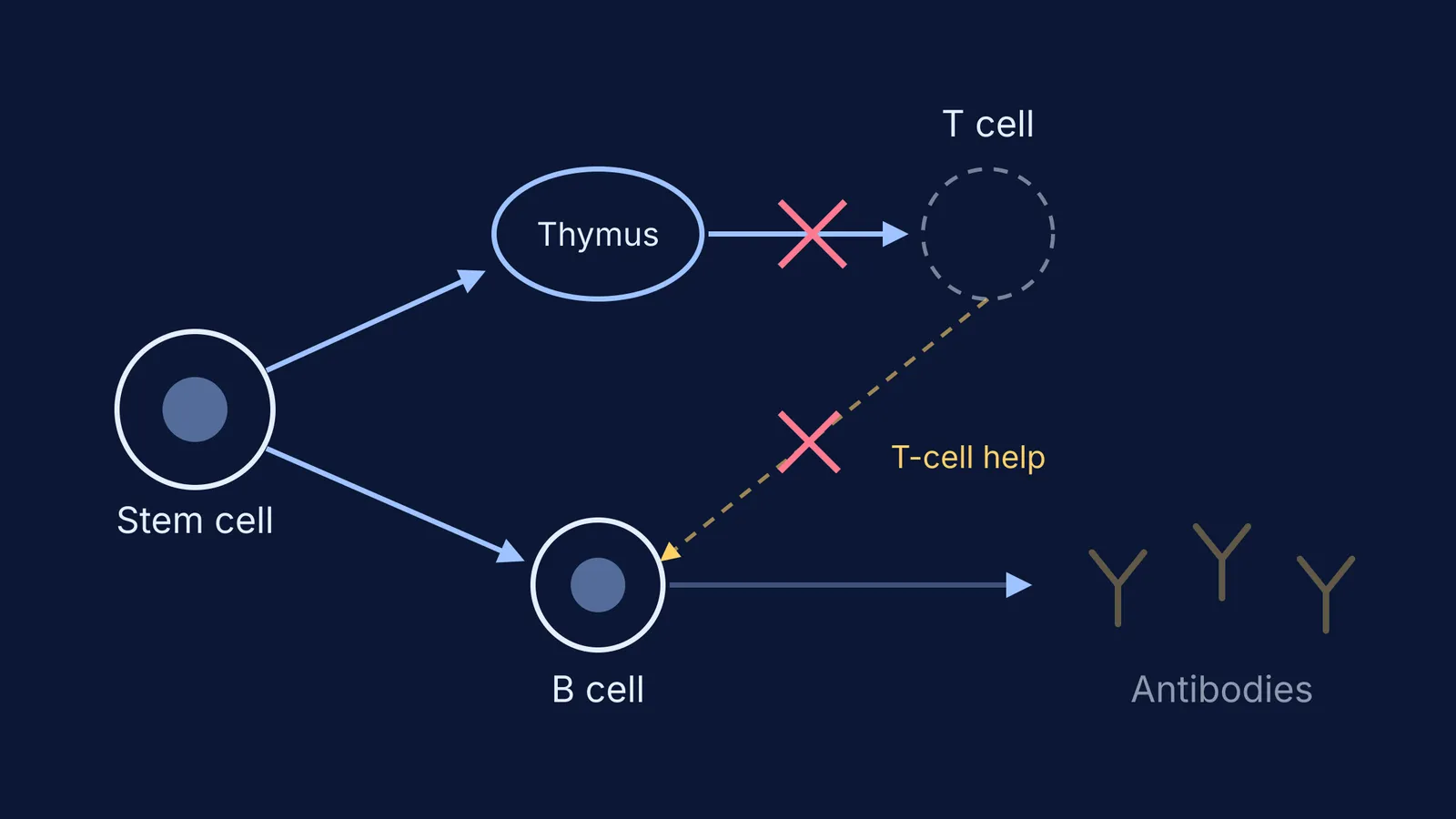
Severe combined immunodeficiency is a primary immunodeficiency disorder that causes low levels of antibodies and low or no T cells, according to the Merck Manual. Most affected infants develop pneumonia, persistent viral infections, thrush and diarrhoea, usually by age 6 months, and without treatment they usually die before age 1. The "bubble" comes from the past practice of keeping these children in strict isolation, sometimes in a plastic tent.
SCID is rare. MedlinePlus Genetics, from the US National Library of Medicine, puts the incidence of all SCID disorders at 1 in 60,000 newborns, with X-linked SCID, caused by variants in the IL2RG gene, the most common form (MedlinePlus Genetics: X-linked SCID). About 15 percent of people with SCID have ADA deficiency (MedlinePlus Genetics: ADA deficiency).
The main treatment is a stem cell transplant, and if it is done by age 3 months, nearly all infants survive (Merck Manual). For questions about a child's health, ask a paediatrician.
Why does SCID knock out both T cells and B cells?
In NCERT Chapter 7, Human Health and Disease, B-lymphocytes produce antibodies, T-lymphocytes mediate cell-mediated immunity, and "the T-cells themselves do not secrete antibodies but help B cells to produce them" (NCERT Class 12 Biology, Chapter 7).
That sentence explains the word "combined". As the Merck Manual puts it, there are no T cells, and B cells cannot produce antibodies without T-cell help, so antibody levels are low.
ADA deficiency shows the chemistry behind it. The ADA enzyme converts deoxyadenosine into deoxyinosine, which is not harmful; without it, deoxyadenosine builds up, and immature lymphocytes in the thymus are particularly vulnerable, dying before they mature (MedlinePlus Genetics). The condition is autosomal recessive, so both copies of the gene must carry a variant.
Why is ADA deficiency the first gene therapy case in NCERT?
Section 10.2.2 of Chapter 10, Biotechnology and its Applications, says the first clinical gene therapy was given in 1990 to a 4-year-old girl with adenosine deaminase (ADA) deficiency (NCERT Class 12 Biology, Chapter 10). The chapter's reasoning runs in four steps:
The disorder is caused by deletion of the gene for adenosine deaminase, an enzyme the immune system needs.
Bone marrow transplantation cures some children and enzyme replacement therapy treats others, but NCERT notes neither is completely curative.
Lymphocytes from the patient's blood are grown outside the body, a functional ADA cDNA is introduced with a retroviral vector, and the cells are returned to the patient.
These cells are not immortal, so the patient needs periodic infusions; if the gene isolated from marrow cells producing ADA is introduced into cells at early embryonic stages, it could be a permanent cure.
In a 1995 paper in Science, R. Michael Blaese and colleagues described the trial, started in 1990, that transferred the ADA gene into the T cells of two children with ADA-SCID; their blood T-cell counts normalised, and ADA expression in T cells persisted after gene treatment ended at 2 years (Blaese et al., Science, 1995).
For the longer story, read our post on ADA deficiency and why the first gene therapy needed repeating.
How do you answer SCID questions in board exams and NEET?
Build answers from five links:
Gene: the ADA gene is deleted.
Enzyme: no adenosine deaminase.
Cell: toxic build-up kills developing lymphocytes.
Immunity: no T-cell help, so B cells make too few antibodies; both humoral and cell-mediated immunity fail.
Fix: patient's lymphocytes plus ADA cDNA via a retroviral vector, returned to the patient, repeated periodically.
Worked example. Q: "Why must gene therapy for ADA deficiency be repeated?" A two-mark answer: the engineered lymphocytes are not immortal, so the patient needs periodic infusions of them. A permanent cure would need the ADA gene, isolated from marrow cells, introduced into cells at early embryonic stages.
To revise B and T roles, see our explainer on B lymphocytes vs T lymphocytes and where they mature. If one link in the chain feels shaky, the Fermi Concept Library gives each concept its own lesson and its place in the map. For practice, the Fermi Problem Library has worked problems with a step-by-step solver that explains the reasoning rather than printing an answer.
Tonight, write the five-link chain from memory, then check it against section 10.2.2.


