

On this page
Adenosine deaminase (ADA) deficiency is a rare genetic metabolic disorder that severely damages the immune system. For biology students studying genetic engineering, it is a crucial topic because it was the target of the first successful human gene therapy trial in 1990.
Understanding how this treatment worked—and why it was not a one-time cure—offers a practical look at how biotechnology applies to human medicine.
What is ADA deficiency?
ADA deficiency is caused by a mutation in the gene that produces the enzyme adenosine deaminase. This enzyme is essential for the purine salvage pathway in the body. When the enzyme is missing, deoxyadenosine is not properly broken down, leading to a massive buildup of deoxyadenosine triphosphate (dATP).
High levels of dATP inhibit ribonucleotide reductase, an enzyme required to synthesize DNA. This stops cells from dividing. Because developing lymphocytes are highly active and frequently dividing, the buildup of dATP is extremely toxic to them. As a result, T cells, B cells, and natural killer cells fail to mature, leading to a condition called Severe Combined Immunodeficiency (SCID).
ADA deficiency is exceedingly rare, occurring in fewer than one in 100,000 live births worldwide, and accounts for approximately 10–20% of all autosomal recessive SCID cases. Children with SCID have virtually no functioning immune system, leaving them extremely vulnerable to everyday infections. While bone marrow transplants or enzyme replacement therapy can help manage the condition, neither provides a simple, permanent cure.
If you are studying these pathways and find the molecular biology hard to follow, the Fermi Concept Library covers every concept in biology, each with its own lesson and its place in the map. Furthermore, Fermi's AI tutor can work out what you already know and build a plan for the session, so you sit down to a clear next step.
How did the 1990 gene therapy work?
Gene therapy is a technique that uses genes to treat, prevent, or cure diseases by adding new copies of a broken gene or replacing a defective one with a healthy version. On September 14, 1990, a four-year-old girl named Ashanti DeSilva became the first patient to undergo this experimental procedure at the National Institutes of Health.
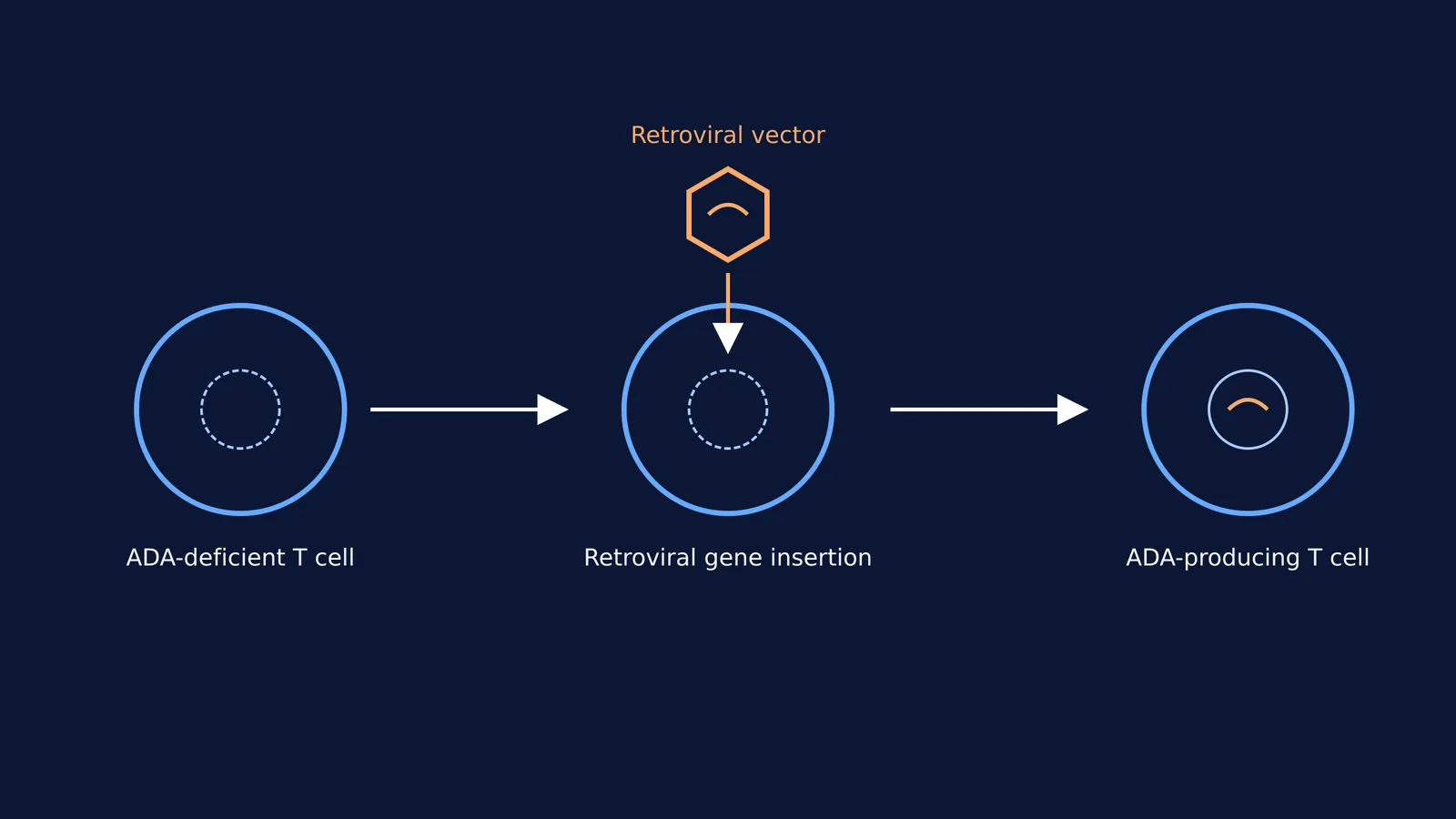
The doctors used a method called *ex vivo* gene therapy, meaning the genetic modification took place outside the body. Here is a step-by-step breakdown of the process:
Extraction: T lymphocytes (white blood cells) were extracted from the patient's blood.
Gene Insertion: In the laboratory, researchers used a modified, harmless retroviral vector to carry a functional copy of the ADA gene and insert it into the DNA of her cultured lymphocytes.
Reinfusion: The genetically engineered lymphocytes, now capable of producing the ADA enzyme and breaking down toxic purines, were infused back into her bloodstream.
The treatment was a clinical success, restoring her immune function enough to allow her to live a relatively normal childhood.
Why did the treatment need repeating?
While the infusion of engineered lymphocytes restored the patient's immune function, it was not a permanent fix.
The central challenge lies in the biology of the specific cells targeted. The engineered T lymphocytes were mature blood cells. Mature T cells have a finite lifespan; they circulate for a limited period, perform their function, and eventually undergo programmed cell death. Unlike stem cells, they do not divide endlessly to create a permanent, self-renewing lineage of new, ADA-producing cells.
As the engineered lymphocytes naturally died off over several months, the patient's overall immune function would decline again. Therefore, the treatment required periodic infusions of newly engineered lymphocytes to sustain the necessary ADA enzyme levels and keep the immune system functioning.
Is gene therapy a permanent cure?
The 1990 case proved that gene therapy was fundamentally possible and safe in humans, but it also highlighted the limitation of using mature somatic cells. To achieve a permanent cure, researchers realised they needed to target the cellular source.
If a functional ADA gene is introduced into hematopoietic stem cells isolated from a patient's bone marrow, the genetic correction can be permanent. A modified stem cell will pass the functional gene to all its daughter cells, providing a lifelong, self-renewing supply of ADA-producing lymphocytes without the need for repeated treatments. Modern gene therapies for SCID now utilize this stem cell approach, cementing the legacy of that first pioneering trial.


