

On this page
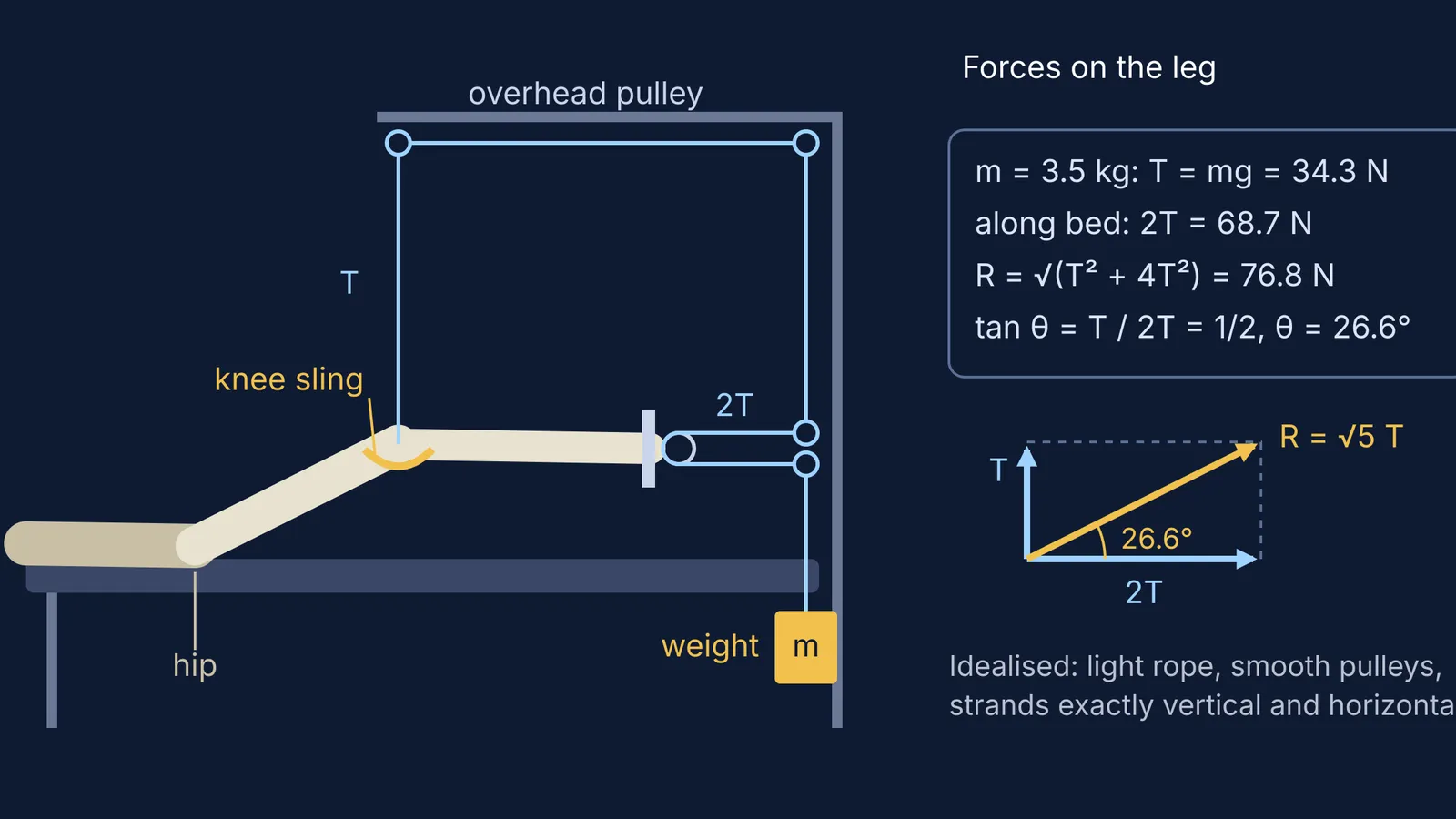
Picture a hospital bed with a metal frame over it, a sling under a patient's knee, a rope running over a few pulleys, and a single weight hanging at the foot of the bed. That set-up is Russell traction, one of the older ways of holding a broken thigh bone steady. It is also a neat laws-of-motion problem: one rope, one tension, and three pulls that add up to a force aimed along the thigh.
This post explains the physics only. It is not medical advice. Traction is set up, adjusted and supervised by trained clinicians, and the weights and angles for any real patient are their decision.
What is Russell traction?
A 2020 review of traction methods in the journal Cureus by Choudhry, Leung, Filips and Dhaliwal describes Hamilton-Russell traction as a balanced system first developed for fractures of the femur, to control muscle spasm. A frame carries a crossbar above the knee and bars at the foot of the bed. A broad, soft sling under the knee gives an upward force. Below the knee, skin traction gives a horizontal pull on the shin through a cord, pulleys and a weight. The review states the key point directly: the horizontal pull is twice the vertical pull, which gives a resultant in line with the axis of the femur.
The same review notes that traction is used much less than it once was, as surgery has become safer and hospital stays shorter. It is still a clean example of forces in a string.
In the idealised version drawn in the diagram, one continuous rope runs:
from the knee sling straight up to a pulley on the overhead frame,
across to a pulley at the foot of the bed,
down and horizontally to a pulley on a foot plate attached to the leg,
back horizontally to another pulley at the foot of the bed,
and down to the hanging weight.
Why is the tension the same all along the rope?
For a light (massless) rope passing over smooth, light pulleys, the tension is the same everywhere. A pulley only changes the direction of the rope; with no friction and no mass to accelerate, it cannot change the tension. With the weight hanging at rest, T = mg.
So every strand that touches the leg pulls with the same T:
the strand from the knee sling to the overhead pulley pulls the leg up with T;
the two strands at the foot plate both pull the leg towards the foot of the bed with T each, 2T in total.
This is the same idea as in any pulley system: count how many strands pull on the body you care about. For a system where pulleys trade force for distance, see how a differential pulley lifts heavy loads.
How do the pulls add up to one resultant?
The leg feels two perpendicular forces: T vertically and 2T horizontally. Add them as vectors, exactly as in finding the resultant of two vectors with the parallelogram law:
Magnitude: R = √(T² + (2T)²) = √5 T ≈ 2.24T.
Direction: tan θ = T / 2T = 1/2, so θ = 26.6° above the horizontal.
The resultant points towards the foot and slightly upwards, along the line of the thigh bone when the thigh rests at that angle.
Worked example: a 3.5 kg weight
The Cureus review quotes a counterweight of approximately 3.5 kg for this set-up. We use it only as a number to calculate with. Take g = 9.81 m/s².
Tension. T = mg = 3.5 × 9.81 = 34.3 N.
Vertical pull from the sling. T = 34.3 N upward.
Horizontal pull from the two foot strands. 2T = 68.7 N towards the foot of the bed.
Resultant. R = √(34.3² + 68.7²) = √5 × 34.3 = 76.8 N.
Direction. θ = tan⁻¹(34.3 / 68.7) = tan⁻¹(0.5) = 26.6° above the bed.
Compare. Hanging the same 3.5 kg on a single strand would pull with only 34.3 N. The pulleys do not create energy; they let one weight act on the leg through three strands.
Check the units: kg × m/s² = N, and the ratio inside tan⁻¹ is dimensionless. Notice that the angle does not depend on the weight at all. A heavier weight scales T, 2T and R together and leaves θ at 26.6°.
What changes when the rope angles are not perfect?
Real strands are never exactly vertical and horizontal, and real pulleys have friction. Both change the numbers.
Suppose the sling strand leans 10° from vertical towards the foot of the bed:
Horizontal pull = 2T + T sin 10° = 2.174T.
Vertical pull = T cos 10° = 0.985T.
Resultant = √(2.174² + 0.985²) T = 2.39T, at tan⁻¹(0.985 / 2.174) = 24.4° above the bed.
A 10° lean changes the direction by about 2° and the size by about 7%. Pulley friction works the other way: tension drops a little at each pulley the rope passes, so strands further from the weight pull slightly less than mg. The review stresses that ropes must slide freely through each pulley and the weight must hang free; in physics terms, both keep the tension close to mg.
Where does the counter-pull come from?
If the leg is pulled towards the foot of the bed, Newton's third law says something must stop the whole patient sliding that way. In sliding traction, the review explains, the counter-pull comes from the patient's own body weight. For neck traction it describes raising the head end of the bed so that body weight acts as counter-traction; the same physics applies to a pull towards the foot with the foot end raised.
As a pure statics exercise, with friction ignored: on a bed tilted by angle α, the component of body weight along the bed is Mg sin α. For a 70 kg body to balance 2T = 68.7 N, sin α = 68.7 / (70 × 9.81) = 0.100, so α = 5.7°. Friction between body and mattress also helps in reality, so this is only a textbook estimate, not a guide for any real bed.
For more practice with strings, pulleys and vector addition, the Fermi Problem Library has a step-by-step solver that explains the reasoning.
Quick checklist
One light rope over smooth pulleys has the same tension T = mg everywhere.
Count strands on the leg: T up from the sling, 2T along the bed from the foot plate.
Resultant R = √5 T ≈ 2.24T at tan⁻¹(1/2) = 26.6°.
For 3.5 kg: T = 34.3 N, 2T = 68.7 N, R = 76.8 N.
The angle depends on geometry, not on the weight.
Real rope angles and pulley friction change the ideal numbers.
This is physics only; traction is set up and supervised by trained clinicians.


