

On this page
Two forces pull on a ring, or a boat crosses a moving river: how big is the combined vector, and which way does it point? Here are the two formulas, a quick check and five worked numbers.
What is the parallelogram law of vector addition?
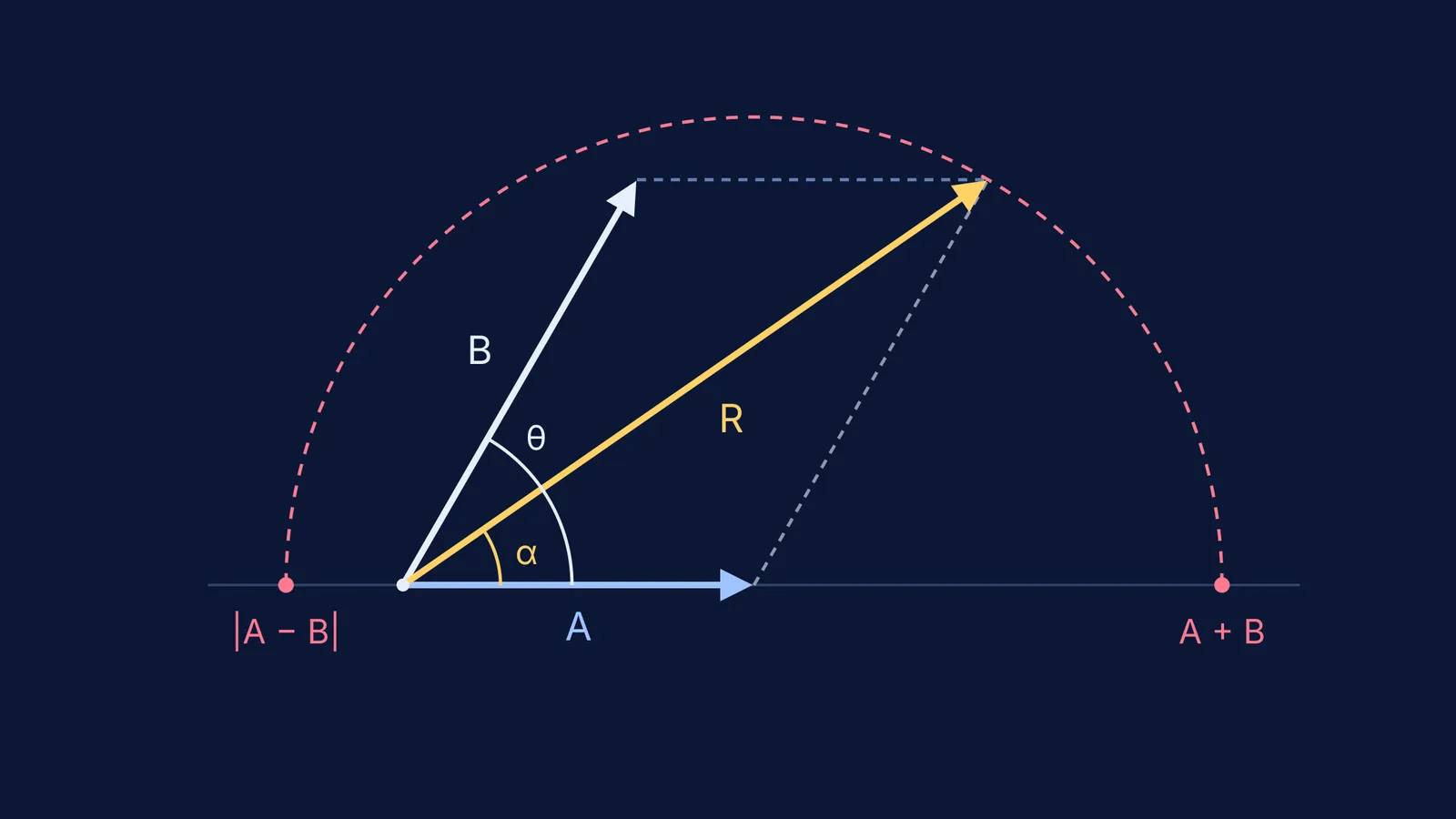
Place the two vectors A and B tail to tail at one point, complete the parallelogram, and the diagonal from that common point is the resultant R = A + B. The NCERT Class 11 Physics chapter Motion in a Plane (section 3.4) shows that this parallelogram method gives the same result as the head-to-tail triangle method.
The angle θ in every formula below is the angle between the vectors when their tails meet. If a question draws them head to tail, slide one so the tails touch before you read off θ.
How do you find the magnitude of the resultant?
Drop a perpendicular from the tip of the diagonal onto the line of A. The extra length along A is B cos θ and the height is B sin θ, so Pythagoras gives R² = (A + B cos θ)² + (B sin θ)². Expanding gives NCERT's Eq. 3.24a, which it calls the law of cosines: R = √(A² + B² + 2AB cos θ) (NCERT, section 3.6).
Why a plus, when the triangle law of cosines has a minus? In the triangle, the angle opposite R is 180° − θ, and cos(180° − θ) = −cos θ flips the sign.
How do you find the direction of the resultant?
The same right triangle gives the angle α that R makes with A: tan α = B sin θ / (A + B cos θ), which is NCERT's Eq. 3.24f. Its Eq. 3.24e gives the same angle from the law of sines as sin α = (B/R) sin θ (NCERT, section 3.6).
α is measured from A, not from the x-axis. If A + B cos θ is negative, R leans more than 90° away from A, so sketch before trusting your calculator.
What is the range of possible resultants?
Because cos θ in Eq. 3.24a (NCERT) runs from 1 to −1, R² runs from (A + B)² down to (A − B)². So |A − B| ≤ R ≤ A + B. The maximum comes at θ = 0° (vectors in the same direction), the minimum at θ = 180° (opposite), and at θ = 90° you get R = √(A² + B²).
Forces of 5 N and 12 N give any resultant from 7 N to 17 N (exactly 13 N at right angles), so 6 N or 18 N is wrong without calculating. Extended to three vectors, the same idea decides whether three vectors of given magnitudes can add to zero.
Worked Class 11 numbers
Each example uses the formulas from NCERT section 3.6.
A = 3 units, B = 4 units, θ = 60°. R² = 9 + 16 + 2 × 3 × 4 × 0.5 = 37, so R = √37 ≈ 6.08 units. tan α = (4 × 0.866) / (3 + 4 × 0.5) = 3.464 / 5 ≈ 0.693, so α ≈ 34.7° from A. Check: 6.08 lies between 1 and 7.
Rain falls vertically at 35 m/s while wind blows east to west at 12 m/s. At 90°, R = √(35² + 12²) = 37 m/s, and tan θ = 12/35 ≈ 0.343 gives about 19° from the vertical: tilt the umbrella that much towards the east (NCERT, Example 3.1).
A motorboat heads north at 25 km/h and the current flows at 10 km/h towards 60° east of south. The angle between them is 120°, so R² = 625 + 100 + 2 × 25 × 10 × (−0.5) = 475 and R ≈ 21.8 km/h (NCERT: about 22 km/h). The law of sines gives sin φ = 10 sin 120° / 21.8 ≈ 0.397, so φ ≈ 23.4° from north (NCERT, Example 3.3).
Two 10 N forces act at 120°. R = 2 × 10 × cos 60° = 10 N, pointing along the bisector, 60° from each.
Backwards: 3 N and 5 N forces give 7 N. Find θ. cos θ = (R² − A² − B²) / 2AB = (49 − 9 − 25) / 30 = 0.5, so θ = 60°.
With more than two vectors, switch to components; see our guide to resolving a vector along two non-perpendicular axes. If you get one wrong and cannot see which step slipped, the Fermi Problem Library has worked problems with a step-by-step solver that explains the reasoning rather than printing an answer.
Sketch and guess R and α before calculating, as in our vector addition simulation walkthrough.
Next step: redo example 1 with θ = 0°, 90° and 180°, and confirm you get 7, 5 and 1.


