

On this page
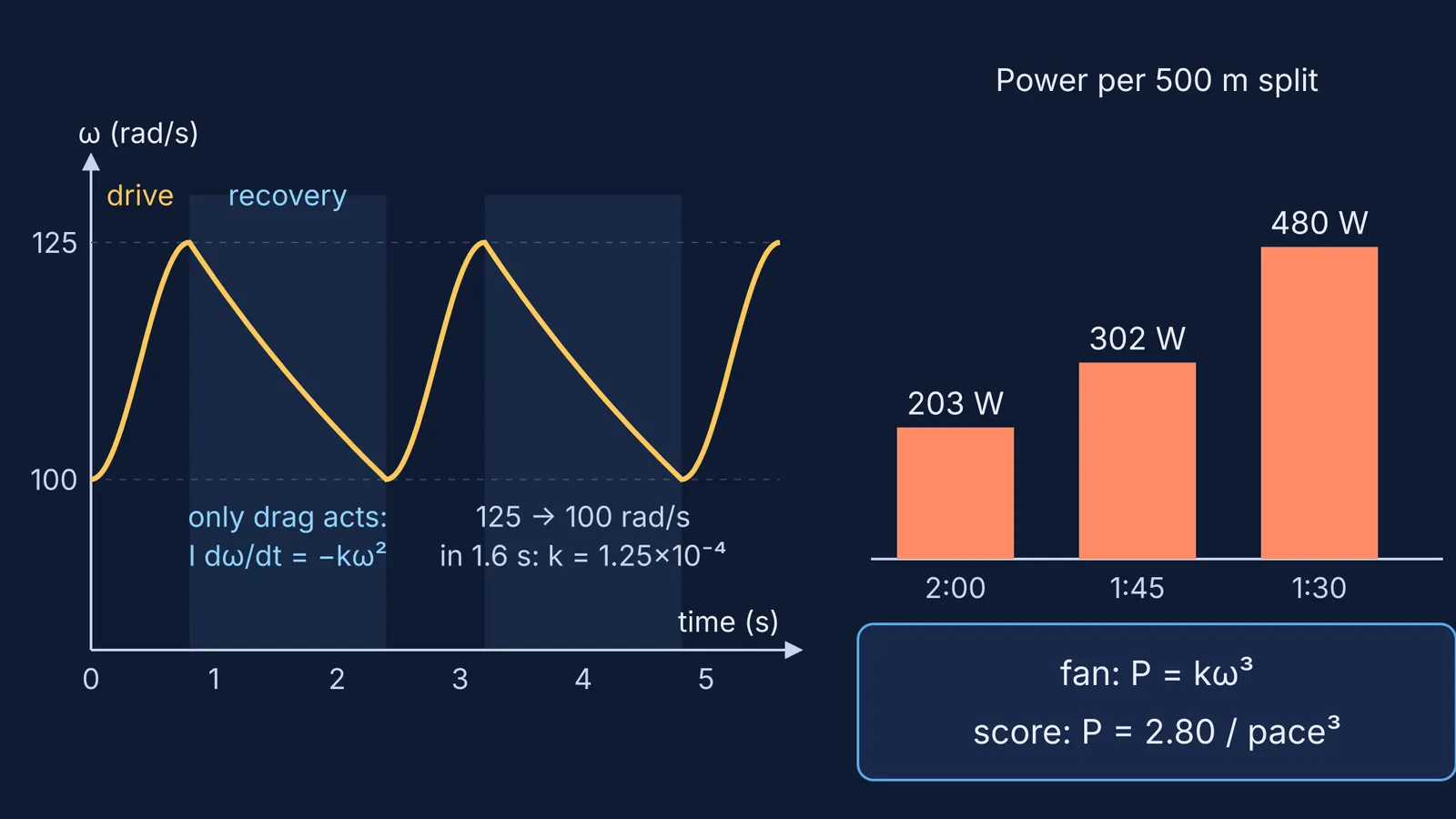
Push the pace on an air rowing machine from 2:00 to 1:45 per 500 m and the screen says your power has jumped from about 203 W to 302 W. You went 14% faster but had to work 49% harder. The fan inside is built to copy a boat, whose water drag grows as speed squared. Here is where those numbers come from, and how the monitor weighs your effort by timing how fast the fan slows between strokes.
Why is the flywheel on a rowing machine a fan?
On an air rower, the handle chain spins a flywheel with vanes, a fan in a cage. Air drag on the vanes gives a torque that opposes the motion and grows, to a good approximation, with the square of the angular speed:
τ_drag = kω²
Here k is a constant for that machine and that damper setting, in N m s². Power is torque times angular speed, so the power the fan soaks up is
P = τω = kω³
That cube is the point. A real boat feels a water drag force close to bv², so the power to keep it moving is bv³. The fan gives the rower the same "twice the power for only 26% more speed" feeling that a boat does (2^(1/3) = 1.26). Why the cube appears for any drag that grows as speed squared, and what it means for a cyclist, is covered in why the power to beat air drag grows with the cube of speed, so we will not repeat it here.
How does the monitor turn pace into watts?
Concept2, a major maker of air rowers, publishes the conversion on its watts calculator page:
watts = 2.80 / pace³
where pace is in seconds per metre, not minutes per 500 m. The 2.80 plays the role of the boat's drag constant b. A physics page on rowing ergometers from the University of Oxford calls the choice somewhat arbitrary: it is a convention for the score, not a law of nature.
Worked example: three splits
2:00 per 500 m. Pace = 120 s / 500 m = 0.240 s/m. P = 2.80 / 0.240³ = 2.80 / 0.013824 = 202.5 W.
1:45 per 500 m. Pace = 105 / 500 = 0.210 s/m. P = 2.80 / 0.210³ = 302.3 W.
1:30 per 500 m. Pace = 90 / 500 = 0.180 s/m. P = 2.80 / 0.180³ = 480.1 W.
The speed goes from 500/120 = 4.17 m/s to 500/105 = 4.76 m/s, a rise of 14.3%. The power ratio is (120/105)³ = 1.143³ = 1.49, so 49% more. Going from 2:00 to 1:30 means a speed ratio of 1.33 and a power ratio of 1.33³ = 2.37. Check the units: 2.80 has units of W s³/m³, which is N s²/m², the same as a drag constant b in F = bv².
How does the machine find k by watching the fan slow down?
During the recovery you slide forward and the chain goes slack, so the only torque on the flywheel is drag (bearing friction is small). Newton's second law for rotation, τ = Iα, the same idea worked in how to find the angular acceleration of a flywheel, gives
I dω/dt = −kω²
Rearranged, d(1/ω)/dt = k/I. So 1/ω grows in a straight line with time, and
k = I (1/ω₂ − 1/ω₁) / Δt
A sensor times the flywheel's turns, so the monitor knows ω at every instant, and I is fixed for each model. Concept2 describes the drag factor as the rate at which the flywheel slows between strokes, measured on every recovery, and the Oxford page notes that the displayed drag factor is k in units of 10⁻⁶ N m s².
Worked example: from deceleration to watts
Take I = 0.10 kg m². This is a round illustrative value; Concept2 does not publish its flywheel's moment of inertia. During one recovery the fan slows from 125 rad/s to 100 rad/s in 1.6 s.
Find k. 1/100 − 1/125 = 0.0100 − 0.0080 = 0.0020 s/rad. k = 0.10 × 0.0020 / 1.6 = 1.25 × 10⁻⁴ N m s². On the monitor's scale that is a drag factor of 125.
Check the drag torque. At 125 rad/s, τ = kω² = 1.25 × 10⁻⁴ × 125² = 1.95 N m, so α = τ/I = 19.5 rad/s². At 100 rad/s the torque is 1.25 N m and α = 12.5 rad/s². The fan slows more gently as it slows down, as drag ∝ ω² says it should.
Power at a typical speed. At 112 rad/s, P = kω³ = 1.25 × 10⁻⁴ × 112³ = 176 W.
Check with energy. The kinetic energy lost in the recovery is ½I(ω₁² − ω₂²) = 0.5 × 0.10 × (125² − 100²) = 281 J. Over 1.6 s that is 176 W on average, which matches step 3. All of that energy went into stirring air.
Convert to a split. pace = (2.80 / 176)^(1/3) = 0.252 s/m, which is about 2:06 per 500 m.
In the drive, the fan speeds up again. Your work is the rise in ½Iω² plus the drag loss during the drive, which the monitor can find because it already knows k.
Does a higher damper setting make you work harder?
The damper is a lever that lets more or less air into the fan cage. Open it and k goes up, so the fan slows faster between strokes and feels heavier, like a bigger boat. But the monitor measures the new k on the very next recovery, so the watts and the split stay honest. Concept2 says your effort is calculated the same way at any damper setting, which is why scores can be compared across machines.
With P = kω³: To hold 202.5 W (a 2:00 split), a drag factor of 100 needs the fan at (202.5 / 1.00 × 10⁻⁴)^(1/3) = 127 rad/s. A drag factor of 150 needs only 111 rad/s. Same power, same score, different feel.
Is 200 W on the screen the same as 200 W of food energy?
No. The monitor shows the mechanical power that reaches the handle. Your muscles turn chemical energy into work with an efficiency of roughly 25%, and the Oxford ergometer page assumes 4 units of chemical energy per unit of work. So 200 W at the handle means something like 800 W of metabolic power, before counting what your body uses at rest.
The model has limits too: real fan drag is close to kω² but not exact, and bearing friction adds a little.
If you want more problems that mix τ = Iα with power, the Fermi Problem Library has a step-by-step solver that explains the reasoning at each stage.
Quick checklist
Fan drag torque ≈ kω², so fan power P = kω³, like a boat's P = bv³.
Concept2's score uses watts = 2.80 / pace³ with pace in seconds per metre.
14% faster needs (1.143)³ = 1.49 times the power, not 1.14 times.
In the recovery only drag acts: I dω/dt = −kω², so k = I(1/ω₂ − 1/ω₁)/Δt.
Kinetic energy lost in the recovery equals the energy the fan absorbed.
The damper changes k and the feel, not the fairness of the score.


