

On this page
These eight original NEET-style questions follow set 1 of our rotational motion NEET practice questions, repeat none of its scenarios and come from no textbook or past paper.
What does set 2 cover that set 1 did not?
Set 1 tested centre of mass position, r × F, angular kinematics, radius of gyration, a hinged beam and power. Set 2 covers centre of mass velocity, v = ωr, a particle's angular momentum, a couple, work by a torque, kinetic energy at equal angular momentum, the centre of mass of a plate with a piece cut out and torque as the rate of change of angular momentum.
All of these sit inside Physics Unit 5, Rotational Motion, of the National Medical Commission's updated syllabus for NEET (UG)-2026. Each is a section of Chapter 6 of the NCERT Class 11 Physics textbook, Reprint 2026-27.
How should you use this set?
Cover the answers; allow one or two minutes each.
Write the axis and linking equation first.
Mark each answer right, wrong or guessed. In NEET-UG 2026 the NTA information bulletin gave +4 for a correct answer and −1 for a wrong one.
Read every trap line; redo misses later.
New to the chapter? Read our guide on how to prepare rotational motion for NEET first.
Easy: centre of mass velocity, v = ωr and angular momentum
Q1 (easy). A 2 kg trolley moves east at 6 m/s and a 4 kg trolley moves west at 1.5 m/s on the same track. What is the velocity of their centre of mass?
(A) 3 m/s east (B) 0 (C) 1 m/s east (D) 2.25 m/s east
Answer: (C). Take east as positive: v_cm = (2 × 6 + 4 × (−1.5))/(2 + 4) = (12 − 6)/6 = 1 m/s east.
Trap: (A) ignores direction; the westward momentum subtracts.
Q2 (easy). A ceiling fan turns at 240 revolutions per minute. How fast is the tip of a blade 0.5 m from the axis moving?
(A) 2.0 m/s (B) 120 m/s (C) 25.1 m/s (D) 12.6 m/s
Answer: (D). ω = 240 × 2π/60 = 8π rad/s, so v = ωr = 8π × 0.5 = 4π ≈ 12.6 m/s.
Trap: (B) treats 240 rev/min as 240 rad/s.
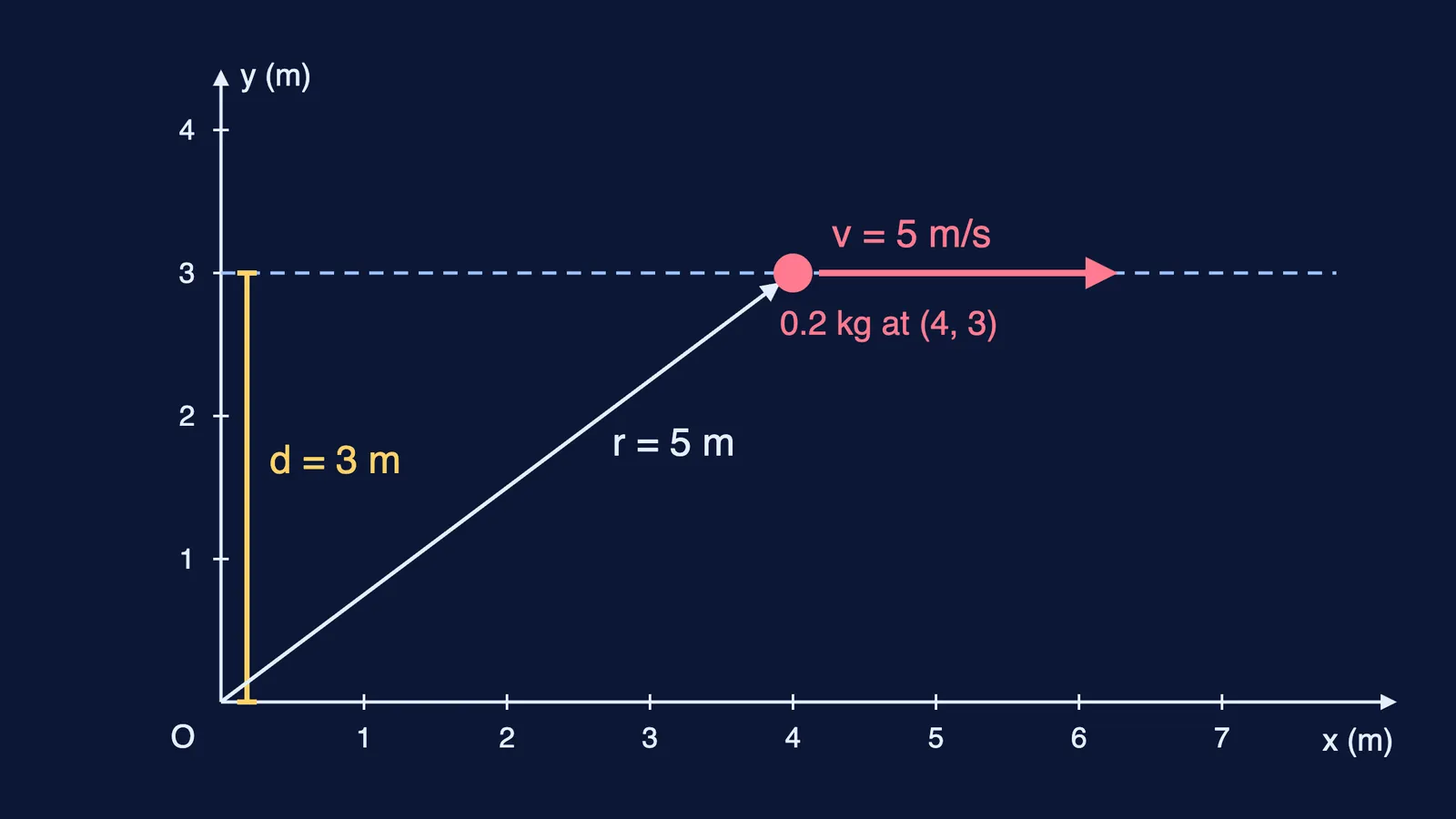
Q3 (easy). A 0.2 kg particle moves at 5 m/s in the +x direction along the line y = 3 m. What is the magnitude of its angular momentum about the origin when it is at (4 m, 3 m)?
(A) 3 kg m²/s (B) 5 kg m²/s (C) 0 (D) 4 kg m²/s
Answer: (A). L = mvd, with d the perpendicular distance from O to the line of motion: 0.2 × 5 × 3 = 3 kg m²/s.
Trap: (B) uses the distance to the particle, 5 m.
Medium: couples, work by a torque and energy at equal angular momentum
Q4 (medium). A driver pushes a steering wheel of diameter 0.36 m with 15 N from each hand, tangentially and in opposite directions, at opposite ends of a diameter. The wheel's moment of inertia about its column is 0.09 kg m². What is its angular acceleration?
(A) 0 (B) 30 rad/s² (C) 60 rad/s² (D) 120 rad/s²
Answer: (C). The two forces form a couple. Its moment is force × separation = 15 × 0.36 = 5.4 N m, so α = 5.4/0.09 = 60 rad/s².
Trap: (A) says the forces cancel; they do as forces, not as torques. (B) uses the radius as the couple's arm.
Q5 (medium). A constant torque of 10 N m speeds up a flywheel of moment of inertia 0.5 kg m² from 20 rad/s to 40 rad/s. Through what angle does the flywheel turn meanwhile?
(A) 30 rad (B) 10 rad (C) 40 rad (D) 20 rad
Answer: (A). Work done by the torque equals the gain in rotational kinetic energy: τθ = ½I(ω₂² − ω₁²) = ½ × 0.5 × (1600 − 400) = 300 J, so θ = 300/10 = 30 rad.
Trap: (B) uses (40 − 20)² instead of 40² − 20².
Q6 (medium). Flywheel A (I = 0.8 kg m²) and flywheel B (I = 0.2 kg m²) each have angular momentum 4 kg m²/s about their axles. How much more kinetic energy does B have than A?
(A) 0 (B) 60 J (C) 30 J (D) 10 J
Answer: (C). With L = Iω, kinetic energy is K = ½Iω² = L²/2I. So K_A = 16/1.6 = 10 J and K_B = 16/0.4 = 40 J, a difference of 30 J.
Trap: (A) assumes equal angular momentum means equal energy. (B) drops the ½.
Hard: a plate with a corner cut out and a growing torque
Q7 (hard). A 20 cm × 20 cm square is cut from one corner of a uniform square plate of side 40 cm. How far from the centre of the original plate is the centre of mass of the remaining piece?
(A) 3.54 cm (B) 4.71 cm (C) 3.33 cm (D) 14.1 cm
Answer: (B). With the origin at the plate's centre, the cut square has a quarter of the mass, with its centre at (10 cm, 10 cm). The full plate's centre of mass is at the origin, so (3/4)r_rest + (1/4)(10, 10) = 0, giving r_rest = (−3.33, −3.33) cm. Its distance from the centre is 3.33 × √2 ≈ 4.71 cm.
Trap: (A) divides by the full mass instead of the remaining three quarters. (C) gives one coordinate, not the distance.
Q8 (hard). A wheel of moment of inertia 0.4 kg m², at rest on a frictionless axle, is acted on by a torque τ = 4t N m, with t in seconds. What is its kinetic energy at t = 2 s?
(A) 320 J (B) 80 J (C) 12.8 J (D) 160 J
Answer: (B). Since τ = dL/dt, L = ∫4t dt from 0 to 2 s = 2t² = 8 kg m²/s. Then ω = L/I = 20 rad/s and K = ½ × 0.4 × 20² = 80 J.
Trap: (A) treats the torque as a constant 8 N m. (C) uses 8 as ω instead of L.
Stuck on a step? The Fermi Problem Library has worked problems with a step-by-step solver that explains the reasoning rather than printing an answer.


