

On this page
In a lab or a plant you will often see a vertical glass tube with a small float inside and a scale printed on the glass. Fluid enters at the bottom, the float rises, and you read the flow where the float stops. This is a rotameter, or variable-area flowmeter. It needs no power and no electronics, only Archimedes' principle and Bernoulli's equation. Unlike the electromagnetic flowmeter or the ultrasonic transit-time flowmeter, it has a moving part you can watch. The clever part is that the tube is not straight: it widens upwards.
How does the float in a rotameter balance?
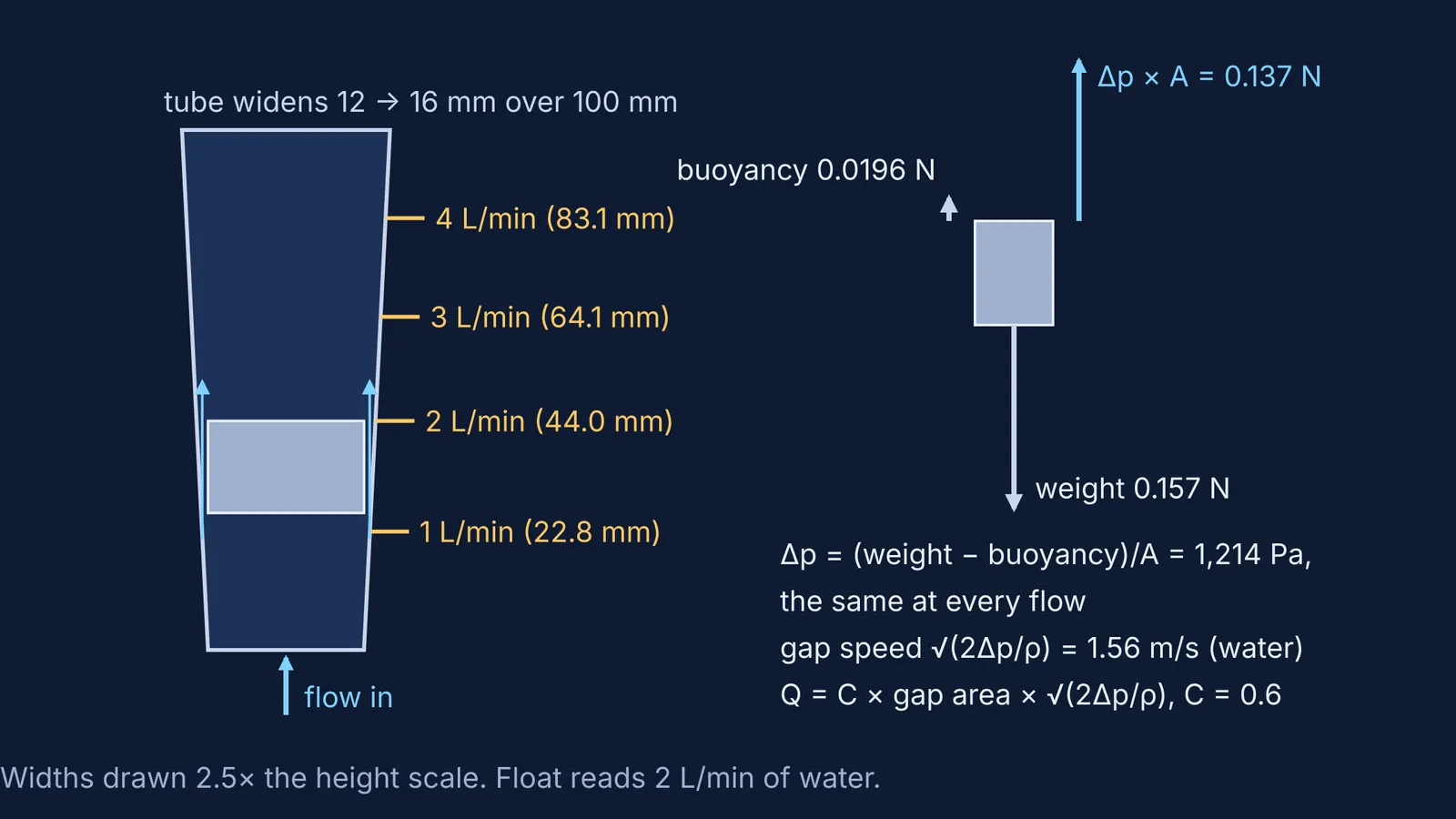
Three forces act on the float when it hangs steady in the flow:
its weight W = ρ_float × g × V, downwards;
the buoyancy B = ρ × g × V of the fluid it displaces, upwards;
the pressure force of the flow, upwards. Fluid squeezing past the float leaves a higher pressure below it than above it. Call the difference Δp. Over the float's cross-section A it pushes up with Δp × A.
Fluke's calibration guide describes the same balance: the float settles where its weight is balanced by the drag and buoyancy of the fluid. In equilibrium,
Δp × A = (ρ_float − ρ) g V.
Why is the pressure drop the same at every flow?
Look at that equation again. Nothing on the right depends on the flow. The float's volume, its density and the fluid's density are fixed. So Δp is fixed too.
This is the opposite of a Venturi meter. In Venturi's narrow-throat meter the throat area is fixed, and the pressure difference grows with the flow, as Q². In a rotameter the pressure drop is fixed, and the area changes.
Here is how. More flow pushes the float up, into a wider part of the tube. The ring-shaped gap between float and wall gets bigger. The float keeps rising until the gap is just wide enough to pass the whole flow at that fixed Δp. Its height is the reading.
How does the float's height give the flow rate?
Treat the gap as an orifice. Bernoulli's equation gives the speed of fluid through it as u = √(2Δp/ρ). With a discharge coefficient C to allow for the jet narrowing and for friction,
Q = C × A_gap × √(2Δp/ρ).
Since Δp is constant, the speed through the gap is constant. The flow is proportional to the gap area. If the tube's diameter is D(h) at height h and the float's diameter is d,
A_gap = (π/4)(D² − d²).
For a straight taper, D = d + kh. Then D² − d² = 2dkh + k²h². When the gap is small compared with the float, the first term wins, the area grows almost in step with height, and the scale is nearly even. That is why rotameter scales look almost like rulers, while a Venturi scale squeezes up at the low end.
Worked example: where do the 1, 2, 3 and 4 L/min marks go?
The numbers here are illustrative, chosen to show how the design works, with C = 0.6 assumed.
A steel float (density 8,000 kg/m³) has volume 2.0 cm³ and diameter 12.0 mm. The tube widens from 12.0 mm at the bottom to 16.0 mm at 100 mm. The fluid is water.
Float area. A = π(6.0 × 10⁻³)² = 1.131 × 10⁻⁴ m².
Forces. Weight = 8,000 × 9.81 × 2.0 × 10⁻⁶ = 0.157 N. Buoyancy = 1,000 × 9.81 × 2.0 × 10⁻⁶ = 0.0196 N. Net = 0.137 N.
Pressure drop. Δp = 0.137 ÷ 1.131 × 10⁻⁴ = 1,214 Pa, at every flow.
Gap speed. u = √(2 × 1,214 ÷ 1,000) = 1.56 m/s.
Gap area for 2 L/min. Q = 2 L/min = 3.33 × 10⁻⁵ m³/s. A_gap = Q ÷ (C × u) = 3.33 × 10⁻⁵ ÷ (0.6 × 1.56) = 3.57 × 10⁻⁵ m², or 35.7 mm².
Height. Solve (π/4)(D² − 12.0²) = 35.7 mm²: D = 13.76 mm. The tube widens 0.04 mm per mm of height, so h = 1.76 ÷ 0.04 = 44.0 mm.
Repeating step 6 gives the marks at 22.8 mm for 1 L/min, 44.0 mm for 2, 64.1 mm for 3 and 83.1 mm for 4. The spacing is 22.8, 21.3, 20.0 and 19.0 mm: nearly even, closing up slowly because of the k²h² term. At the top of the tube the meter reads about 4.9 L/min.
Why does a water-calibrated rotameter read wrongly for air?
The fluid's density appears twice: in the buoyancy, which sets Δp, and in u = √(2Δp/ρ). Put air (1.2 kg/m³) through the same tube.
Δp = (8,000 − 1.2) × 9.81 × 2.0 × 10⁻⁶ ÷ 1.131 × 10⁻⁴ = 1,388 Pa. Buoyancy in air is almost nothing, so Δp rises slightly.
u = √(2 × 1,388 ÷ 1.2) = 48.1 m/s, which is 30.9 times faster than water.
With the same C, every mark now means 30.9 times the flow. The top of the tube reads about 152 L/min of air, not 4.9.
So a rotameter is made for one fluid. Fluke notes that a gas rotameter is designed for one specific gas density and flow range, that readings for other conditions need a square-root density correction, and that the tube must be vertical. A tilted tube changes the force balance. Real meters state the fluid, temperature and pressure on the scale.
What does an accuracy of "±2% of full scale" mean?
Rotameter makers quote accuracy as a percentage of the full-scale reading, not of the actual reading. Brooks Instrument, for example, lists its glass-tube meters at accuracies from ±2% to ±10% of full scale, depending on model.
On a 0–5 L/min meter at ±2% of full scale, the error can be 0.02 × 5 = ±0.1 L/min anywhere on the scale. At 4 L/min that is 2.5% of the reading. At 1 L/min it is 10%. The lesson: pick a meter whose normal reading sits in the upper part of the scale.
For more flow, pressure and Bernoulli problems, the Fermi Problem Library has a step-by-step solver that explains the reasoning at each stage.
Quick checklist
Float in equilibrium: Δp × A = (ρ_float − ρ) g V, so Δp is the same at every flow.
Gap speed u = √(2Δp/ρ) is constant, so the flow is proportional to the gap area.
A tube that widens linearly gives a nearly even scale.
Rotameter: fixed Δp, variable area. Venturi: fixed area, variable Δp.
A scale made for one fluid reads wrongly for another; the tube must be vertical.
Accuracy is quoted as a percentage of full scale, so low readings are less accurate.


