

On this page
Saying that cyclopropane is "strained" is easy. Putting a number on it takes one simple measurement: burn the ring and see how much heat comes out. Every cycloalkane has the formula (CH₂)n, so you can compare the heat released per CH₂ group with the value for a strain-free chain. Any extra heat is energy that was stored in the bent and crowded bonds of the ring. This post walks through that calculation for cyclopropane, cyclobutane, cyclopentane and cyclohexane, then explains where the strain comes from.
Why can heat of combustion measure ring strain?
When a hydrocarbon burns completely, it ends up as CO₂ and H₂O. A cycloalkane and an open-chain compound with the same number of CH₂ groups give the same products in the same amounts. So if one releases more heat, it must have started with more energy.
In long open-chain alkanes, each extra CH₂ group adds about 658.6 kJ/mol to the heat of combustion. That steady step is explained in why the heat of combustion of alkanes rises about 659 kJ/mol per CH₂. Take 658.6 kJ/mol as the heat released by one strain-free CH₂.
A strain-free ring of n CH₂ groups should then release n × 658.6 kJ/mol. Whatever it releases above that is its strain energy. Two details matter:
Compare values per CH₂, because a bigger ring always releases more heat in total simply because it has more carbon.
Use gas-phase values, so that differences in intermolecular forces between liquids do not creep in.
How do you calculate strain energy from heat of combustion?
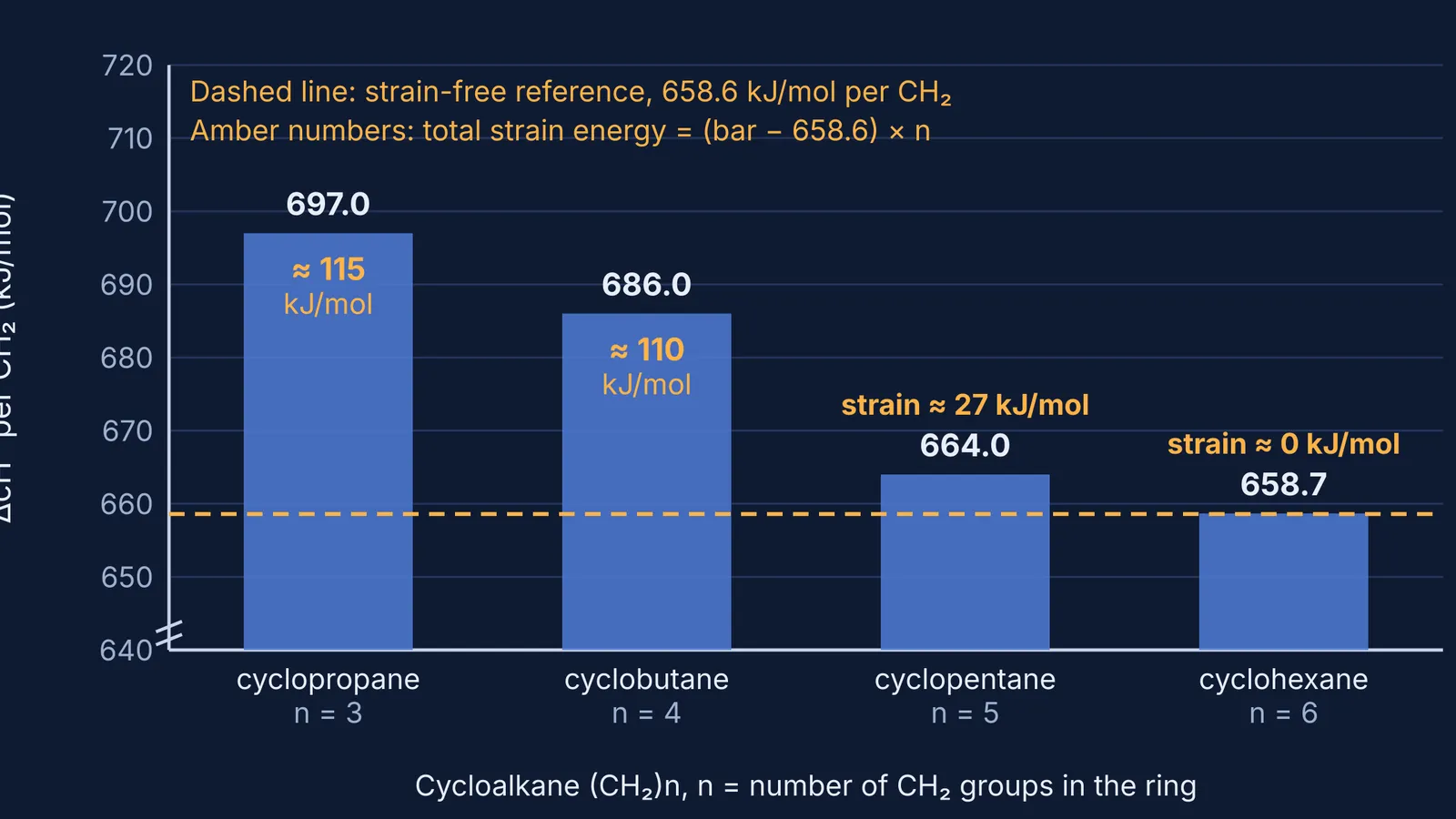
Use the standard gas-phase heats of combustion (ΔcH°, given here as positive heat released): cyclopropane 2091 kJ/mol, cyclobutane 2744 kJ/mol, cyclopentane 3320 kJ/mol and cyclohexane 3952 kJ/mol.
Worked example: cyclopropane, C₃H₆
Count the CH₂ groups. Cyclopropane is (CH₂)₃, so n = 3.
Heat per CH₂. 2091 ÷ 3 = 697.0 kJ/mol.
Extra heat per CH₂. 697.0 − 658.6 = 38.4 kJ/mol.
Total strain energy. 38.4 × 3 = 115.2 kJ/mol, about 115 kJ/mol.
Check by the other route. A strain-free (CH₂)₃ would release 3 × 658.6 = 1975.8 kJ/mol. Then 2091 − 1975.8 = 115.2 kJ/mol. Same answer.
Repeat the steps for the other rings:
Cyclobutane (n = 4): 2744 ÷ 4 = 686.0 per CH₂; 686.0 − 658.6 = 27.4; 27.4 × 4 = 109.6, about 110 kJ/mol.
Cyclopentane (n = 5): 3320 ÷ 5 = 664.0 per CH₂; 664.0 − 658.6 = 5.4; 5.4 × 5 = 27.0, about 27 kJ/mol.
Cyclohexane (n = 6): 3952 ÷ 6 = 658.7 per CH₂; 658.7 − 658.6 = 0.1; total about 0.4 kJ/mol, which is zero within the accuracy of the data.
Notice that cyclobutane carries almost as much total strain as cyclopropane, even though its per-CH₂ strain is lower. It has four CH₂ groups sharing the strain instead of three. Cyclohexane, on the other hand, behaves as if it were an open chain.
Where does ring strain come from?
Two kinds of strain add up in small rings.
Angle strain
An sp³ carbon prefers bond angles of 109.5° (109°28′). In 1885 Adolf von Baeyer assumed that rings are flat, so the C–C–C angle equals the angle of a regular polygon: 60° in cyclopropane, 90° in cyclobutane, 108° in cyclopentane and 120° in cyclohexane. He measured the strain as the deviation, d = ½(109°28′ − ring angle), shared between the two bonds at each carbon:
Cyclopropane: d = 24°44′
Cyclobutane: d = 9°44′
Cyclopentane: d = 0°44′
Cyclohexane (if flat): d = −5°16′
In cyclopropane the orbitals cannot point along the C–C lines at 60°, so they overlap at an angle outside the line joining the nuclei. These are often called bent or banana bonds, and they are weaker than normal C–C bonds.
Torsional strain
The second source is eclipsing. When C–H bonds on neighbouring carbons line up, their electron pairs repel, just as in the eclipsed form of ethane. Cyclopropane is flat by necessity, so every pair of neighbouring C–H bonds is eclipsed.
Cyclobutane folds slightly out of plane. The angles shrink a little below 90°, which adds a little angle strain, but the hydrogens become less eclipsed, which saves more.
Cyclopentane would have almost perfect 108° angles if flat, but then all ten pairs of neighbouring C–H bonds would be eclipsed. It lifts one carbon out of the plane to form an envelope, trading a tiny bit of angle strain for much less eclipsing. The 27 kJ/mol that remains is mostly torsional.
Why is the cyclohexane chair strain-free?
Cyclohexane is not flat. In the chair conformation the C–C–C angles are close to 109.5°, so there is essentially no angle strain. Look along any C–C bond and every C–H bond is staggered, so there is no torsional strain either. That is exactly what the combustion data say: 658.7 kJ/mol per CH₂, the same as a strain-free chain.
Why did Baeyer's strain theory fail for larger rings?
Baeyer's flat-ring assumption predicted that cyclohexane, with a negative deviation, would be strained, and that rings larger than six would be increasingly strained and hard to make. Combustion data showed the opposite. Rings of six or more carbons are puckered, not planar, so their carbons can adopt near-tetrahedral angles. Medium-sized rings carry some strain from hydrogens crowding across the ring, but large rings come close to the strain-free value per CH₂. The theory works reasonably for three- and four-membered rings and fails beyond five. For the story of Baeyer and his work, see Adolf von Baeyer, synthetic indigo and the strain in small rings.
Why does cyclopropane add H₂ and Br₂ when cyclohexane does not?
Opening the ring releases its strain energy, about 115 kJ/mol for cyclopropane. That gives cyclopropane a driving force that cyclohexane does not have, and its weak bent bonds behave a little like a π bond. So cyclopropane undergoes ring-opening additions:
With H₂ over a nickel catalyst at about 80 °C (353 K), it gives propane. Cyclobutane needs a higher temperature, around 200 °C (473 K).
With Br₂ it gives 1,3-dibromopropane, BrCH₂CH₂CH₂Br.
With HBr it gives 1-bromopropane.
Cyclohexane has no strain to release. It behaves like an open-chain alkane: with Br₂ in light it undergoes free-radical substitution to give bromocyclohexane and HBr, and the ring stays intact. The qualitative side of this comparison is covered in why cyclopropane is more reactive than cyclohexane.
If you want to revise how bond angles, conformations and stability connect, the Concept Library covers every concept in chemistry, including these.
Quick checklist
Strain-free reference: 658.6 kJ/mol per CH₂.
Strain energy = ΔcH° − n × 658.6, or (per-CH₂ value − 658.6) × n.
Strain: cyclopropane ≈ 115, cyclobutane ≈ 110, cyclopentane ≈ 27, cyclohexane ≈ 0 kJ/mol.
Angle strain plus torsional strain make up the total.
Cyclobutane puckers and cyclopentane takes an envelope to reduce eclipsing.
The cyclohexane chair has tetrahedral angles and staggered bonds, so no strain.
Strained small rings open with H₂, Br₂ and HBr; cyclohexane does substitution instead.


