

On this page
In 1945, Edward Prosen and Frederick Rossini at the US National Bureau of Standards published selected "best" values for the heats of combustion of the paraffin hydrocarbons at 25 °C (Prosen and Rossini, Journal of Research of the NBS, 1945). Paraffin is the old name for an alkane (why alkanes are called paraffins). Their table lets you predict a trend, plot it, and check your guess against real calorimetry.
Predict first: what will the graph look like?
Before you look at any numbers, take two minutes and write down your answers:
As the carbon number n goes from 1 (methane) to 8 (octane), does the heat released per mole rise, fall or stay flat?
Will the points make a straight line or a curve?
Guess the gap in kJ/mol between hexane and heptane.
Will the gap from methane to ethane match the later gaps?
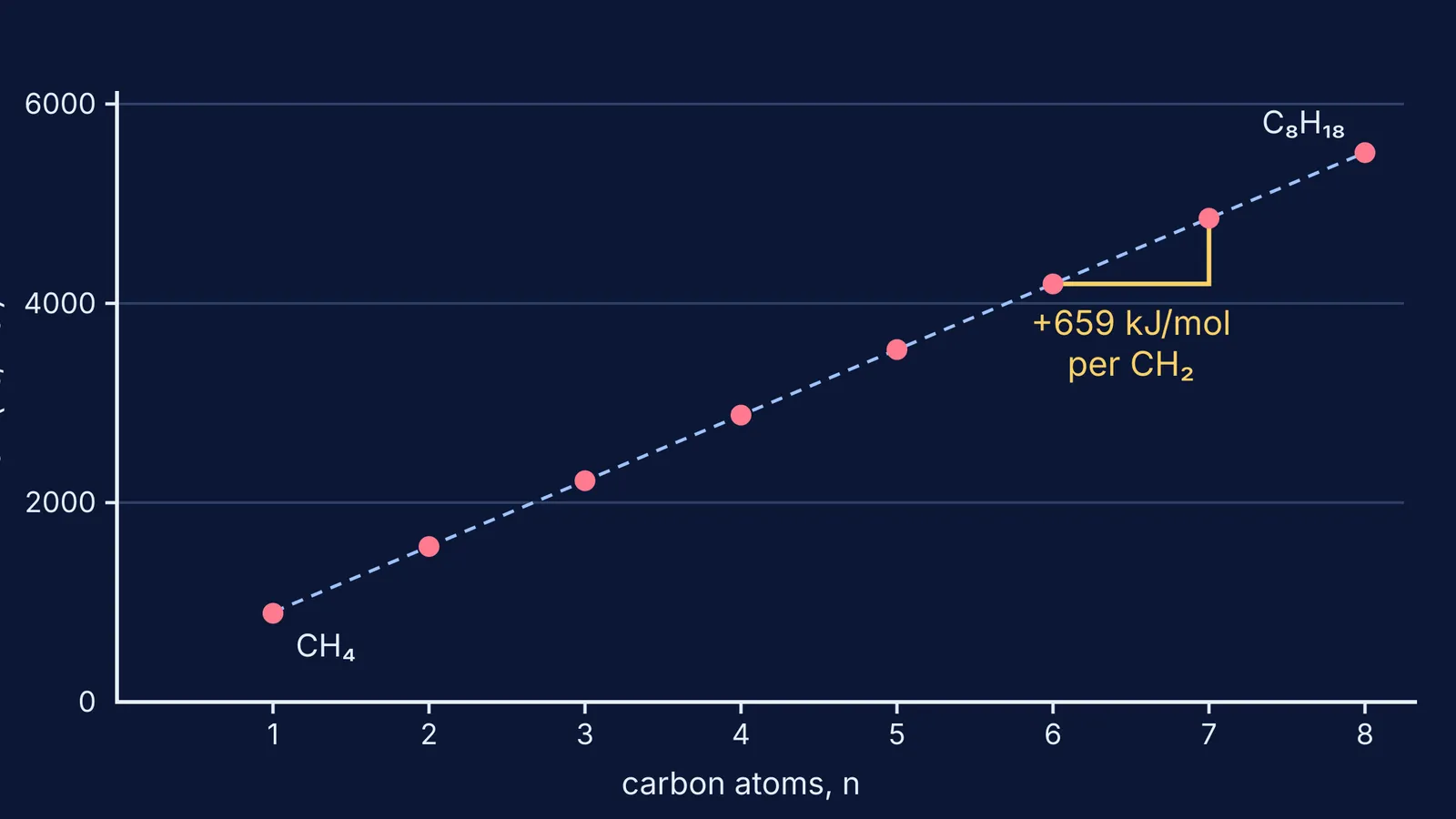
Then plot the values below, n on the x-axis and heat released on the y-axis. Rusty on graphs? See how to read increases and flat lines in a line graph.
Does the heat of combustion of alkanes increase with carbon number?
Yes, and steadily. Each value below is the heat released when one mole of the gaseous straight-chain alkane burns in oxygen to gaseous carbon dioxide and liquid water at 25 °C, taken from table 2 of Prosen and Rossini (1945). We converted from kcal/mol at 4.184 kJ per kcal and rounded:
Methane, CH4: 890 kJ/mol
Ethane, C2H6: 1,560 kJ/mol
Propane, C3H8: 2,220 kJ/mol
Butane, C4H10: 2,879 kJ/mol
Pentane, C5H12: 3,536 kJ/mol
Hexane, C6H14: 4,195 kJ/mol
Heptane, C7H16: 4,853 kJ/mol
Octane, C8H18: 5,512 kJ/mol
The NIST Chemistry WebBook entry for methane lists the same study's value as 890.35 kJ/mol. As a sign convention, ΔcH is negative because heat leaves the system, so octane's ΔcH is about −5,512 kJ/mol.
How much does each extra CH2 add?
Subtract each value from the next. The steps, from the 1945 table, are 670, 660, 658, 658, 659, 659 and 659 kJ/mol.
Prosen and Rossini fitted a straight line to the normal alkanes from hexane to dodecane and found an increment of 157.443 kcal/mol per CH2 in the gas phase, which is 658.7 kJ/mol (Prosen and Rossini, 1945). In kJ, their equation is −ΔcH ≈ 242.3 + 658.7n kJ/mol, for n greater than 5.
Try it on nonane (n = 9): 242.3 + 658.7 × 9 = 6,171 kJ/mol. The same paper's table lists gaseous n-nonane at 1,474.90 kcal/mol, which is 6,171 kJ/mol.
Why is the step close to 659 kJ/mol?
This is Hess's law in one line. Each CH2 adds one carbon and two hydrogens, so the balanced equation gains one CO2 and one H2O on the product side.
The standard enthalpy of formation of CO2 gas is −393.51 kJ/mol (NIST WebBook, CODATA value), and that of liquid water is −285.83 kJ/mol (NIST WebBook, CODATA value). Together they add −679.34 kJ/mol per CH2.
But the alkane itself also gets a little more stable with each CH2: its gas-phase enthalpy of formation falls by 4.926 kcal/mol, or 20.6 kJ/mol, per CH2 (Prosen and Rossini, 1945). Since ΔcH = ΣΔfH(products) − ΣΔfH(reactants), the step is −679.3 − (−20.6) = −658.7 kJ/mol. The two routes agree, as Hess's law requires. The 1945 formation values were themselves worked out from the combustion data, so treat this as a consistency check rather than an independent test.
If you lose track of signs in chains like this, the Fermi Problem Library has worked problems with a step-by-step solver that explains the reasoning rather than printing an answer.
Which alkane gives more heat per carbon and per gram?
Per mole of molecules, octane wins easily. Per carbon, the order flips: methane gives 890 kJ per mole of carbon, while octane gives 5,512 ÷ 8 = 689. Per gram, using the NIST WebBook molar mass of methane (16.0425 g/mol) and of octane (114.2285 g/mol), methane gives 55.5 kJ/g and octane 48.3 kJ/g.
Prosen and Rossini's fitted equation explains why. The fixed 242.3 kJ/mol part does not grow with n, so as the chain lengthens it is shared over more carbons and the value per carbon slides towards 658.7.
What to do next
Redo the plot with liquid values and watch the step shrink. Then compare the jagged pattern of even-odd alkane melting points, where chain packing matters. The Fermi Simulation Lab has interactive simulations for the ideas that are easier to see than to read.


