

On this page
In Excretory Products and their Elimination, the renin-angiotensin-aldosterone system (RAAS) is the NEET-UG topic where the kidney, liver, lungs, adrenal gland and heart all appear together. We walk the chain, flag the traps, and end with a one-page flowchart. For the rest of the chapter, see our worked guide to the nephron, GFR and counter-current for NEET.
What does the renin-angiotensin-aldosterone system do?
The RAAS is a chain of an enzyme and hormones that pushes blood pressure back up when it falls. A StatPearls chapter by Jasleen Kaur and Preeti Rout calls it "a primary regulator of blood volume, electrolyte homeostasis, and systemic vascular resistance" (StatPearls, via Europe PMC). The chapter adds that the baroreceptor reflex handles short-term drops in pressure, while the RAAS handles both quick and long-term adjustments.
It works on two fronts: it squeezes blood vessels, and it holds on to salt and water so there is more blood to push. (See also our explainer on systolic and diastolic blood pressure and 120/80.)
How does the RAAS work, step by step?
In NCERT Class 11 Biology this sits in chapter 16, which defines the juxtaglomerular apparatus (JGA) as a specialised sensitive region formed by cellular modifications in the distal convoluted tubule and the afferent arteriole where they touch (chapter 16 NCERT answers, PW). From there the chain runs in six links:
Trigger. Blood pressure, kidney blood flow or GFR falls. StatPearls lists reduced renal perfusion, less salt reaching the distal convoluted tubule, and beta-adrenergic (sympathetic) stimulation as triggers (StatPearls).
Renin. JG cells sense the low pressure and release renin (Colorado State University, VIVO Pathophysiology).
Angiotensin I. Renin cuts angiotensinogen, a large protein made in the liver, to release angiotensin I, a 10-amino-acid peptide that is still inactive (same source).
Angiotensin II. Angiotensin-converting enzyme (ACE), on the inner lining of blood vessels and most prominently in the lungs, removes 2 amino acids to make angiotensin II, an 8-amino-acid peptide (same source).
Vasoconstriction. Angiotensin II narrows blood vessels and raises blood pressure (same source). In the kidney, narrowing the efferent arterioles raises glomerular pressure and brings GFR back up (NCERT answers, PW).
Aldosterone. Angiotensin II also makes the adrenal gland release aldosterone, which acts on the distal tubule to increase reabsorption of sodium and water and excretion of potassium (VIVO Pathophysiology, mineralocorticoids). More water kept means more blood volume, so pressure rises.
Where does ANF fit in the RAAS flowchart?
Atrial natriuretic peptide (ANP, also called atrial natriuretic factor or ANF) is secreted from the cardiac atria and acts to decrease blood pressure, according to a review by L. R. Potter and colleagues (Handbook of Experimental Pharmacology, 2009). Atrial natriuretic hormone is also listed among the factors that suppress aldosterone secretion (VIVO Pathophysiology).
A key early clue came in 1981, when A. J. de Bold's team published a paper titled "A rapid and potent natriuretic response to intravenous injection of atrial myocardial extract in rats" (Life Sciences, 198190370-2)). Natriuretic means making the kidney lose sodium in urine, the opposite of aldosterone. So draw ANF as a brake on the RAAS, not as part of it.
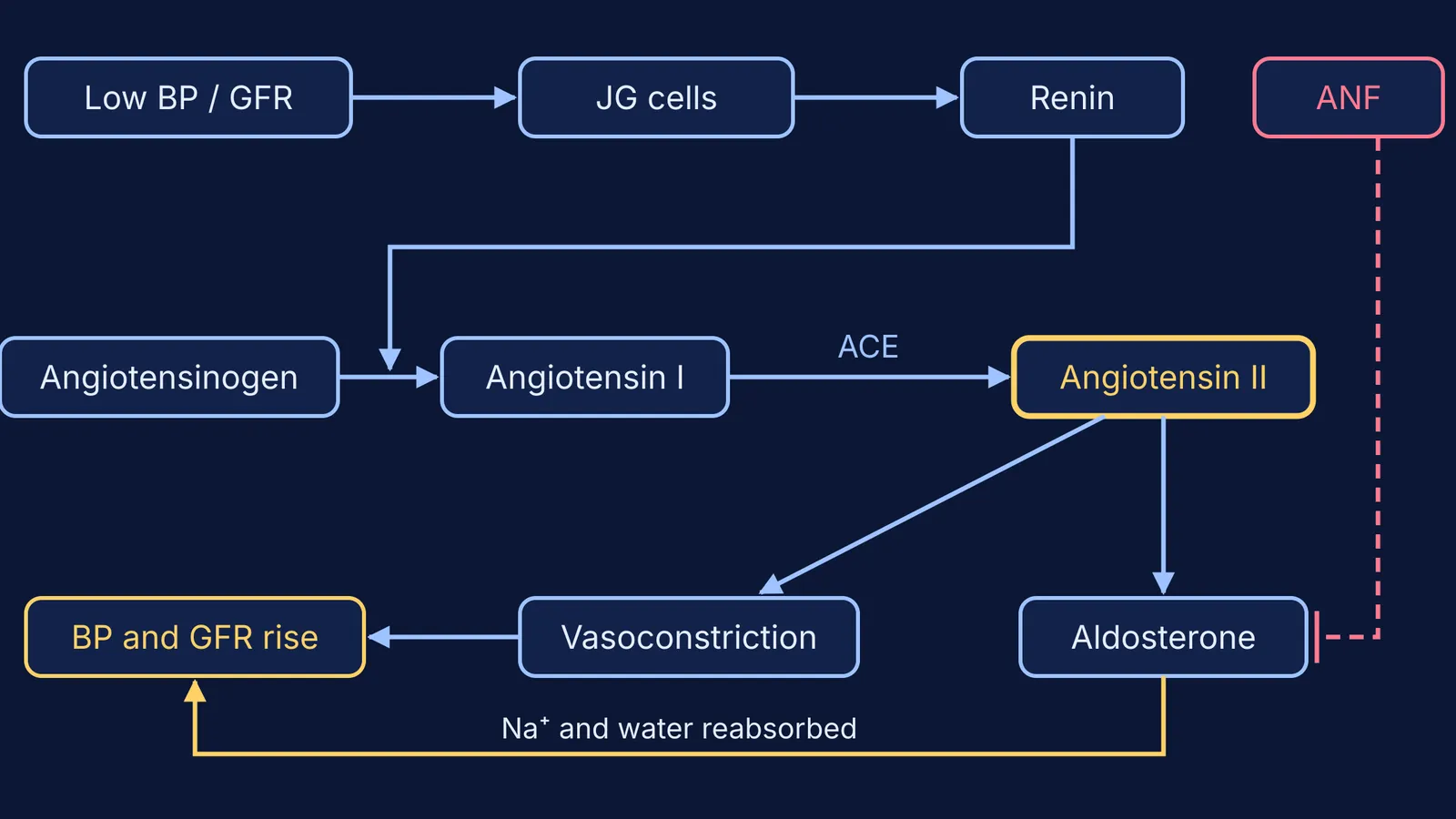
The one-page RAAS flowchart for NEET revision
Copy this onto a single page, top to bottom, and say each arrow aloud as you write it (peptide sizes from VIVO Pathophysiology):
Low BP or low GFR → JG cells of the JGA
JG cells → renin
Angiotensinogen (liver) + renin → angiotensin I (10 amino acids)
Angiotensin I + ACE (most prominently in the lungs) → angiotensin II (8 amino acids)
Angiotensin II → vasoconstriction → glomerular pressure and GFR up
Angiotensin II → adrenal gland → aldosterone → sodium and water reabsorbed in the distal tubule → blood volume up
Result: blood pressure and GFR back up
Brake: atria → ANF → blood pressure down, aldosterone suppressed
Then cover it and answer: which organ makes angiotensinogen, where is ACE most prominent, and what two things does angiotensin II do? Redraw any link you missed.
How should you revise the RAAS in 10 minutes?
Minutes 0 to 3: draw the chain from memory on a blank page.
Minutes 3 to 5: check it against the flowchart and circle any missing arrow or wrong organ.
Minutes 5 to 8: explain aloud why a fall in GFR ends with more sodium kept.
Minutes 8 to 10: set it beside ADH using our comparison of ADH, the RAAS and ANF in kidney regulation, since questions often mix the three.
If one link keeps slipping, the Fermi Concept Library gives each biology concept its own lesson and its place in the map. To practise, the Fermi Problem Library has worked problems with a step-by-step solver that explains the reasoning rather than printing an answer.


