

On this page
Healthy kidneys filter plenty of glucose and send almost all of it back to the blood. Glucose turns up in urine only when the blood carries more than the tubule's carriers can handle.
What is the renal threshold for glucose?
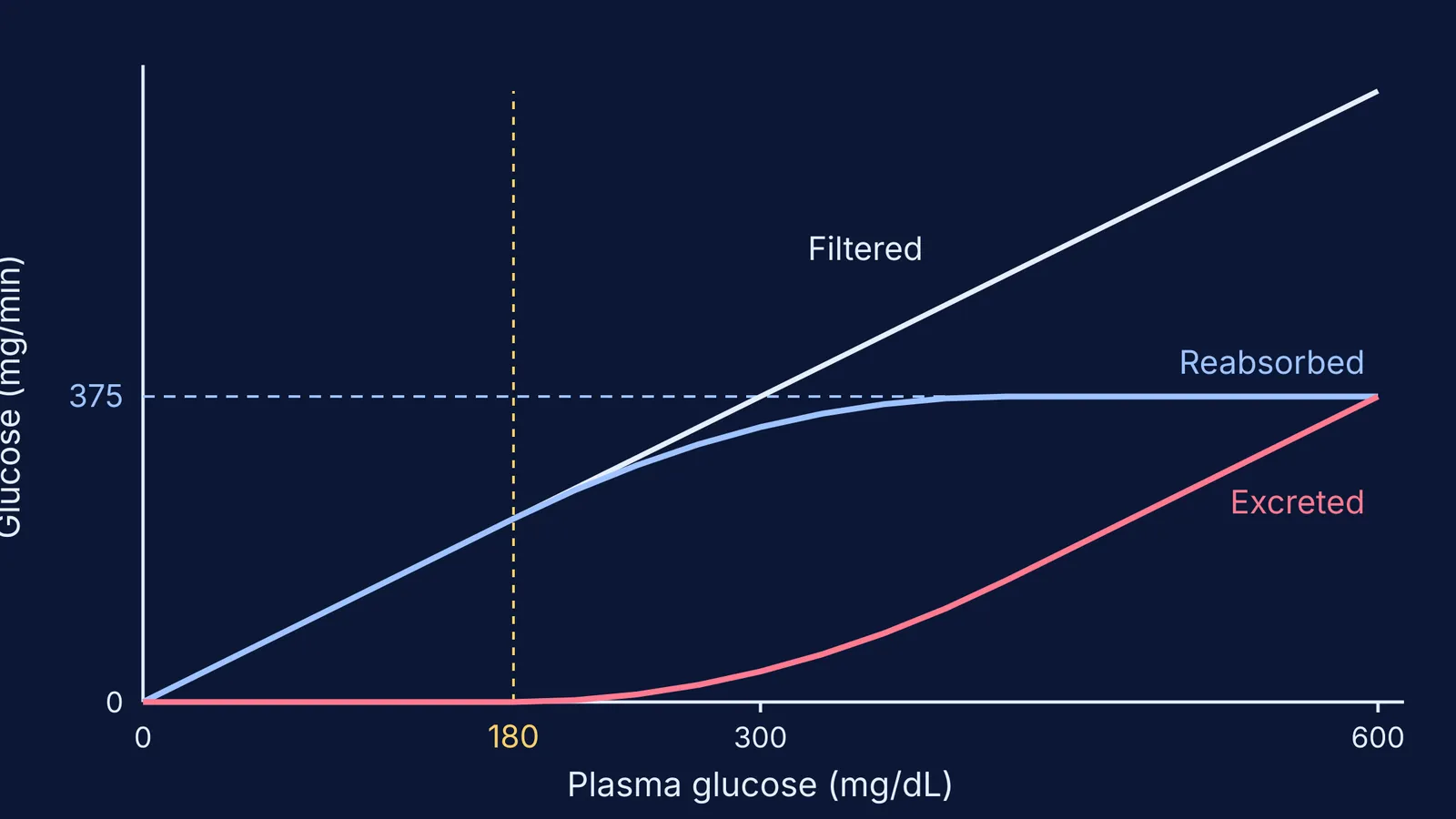
The renal threshold for glucose is the plasma glucose level at which glucose first appears in urine. A 2020 review puts it at about 180 mg/dL and notes that it is higher in people with type 2 diabetes (Gronda et al., Journal of the American Heart Association, 2020). The same review says the kidneys filter about 180 L of plasma, and about 180 g of glucose, a day.
A physiology review puts the cause in one line: glycosuria happens when "the glomerulus filters more glucose than the proximal tubule can reabsorb" (StatPearls, Physiology, Glycosuria). So there are two routes: too much glucose arriving, or a tubule that cannot take it back.
Why do the carriers in the PCT saturate?
Glucose is reabsorbed in the proximal convoluted tubule (PCT). Most of it (80 to 90%) is taken up by the cotransporter SGLT2 in the first part of the tubule, and SGLT1 further along takes up the remaining 10 to 20% (Gronda et al., 2020). Glucose enters the tubule cell across the apical membrane with sodium through the SGLTs, then leaves on the blood side through GLUT2 (Ghezzi, Loo and Wright, Diabetologia, 2018). The gut uses the same sodium-coupled step; see how glucose is absorbed in the small intestine.
Each carrier moves only so many glucose molecules per second, and the tubule has a fixed number of them. That ceiling is the transport maximum, and for glucose (TmG) it is about 375 mg/min (Gronda et al., 2020).
Worked example: filtered load versus reabsorption capacity
Use one formula: filtered load = GFR × plasma glucose. From 180 L a day: 180,000 mL ÷ 1,440 minutes = 125 mL/min. Convert plasma glucose from mg/dL to mg/mL by dividing by 100, and compare the result with the 375 mg/min ceiling from Gronda et al., 2020.
Plasma glucose 100 mg/dL (1.0 mg/mL): filtered load = 125 × 1.0 = 125 mg/min. Well below 375, so all of it is reabsorbed.
Plasma glucose 180 mg/dL (1.8 mg/mL): filtered load = 125 × 1.8 = 225 mg/min. Still below 375, yet this is where glucose starts to appear.
Plasma glucose 300 mg/dL (3.0 mg/mL): filtered load = 125 × 3.0 = 375 mg/min. Exactly the ceiling: if every nephron were identical, glucose would first appear here.
Plasma glucose 400 mg/dL (4.0 mg/mL): filtered load = 500 mg/min. At most 375 mg/min comes back, so at least 125 mg/min goes into urine.
Why is the threshold 180 mg/dL and not 300 mg/dL?
The whole-kidney ceiling is a total over many nephrons, and they are not identical. Some have fewer carriers for the filtrate they receive, so they saturate early and start leaking glucose while others still have spare capacity. The gap between the threshold and the transport maximum is called splay, and it exists because some carriers are overwhelmed before others (transport maximum overview). So the real curve bends gradually instead of turning a sharp corner at 300 mg/dL.
DeFronzo and colleagues raised blood glucose in steps under a clamp in 12 healthy volunteers and 12 people with type 2 diabetes, and estimated the threshold, TmG and splay from each person's titration curve; dapagliflozin, a drug that blocks SGLT2, lowered all three, and its largest effect was on the threshold at which glucose is excreted (DeFronzo et al., Diabetes Care, 2013). The reverse case also exists: mutations in SGLT2 cause renal glucosuria, glucose in urine because the carriers are faulty (Ghezzi, Loo and Wright, 2018).
This is textbook physiology; a doctor should interpret any urine or blood sugar result. For the exam contrast between high-sugar urine and dilute urine, read diabetes insipidus vs mellitus.
How can NEET-UG test the renal threshold?
A quick revision checklist:
Site: glucose is reabsorbed in the PCT, not the loop of Henle or the collecting duct.
Mechanism: entry with sodium (secondary active transport), exit by facilitated diffusion.
Graph: filtered load rises in a straight line; reabsorption flattens at TmG; excretion starts at the threshold.
Cause: high blood glucose overloads normal carriers; faulty carriers can spill glucose without high blood sugar.
Calculation: filtered load = GFR × plasma concentration, with mg/dL changed to mg/mL first.
Try one: with GFR 120 mL/min and plasma glucose 250 mg/dL, the filtered load is 300 mg/min, below the 375 mg/min ceiling (Gronda et al., 2020) but above the threshold, so some nephrons are already spilling. For more traps in this chapter, see excretion mistakes in NEET Biology.
If transport maximum still feels abstract, the Fermi Concept Library has a lesson for every concept in biology, each with its place in the map. For calculations like the one above, the Fermi Problem Library has worked problems with a step-by-step solver that explains the reasoning rather than printing an answer.


