

On this page
Every chapati and plate of rice ends up as glucose in your small intestine. The cells lining the gut often have to pull that glucose in against its concentration gradient, and they do it by tying glucose to sodium. The same trick explains why a packet of ORS contains both sugar and salt.
How is glucose absorbed in the small intestine?
Glucose is absorbed through the cells covering the villi, the finger-like folds of the small intestine. Each cell has a brush border of microvilli facing the gut and a basolateral side facing the blood (we cover the structure in villi in the small intestine, with labels).
The idea that glucose enters these cells coupled to sodium was first proposed by Robert Crane in 1960, and the energy for this active glucose transport comes from the sodium gradient across the cell membrane, as a review in Physiological Reviews by Wright, Loo and Hirayama explains.
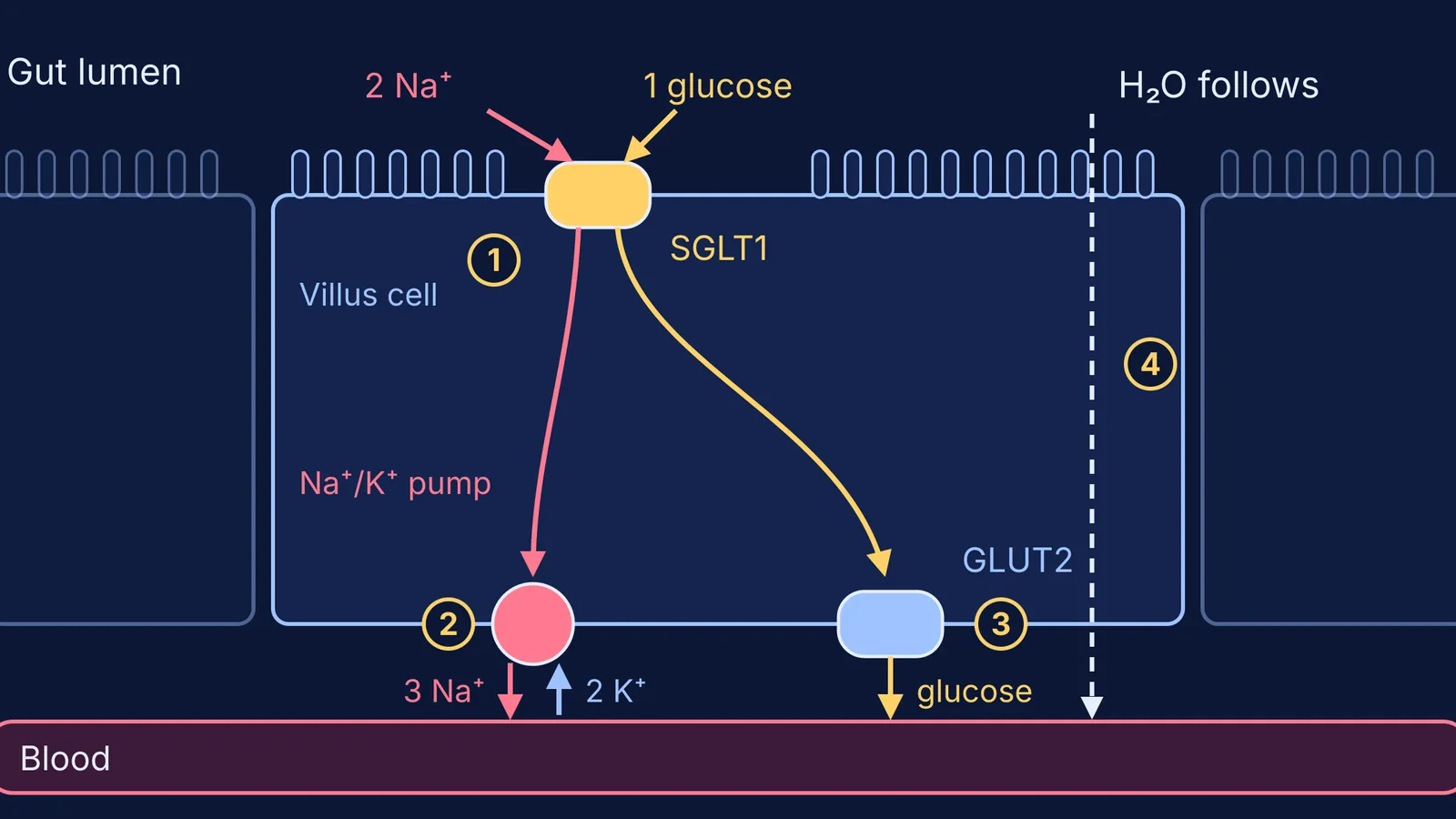
SGLT1 is the sodium-glucose cotransporter found mainly in the intestine, and it has a Na⁺ to glucose stoichiometry of 2:1, according to a review by Sabino-Silva and colleagues. The same review notes absorption happens mostly in the duodenum and early jejunum, places GLUT2 on the basolateral membrane, and describes the Na⁺/K⁺-ATPase there pumping sodium out to keep the gradient going.
What happens at each step of the diagram?
SGLT1 (brush border). Two Na⁺ ions and one glucose molecule bind and cross together, the 2:1 ratio given in the Sabino-Silva review. Sodium flows downhill into the cell, and that downhill flow pays for carrying glucose uphill.
Na⁺/K⁺ pump (blood side). The pump uses ATP to push sodium back out, so sodium inside the cell stays low and step 1 can keep running. In each cycle it moves three Na⁺ out and two K⁺ in, per a 2024 review of the Na⁺/K⁺-ATPase; we explain the ratio in why the sodium-potassium pump moves 3 Na⁺ out and 2 K⁺ in.
GLUT2 (blood side). Glucose has now piled up inside the cell, so it leaves by facilitated diffusion through GLUT2 into the blood.
Water follows. Moving sodium and glucose out of the gut concentrates the fluid on the blood side, so water follows by osmosis. The Wright review also describes SGLTs acting as coupled water transporters.
Why does oral rehydration need both sugar and salt?
In diarrhoea, especially cholera, the gut loses large amounts of water and salt. Glucose helps because SGLT1 cannot move glucose without carrying sodium in with it, and water follows both.
A history in Tropical Medicine and Infectious Disease describes Robert Phillips adding glucose to a perfused saline solution and seeing sodium losses fall, showing that cholera had not switched off coupled glucose-saline transport. An account in the Indian Journal of Medical Research describes Dilip Mahalanabis using oral rehydration in refugee camps near Calcutta during the Bangladesh War of Independence.
The reduced-osmolarity formula that WHO and UNICEF have recommended since 2003 contains 2.6 g sodium chloride and 13.5 g anhydrous glucose per litre, plus potassium chloride and trisodium citrate, as set out in the WHO document on producing the new ORS. That gives 75 mmol/L sodium, 75 mmol/L glucose and a total osmolarity of 245 mOsm/L. WHO lowered the glucose and salt from the older 311 mOsm/L formula to avoid possible harm from a too-concentrated (hypertonic) solution to net fluid absorption. We work through the molarity in molarity of glucose and salt in WHO ORS.
More sugar is not always better. A 2020 lab study on intestinal cells infected with rotavirus, in Scientific Reports, found that fluid secretion switched to absorption when glucose was 80 to 110 mM and sodium 45 to 60 mEq/L. The authors say clinical trials are still needed.
How do you write this answer in an exam?
For "Explain the absorption of glucose in the small intestine", check your answer against these five points.
Glucose enters across the brush border through SGLT1, together with Na⁺ (2 Na⁺ : 1 glucose, per the Sabino-Silva review).
This is secondary active transport, driven by the Na⁺ gradient.
The Na⁺/K⁺ pump on the basolateral side keeps cell Na⁺ low, using ATP.
Glucose leaves the cell into the blood through GLUT2 by facilitated diffusion.
Water follows the solutes by osmosis, which is the basis of ORS.
Then test yourself: if the Na⁺/K⁺ pump stopped, what would happen to glucose uptake? Sodium would build up inside the cell, the gradient would shrink, and SGLT1 would slow down even with glucose still in the gut.
If primary versus secondary active transport is still fuzzy, the Fermi Concept Library gives each biology concept its own lesson and its place in the map. For practice questions, the Fermi Problem Library has a step-by-step solver that explains the reasoning rather than printing an answer.
Next time you open an ORS packet, read the label: sodium and glucose side by side, because one door in your gut lets them in only together.


