

On this page
The red panda lives in high-altitude temperate forests with bamboo understories in the Himalayas, including parts of India and Nepal, and bamboo makes up about 95% of its diet, according to Smithsonian's National Zoo. The puzzle is that it still has “a simple carnivore stomach”, the gut of a meat-eater. So how does it get by? The easiest way to see it is as an energy budget: what comes in, how much of it is absorbed, and how much gets spent.
How does a red panda digest bamboo with a carnivore's gut?
Badly, and it makes up for that by eating fast. In feeding trials in Yele Nature Reserve, Sichuan, Wei and colleagues (1999, Journal of Zoology) found the red panda “poorly processed its bamboo food”, with gut microbes playing only a minor role. Bamboo passed through its gut in 2 to 4 hours.
The fix is quality plus quantity. The same study found red pandas pick the tender leaves and shoots and eat a lot of them: over 1.5 kg of fresh leaves and 4 kg of fresh shoots daily. A 2017 study in PLOS ONE puts the red panda's assimilation rate at 22–42%, depending on whether it eats leaves or shoots.
What is the red panda's false thumb for?
The false thumb is an enlarged wrist bone, the radial sesamoid, that works like an opposable thumb (Salesa and colleagues, PNAS, 2006). The red panda uses it to grip bamboo while feeding (National Zoo).
It probably did not start out as a bamboo tool. Salesa's team found a false thumb in *Simocyon batalleri*, a fossil relative of the red panda from Spain, and argued it probably first evolved to grip thin branches while climbing. The giant panda's false thumb, by contrast, probably evolved for handling bamboo. The two pandas got there separately: a 2017 genome study in PNAS found convergent changes in genes possibly involved in the false thumb and bamboo diet, and a broken umami taste gene, *TAS1R1*, in both. That makes the thumb a textbook case of analogous organs and convergent evolution.
Does the red panda have a low metabolism?
Less clearly than you might read online. The giant panda's daily energy expenditure is only about 38% of the average for a land mammal its size, according to Nie and colleagues' 2015 Science study. For the red panda, an older study found low values in 2 zoo animals, but Fei and colleagues (2017) measured 17 animals and found resting metabolic rates “similar to mammals of the same size”.
So the savings seem to come mostly from behaviour. In the cold, red pandas can become dormant, lowering their metabolic rate and raising it every few hours, and they are awake only about 45% of the day (National Zoo). Compare that with hibernation, a much longer seasonal shutdown.
How do thick fur and long sleep save energy?
The red panda has a dense woolly undercoat under long, coarse guard hairs, fur that completely covers its feet, and a bushy tail that shields it from cold and wind (National Zoo). In the cold, it curls into a tight ball to conserve body heat.
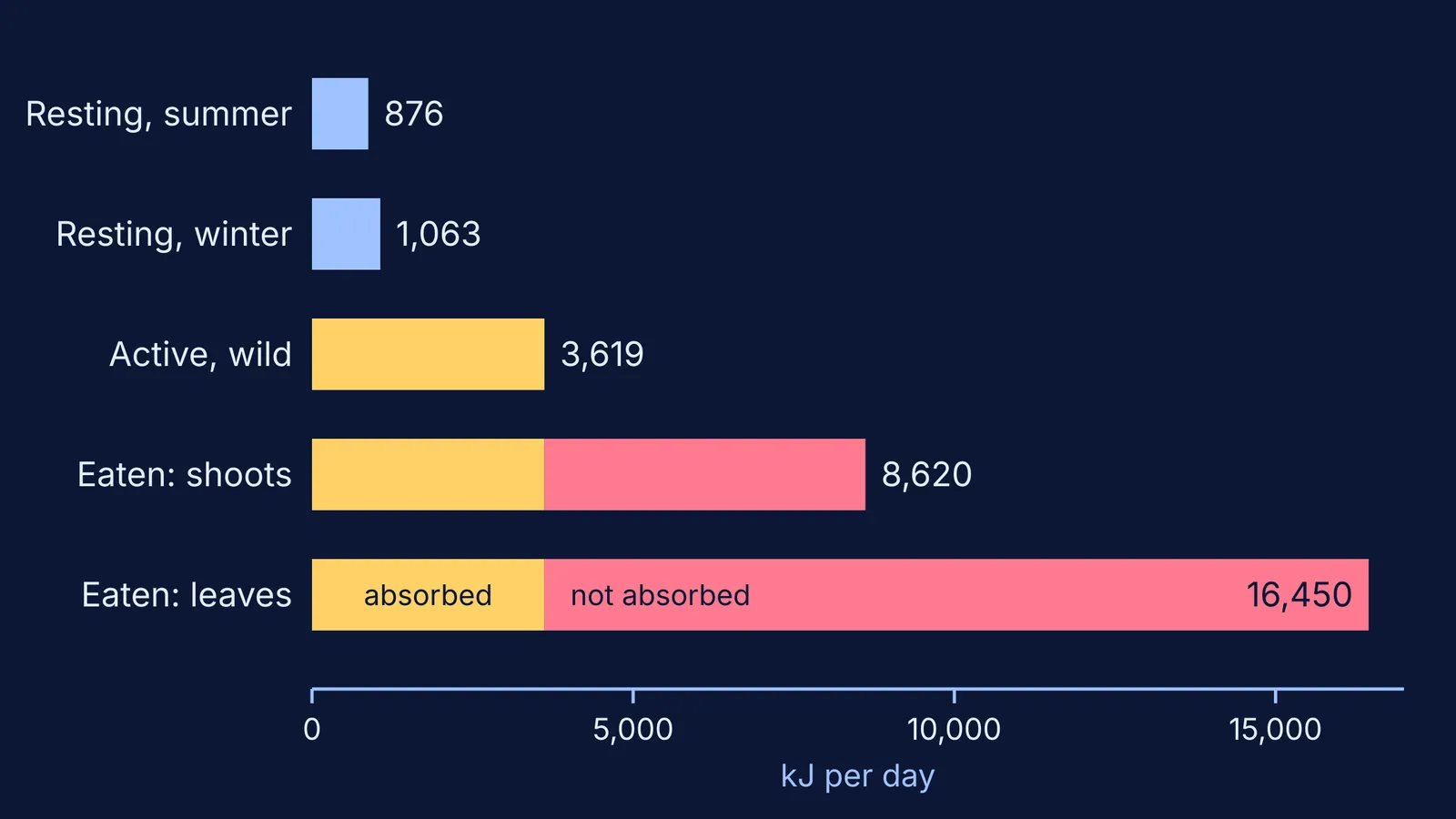
Cold costs energy. In Fei's study, resting red pandas needed 876 kJ/day in summer but 1,063 kJ/day in winter, when test temperatures of 5.3–9.1°C fell below their thermoneutral zone (PLOS ONE). Insulation cuts the need to burn extra fuel for heat, as your body does when you shiver.
Worked example: a red panda's energy budget
Using the 2017 PLOS ONE figures, with the active figure the paper cites for wild red pandas in Wolong Reserve:
Daily spend when active in the wild: 3,619 kJ/day.
Daily spend at rest in summer (measured in captive animals): 876 kJ/day. Activity raises the bill about 4.1 times (3,619 ÷ 876).
Living on leaves, at 22% assimilation, food in = 3,619 ÷ 0.22 ≈ 16,450 kJ of bamboo energy a day.
Living on shoots, at 42%, food in = 3,619 ÷ 0.42 ≈ 8,620 kJ a day, about half as much.
This is a rough model: it treats the assimilation rate as if it applied to energy and ignores growth and breeding. Still, it shows the two levers. The red panda can raise efficiency by choosing shoots, or cut spending by resting, curling up and staying warm. It does both.
If the link between digestion, metabolism and body temperature still feels loose, the Fermi Concept Library gives every concept in biology its own lesson and its place in the map. To try a budget like this for another animal, Fermi's AI tutor works through problems alongside you, deciding whether to explain, ask or show.
Why does this matter for red pandas now?
A diet this tight leaves little slack. Red pandas are endangered, and their total population has fallen by about 40% over the past two decades, according to the National Zoo. An animal that depends on finding the best bamboo every day depends on the forest staying intact.


