

On this page
At an eye check-up you are often shown a chart split into a red half and a green half, with black letters on both, and asked which side looks sharper. It looks like a colour test, but it is a focus test. It works because the eye is a lens, and like every lens made of glass or water it bends green light a little more than red. This post works out how big that difference is with NCERT optics and explains what each answer tells the person testing your eyes.
This is a physics explainer, not medical advice. The test is one step in an eye examination, and an eye doctor or optometrist interprets it. Do not use a chart on a screen to choose spectacles.
What is the red-green (duochrome) eye test?
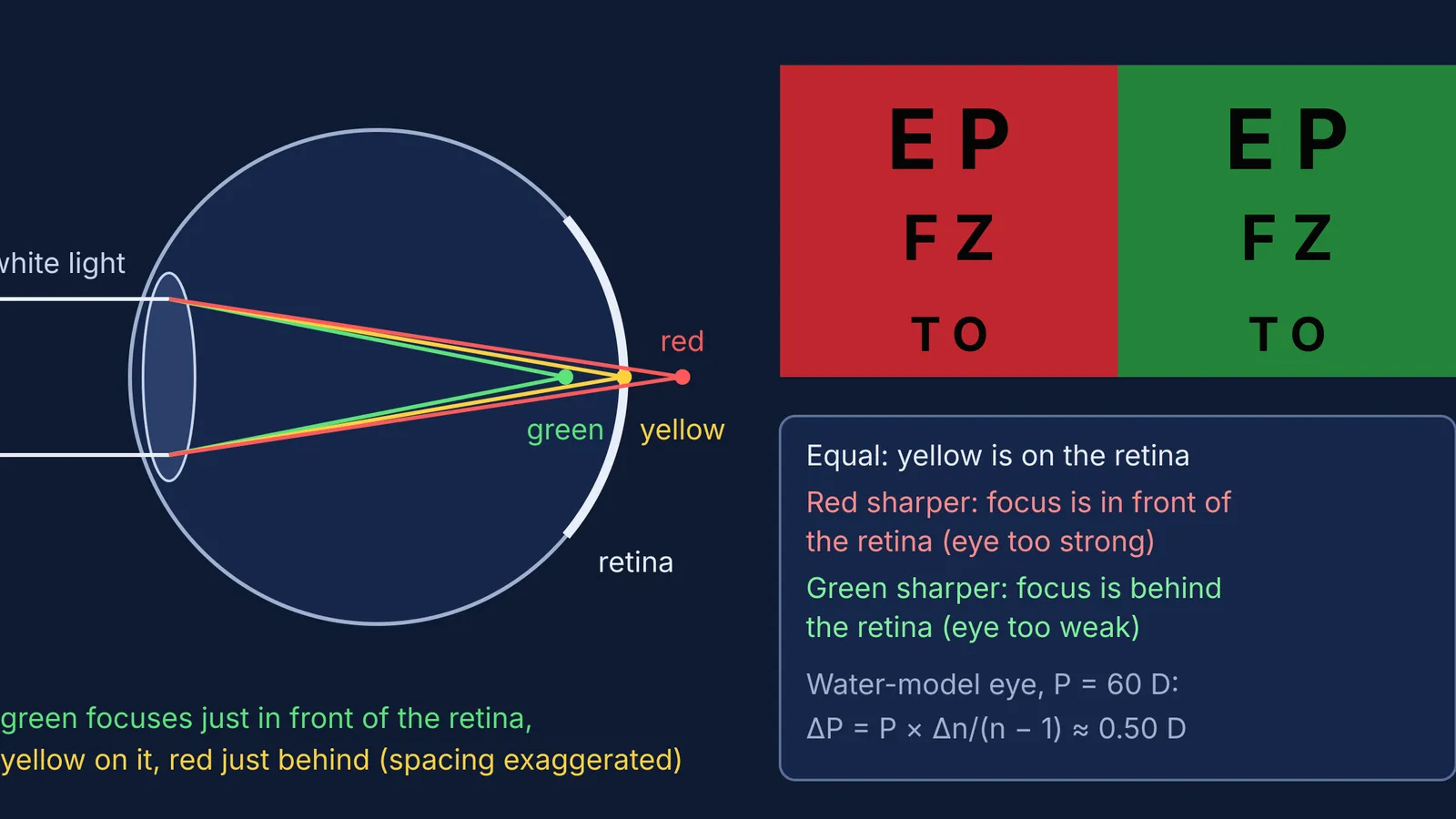
The duochrome test shows the same black letters on a red background and a green background. According to the American Academy of Ophthalmology's EyeWiki entry on the duochrome test, the green is about 535 nm, the red about 620 nm, and both are chosen to sit about the same dioptric distance, roughly 0.25 D, either side of yellow at 570 nm. That makes the two halves about 0.50 D apart. A peer-reviewed study by Rolandi and colleagues in the Journal of Optometry (2024) gives the same wavelengths, from the British Standard for these charts.
The aim is to check that the middle of the spectrum, yellow, is focused on the retina. If it is, the green letters are focused slightly in front of the retina and the red letters slightly behind, by about the same amount, so both look equally sharp.
Why does the eye focus green more strongly than red?
The power of a thin lens is P = 1/f = (n − 1)(1/R₁ − 1/R₂). The shape term is fixed for a given lens, so P is proportional to n − 1. Water, like glass, has a larger refractive index for shorter wavelengths. This is dispersion, and in lenses it gives chromatic aberration. The fix with two glasses is covered in the achromatic combination of two lenses. The eye has no such fix.
The eye's cornea, lens and the fluids inside are mostly water, so a simple model treats the whole eye as a water lens. Its larger n for green makes it a stronger lens for green.
Worked example: the water-model eye
Data. Treat the eye as a 60 D lens for yellow light (570 nm). Water's refractive index is approximately 1.3371 at 486 nm and 1.3311 at 656 nm (standard table values; tables differ slightly in the fourth decimal).
Fit a curve. Use Cauchy's formula n = A + B/λ². Through the two points, A = 1.3238 and B = 3,141 nm².
Indices at the chart's colours. n(535 nm) = 1.3348, n(570 nm) = 1.3335, n(620 nm) = 1.3320.
Fractional change in power. ΔP/P = Δn/(n − 1) = (1.3348 − 1.3320)/(1.3335 − 1) = 0.0028/0.3335 = 0.84%.
Green minus red. ΔP = 60 × 0.0084 = 0.50 D. Green is 0.24 D stronger than yellow and red is 0.27 D weaker.
Shift of focus. Inside the eye (n ≈ 1.336) a 60 D eye focuses about 22 mm behind the lens. A power change ΔP moves the focus by about 1.336 × ΔP/P² = 1.336 × 0.50/3,600 m ≈ 0.19 mm.
Over the whole visible range (400 nm to 700 nm) the same model gives about 2.4 D. Rolandi and colleagues quote about 2 D for real eyes, so the water model is the right size.
What does it mean when the red letters look sharper?
The rule follows from the ray picture. Suppose the eye, with whatever lens is in front of it, is a little too strong. Every colour then comes to a focus slightly in front of the retina. Green, which focuses furthest forward, is now further from the retina, so it is more blurred. Red, which was behind the retina, is pulled forward onto it, so it is sharper. Red sharper means the focus lies in front of the retina. This is the same direction of error as myopia, described in defects of the eye.
If the eye is a little too weak, every focus moves back. Red moves further behind the retina and blurs, while green moves onto the retina. Green sharper means the focus lies behind the retina, the direction of hypermetropia.
The EyeWiki entry states how clinicians use this during a refraction: if the red side stands out, they add minus power in 0.25 D steps, and if the green side stands out, they add plus power, until both sides look the same. That matches the physics. A concave (minus) lens weakens the system and moves the focus back, exactly what choosing a lens for myopia from the far point does on a larger scale. The final decision is the examiner's; the test is a fine adjustment inside a full examination.
Does the red-green test work for people who are colour-blind?
The test compares sharpness, not colour names, so in principle it does not need colour vision. A peer-reviewed study of 32 people with congenital colour vision defects in Healthcare (2024) found that 30 identified the two halves correctly, and two did not. The authors concluded that people with colour vision defects can generally do the test, and suggested examiners ask "which side is clearer, left or right?" instead of naming the colours. It was a small study, and the authors call for larger ones.
Where does this fit in your physics syllabus?
The duochrome test combines three NCERT ideas: the lens maker's formula, dispersion (n depends on wavelength) and the power of the eye in dioptres. JEE and NEET questions on lenses of different colours, or on why a prism splits light, use the same Δn/(n − 1) step. If chromatic aberration is still a hazy idea, the Concept Library covers every concept in physics, chemistry, biology, mathematics and computing.
Quick checklist
Lens power P ∝ (n − 1); water and glass have larger n for green than red.
Water-model eye of 60 D: green is about 0.50 D stronger than red; focus shift about 0.19 mm.
Measured red-green differences in real eyes are smaller, about 0.2 D in one 2024 study.
Equal sharpness: yellow is on the retina.
Red sharper: focus in front of the retina. Green sharper: focus behind it.
The test compares sharpness, not colour; an eye doctor or optometrist interprets it.


