On this page
It is a standard textbook question: a short-sighted student can see clearly only up to 2 m. What lens do they need, and what is its power? The answer is −0.5 D, and getting there takes one idea (where the image goes) and one rule (the sign convention).
What does a far point of 2 m mean?
The far point is the farthest point up to which the eye can see objects clearly, and for a normal eye it is at infinity, according to the NCERT Class 10 chapter on the human eye. The same chapter says a person with myopia "has the far point nearer than infinity", and that in a myopic eye the image of a distant object forms in front of the retina.
So a far point of 2 m means objects up to 2 m away can be seen sharply, and anything farther away is blurred.
Why must the lens put the image at the far point?
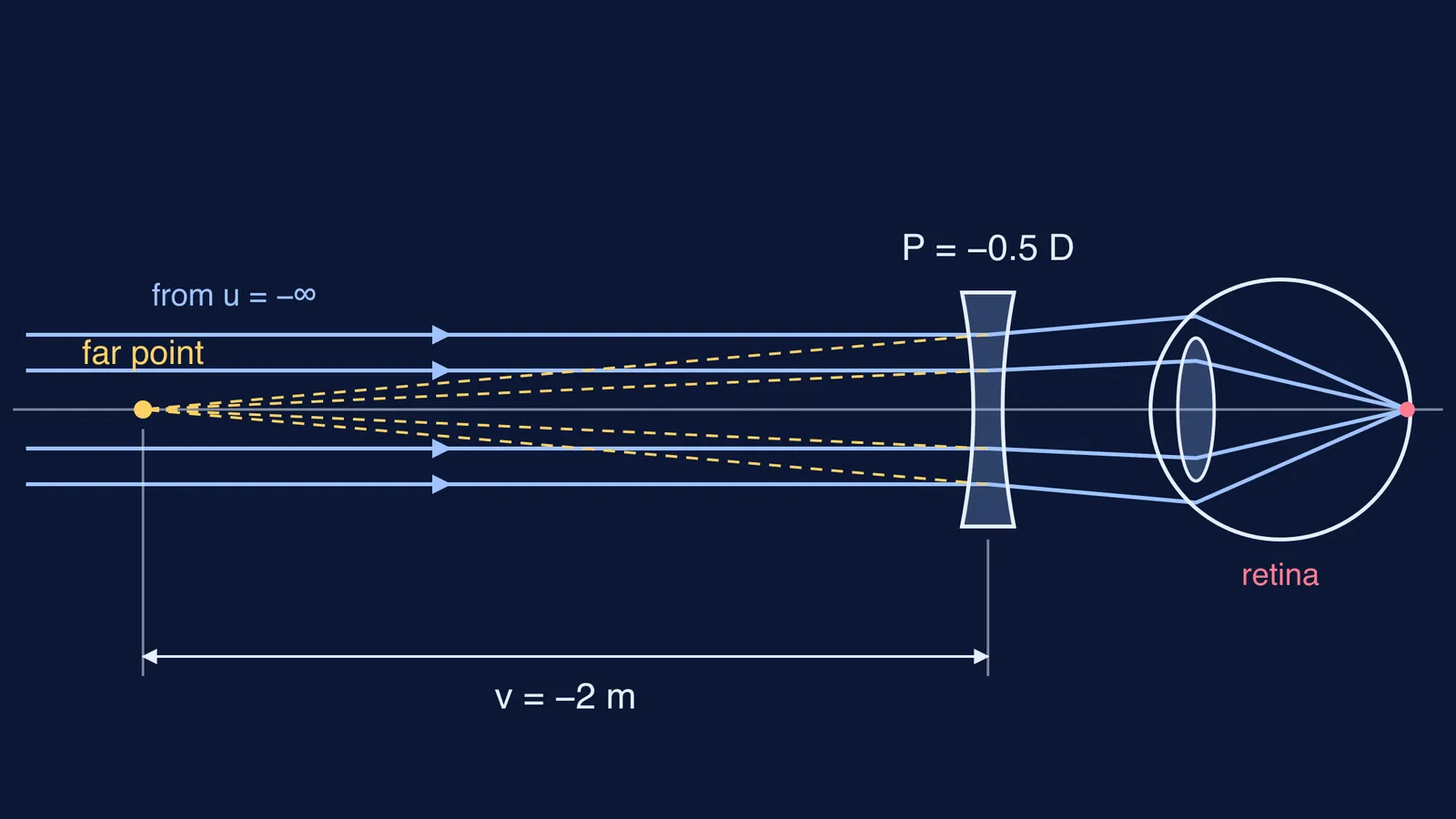
This is the step that is easiest to skip. The eye can already see an object at 2 m. So if a lens makes light from a distant object (a blackboard, a bus number) appear to come from 2 m away, the eye sees it sharply.
A concave lens does exactly this. NCERT's Class 10 chapter on light shows that for an object at infinity, a concave lens forms a virtual, erect image at its focus, on the same side as the object. So the focus of the correcting lens must sit at the eye's far point. The focal length is then 2 m, with a minus sign.
The eye chapter puts it in words: a concave lens of suitable power "will bring the image back on to the retina and thus the defect is corrected" (NCERT Class 10, Chapter 10).
How do you calculate the power of the lens?
Use the lens formula 1/v − 1/u = 1/f from NCERT Class 10, Chapter 9. In that chapter's New Cartesian sign convention, distances are measured from the optical centre of the lens. Distances in the direction of the incident light count as positive and distances against it count as negative. A concave lens has a negative focal length.
The object and the virtual image are both on the incoming side, so both distances are negative.
Object distance: the object is very far away, so u = −∞ and 1/u = 0.
Image distance: the image must form at the far point, on the object's side, so v = −2 m.
Lens formula: 1/f = 1/v − 1/u = 1/(−2) − 0 = −0.5 per metre.
Focal length: f = −2 m.
Power: P = 1/f, with f in metres, so P = −0.5 D.
The chapter defines power as P = 1/f and says that 1 dioptre is the power of a lens whose focal length is 1 metre (NCERT). It also states that the power of a concave lens is negative. That is your check: the answer is negative, so the lens is concave.
The shortcut treats the lens as sitting against the eye, as textbook questions do. If a question gives a lens-to-eye gap, subtract it from the far point first.
What are the common mistakes in myopia lens questions?
Forgetting to convert to metres. A far point of 80 cm is 0.8 m, giving −1.25 D, not −0.0125 D.
Writing v = +2 m. The image is virtual and on the object's side, so v is negative. A positive v would give a convex lens, which is the correction for hypermetropia.
Taking u as the far point. The far point is where the image goes. The object is the distant thing you want to see, at infinity.
Dropping the sign. Write "−0.5 D, concave", not "0.5 D".
Try this one yourself. NCERT's in-text question describes an eye that cannot see beyond 1.2 m (NCERT Class 10, Chapter 10). Using the steps above, f = −1.2 m and P = −1/1.2, which is about −0.83 D.
Where to go next
If choosing the sign of v was the hard part, practise until the order is automatic: object, image, formula, sign check. The Fermi Problem Library has worked problems with a step-by-step solver that explains the reasoning rather than printing an answer, so you can see why v is negative, not just that it is. To revise lens power and the eye as connected ideas, the Fermi Concept Library gives each concept its own lesson and its place in the map.
For the other half of this topic, read how to find the convex lens power for hypermetropia from the near point. Compare all three defects side by side in our guide to myopia, hypermetropia and presbyopia, and practise unit conversion with lens power when the focal length is in centimetres.