

On this page
If you are revising the reproductive health chapter, “RCH” looks like one more acronym to memorise. It is easier to remember once you see it as the end point of a story more than 70 years long. It begins with India's 1952 family planning programme and ends with today's fertility rate of 2.0.
What is the RCH programme in reproductive health?
The Reproductive and Child Health (RCH) programme is India's package of health services for mothers, children, couples and adolescents, launched in October 1997, according to an Indian Public Health Association training report. The same report gives the definition the programme works from: a state in which people can reproduce and regulate their fertility, women go through pregnancy and childbirth safely, mothers and infants survive and do well, and couples can have sexual relations free of the fear of pregnancy and disease.
The report lists five service areas:
care for mothers in pregnancy, childbirth and after birth, including safe abortion services
care for children: newborn care, immunisation, vitamin A, ORS for diarrhoea, and treatment of respiratory infections
contraception and infertility services for couples
prevention and management of reproductive tract and sexually transmitted infections
adolescent health, including counselling on family life and reproductive health
The trigger was the 1994 International Conference on Population and Development in Cairo. The IPHA report says India was one of 180 participating countries and agreed to adopt the reproductive health approach. RCH was its follow-up.
When did family planning start in India: 1951 or 1952?
The National Population Policy 2000 says that in 1952 India became the first country in the world to launch a national programme focused on family planning. Its aim was to cut birth rates “to stabilize the population at a level consistent with the requirement of national economy”. The National Health Mission gives the same year.
You can see the 1951 version in this Careers360 NEET question.
What did each phase aim at, and what did it achieve?
1952, family planning. The aim was to lower the birth rate. The National Population Policy 2000 notes that death rates fell sharply after 1952, but birth rates did not fall as fast.
1970s, targets. By 1974, family planning had been folded into mother-and-child care. In practice, says the IPHA report, it became a centrally driven, target-oriented programme focused on sterilisation. Population policy statements followed in 1976 and 1977. Both were laid before Parliament but never discussed or adopted.
1983, a deadline. The National Health Policy said India should reach replacement-level fertility by 2000.
1992, mothers and children. The Child Survival and Safe Motherhood programme brought immunisation, nutrition and child-care schemes together under one roof.
1996, no targets. A target-free approach began on 1 April 1996. Health workers stopped chasing fixed quotas for each method and planned around community needs instead.
1997, RCH. Family planning became one part of comprehensive reproductive health care.
2000, National Population Policy. It aimed for replacement fertility by 2010, a stable population by 2045, infant mortality below 30 per 1,000 live births and maternal mortality below 100 per 100,000.
2005, NRHM. The National Rural Health Mission was launched in 2005, according to a BMJ Global Health paper.
2013, RMNCH+A. This strategy added adolescents and treated health as a continuum across the life cycle. The same paper reports that it focused on 184 high-priority districts.
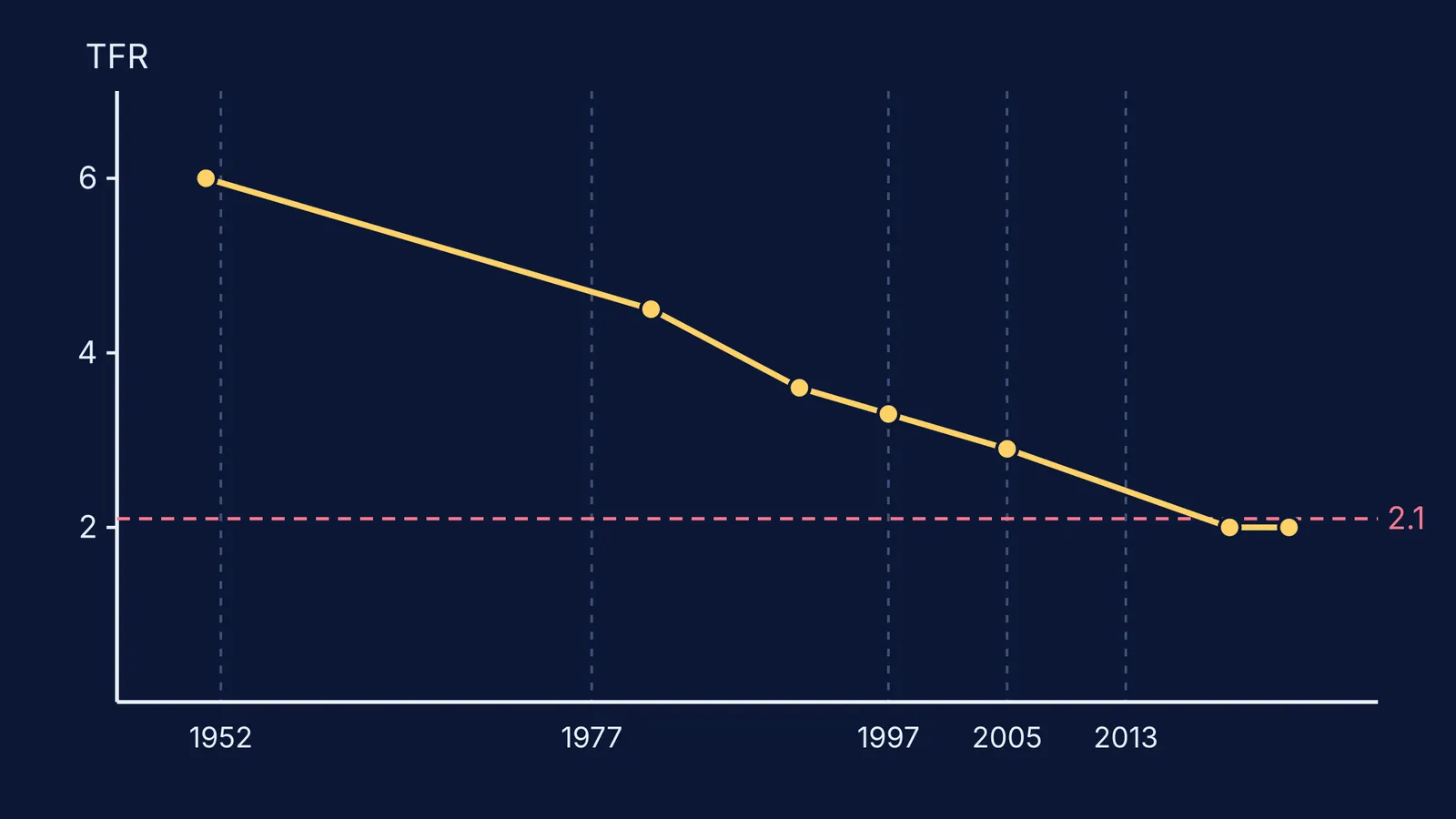
The results came slowly. Total fertility fell from 6.0 in 1951 to 3.2 in 1998, and infant mortality fell from 146 per 1,000 live births in 1951-61 to 70 in 1999, according to the Economic Survey 2001-02. The NHM records fertility falling from 2.9 in 2005 to 2.1 in 2019 and 2.0 in 2020, so replacement level arrived about a decade after the 2010 goal.
Where does India stand now?
India's total fertility rate is 2.0 children per woman: 1.6 in towns and cities and 2.1 in villages, according to the provisional NFHS-6 India fact sheet (2023-24)%202023-2024%20Fact%20Sheets.pdf). The same survey shows three gaps:
69.1% of married women use some family planning method, but female sterilisation (36.5%) still dwarfs male sterilisation (0.5%).
20.1% of women aged 20-24 married before 18, down from 23.3% in NFHS-5.
8.5% of married women have an unmet need for family planning.
How do you remember the RCH timeline for NEET?
Learn it as a chain of seven years, each with one word attached:
1952: start
1977: welfare
1996: no targets
1997: RCH
2000: population policy
2005: NRHM
2013: life cycle
Then test yourself without looking. What does the C in RCH stand for? (Child.) What changed in 1996? (Method-specific targets ended.) Which conference led to RCH? (Cairo, 1994.)
If terms like contraception or infertility are blurry, the Fermi Concept Library gives every biology concept its own lesson and its place in the map. Then work through our reproductive health NCERT numbers for NEET, the common mistakes in reproductive health, and the six features of an ideal contraceptive.


