

On this page
This set follows our first set of ray optics JEE Main practice questions and tests sub-topics that set left out.
How should you use this ray optics set?
Every question stays inside Unit 16 of NTA's Syllabus for JEE (Main) - 2027 and NCERT Class 12 Physics Chapter 9, Ray Optics and Optical Instruments (Reprint 2026-27).
Allow 25 minutes, on paper, no calculator.
Sketch the rays before any formula.
Write u, v, f and R with signs, and read every trap line.
New to the chapter? Start with how to prepare ray optics for JEE Main.
Easy: can you handle plane mirrors, total internal reflection and convex mirrors?
Q1 (easy). Riya is 1.70 m tall and her eyes are 10 cm below the top of her head. The shortest wall mirror in which she sees her whole body, and the height of its lower edge, are:
(A) 0.85 m, 0.80 m (B) 1.70 m, 0 m (C) 0.85 m, 0.85 m (D) 0.80 m, 0.85 m
Answer: (A). Light from her feet reflects at half her eye height, 0.80 m; light from her head reflects halfway between head and eyes, 1.65 m. So the mirror runs from 0.80 m to 1.65 m: 0.85 m long, half her height. Trap: (C), which halves her height for the edge too and ignores where her eyes are.
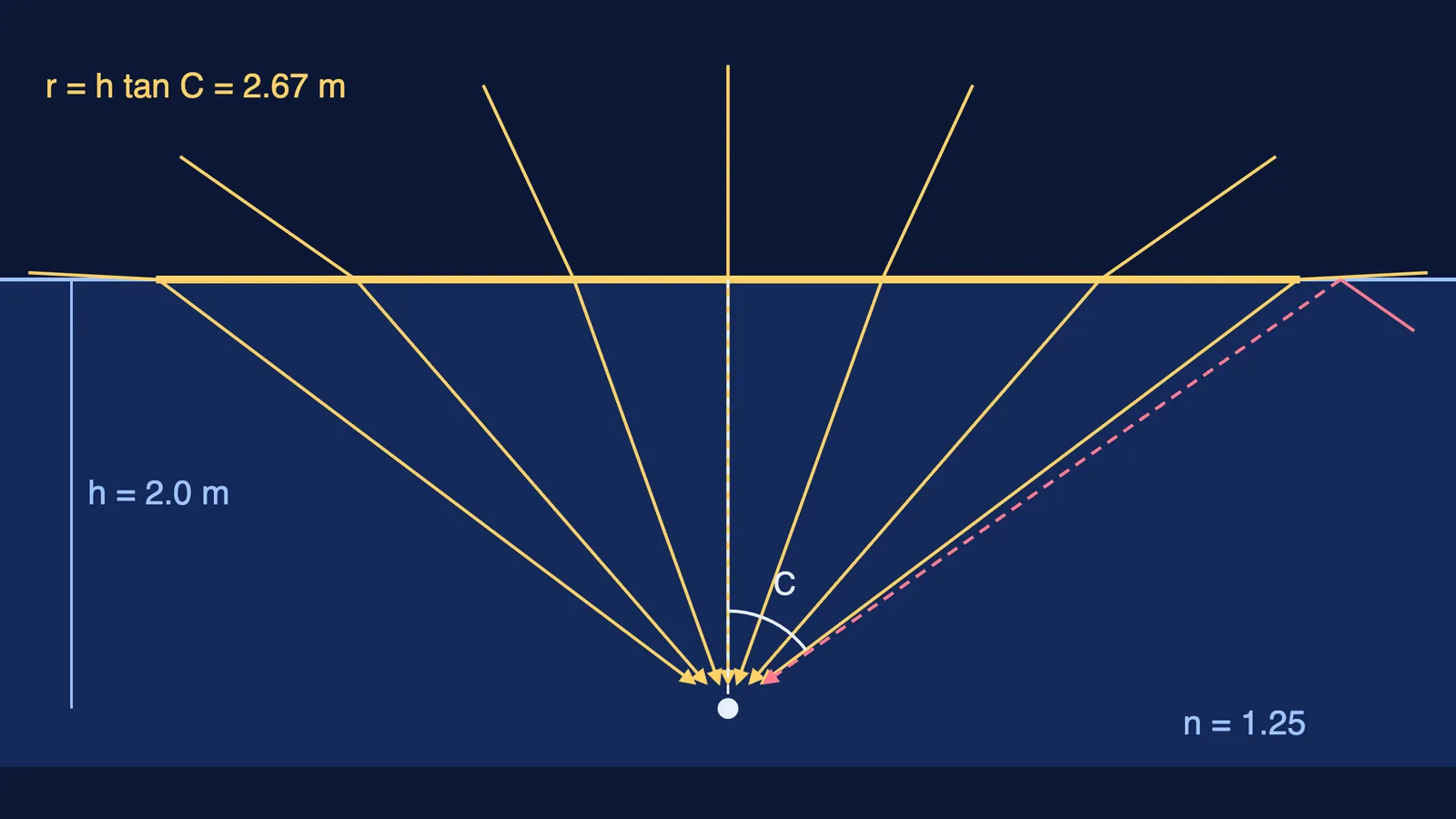
Q2 (easy). A diver's eye is 2.0 m below the calm surface of a liquid of refractive index 1.25. She sees everything above the surface through a bright circle of radius:
(A) 1.6 m (B) 1.5 m (C) 2.67 m (D) 3.33 m
Answer: (C). Grazing light enters at the critical angle C, where sin C = 1/1.25 = 0.8, so tan C = 4/3. The radius is h tan C = 2.0 × 4/3 = 2.67 m. Trap: (B), which uses h/tan C.
Q3 (easy). A car 12 m behind a scooter appears 1/25 of its size in the scooter's convex mirror. The radius of curvature of the mirror is:
(A) 1.0 m (B) 0.5 m (C) 0.92 m (D) 0.96 m
Answer: (A). For a mirror, m = f/(f − u). With u = −12 m and m = +1/25, f/(f + 12) = 1/25, so 24f = 12 and f = +0.5 m. Then R = 2f = 1.0 m. Trap: (B), which stops at the focal length when the question asks for R.
Medium: can you work through prisms, lens pairs and magnifiers?
Q4 (medium). A ray enters a prism of refracting angle 30° (n = 1.5) along the normal to its first face. Its angle of deviation is about:
(A) 18.6° (B) 15° (C) 48.6° (D) 30°
Answer: (A). At normal incidence i = 0 and r1 = 0, so r2 = A = 30°. At the second face, sin e = 1.5 × sin 30° = 0.75, so e ≈ 48.6°. Then δ = i + e − A = 0 + 48.6° − 30° ≈ 18.6°. Trap: (B), the thin-prism result (n − 1)A, which fails for a 30° prism.
Q5 (medium). A plano-convex lens (n = 1.5) and a plano-concave lens (n = 1.7) have curved faces of the same radius, 20 cm, and fit together. The focal length of the pair is:
(A) −100 cm (B) infinite: it is just a slab (C) +100 cm (D) +16.7 cm
Answer: (A). By the lens maker formula, P1 = (1.5 − 1)/20 and P2 = −(1.7 − 1)/20 per cm. In contact the powers add: P = (0.5 − 0.7)/20 = −1/100 per cm, so f = −100 cm. Trap: (B), which assumes the shapes cancel.
Q6 (medium). A watchmaker uses a convex lens of power +12.5 D as a simple microscope, with the final image at the near point, D = 25 cm. How far from the lens is the watch part, and what is the angular magnification?
(A) 6.06 cm, 4.1 (B) 8.0 cm, 3.1 (C) 6.06 cm, 3.1 (D) 11.8 cm, 2.1
Answer: (A). The focal length is 1/12.5 m = 8 cm. With v = −25 cm, 1/u = 1/v − 1/f = −1/25 − 1/8 = −33/200, so u ≈ −6.06 cm. At the near point the magnification is 1 + D/f = 1 + 25/8 ≈ 4.1. Trap: (C), which uses D/f, the value for a final image at infinity.
Hard: can you track images through two elements?
Q7 (hard, numerical value). Convex lenses of focal lengths 10 cm and 15 cm are coaxial, 40 cm apart. An object stands 15 cm in front of the first lens. What is the magnitude of the overall magnification?
Answer: 6. The first lens gives 1/v = 1/10 − 1/15, so v1 = +30 cm and m1 = 30/(−15) = −2. That image is 10 cm in front of the second lens, so u2 = −10 cm and 1/v = 1/15 − 1/10 gives v2 = −30 cm, with m2 = (−30)/(−10) = 3. Overall m = −2 × 3 = −6. Trap: 0.67, which treats the lenses as if they were in contact.
Q8 (hard). A glass slab 9 cm thick (n = 1.5) stands between a concave mirror of focal length 10 cm and a small object 23 cm from the mirror, with its faces parallel to the mirror. Where is the final image?
(A) 23 cm from the mirror, on the object (B) 20 cm from the mirror (C) 17 cm from the mirror (D) 17.7 cm from the mirror
Answer: (A). The slab shifts the object towards the mirror by t(1 − 1/n) = 9 × (1/3) = 3 cm, so the mirror sees it at 20 cm, which is its centre of curvature. The returning light crosses the slab again, which moves its focus 3 cm further along its path, to 23 cm. Trap: (B), which applies the shift on the way in but forgets the return trip.
What should you do after this set?
Sort each miss as set-up (Q1, Q2, Q8), formula choice (Q4, Q5, Q6) or sign (Q3, Q7), and revise the biggest group first. If you cannot see where your working went wrong, the Fermi Problem Library has worked problems with a step-by-step solver that explains the reasoning rather than printing an answer.


