

On this page
The "royal disease" is the classic textbook example of X-linked recessive inheritance, and the easiest way to understand it is to draw it. In 2009, Rogaev and colleagues reported in Science that DNA from Romanov remains carried a mutation in F9, the X-chromosome gene for clotting factor IX. They concluded that the royal disease was a severe form of haemophilia B. Below, we walk through the family one generation at a time, then turn it into a practice pedigree. If the squares and circles are new, first read what the symbols in a pedigree chart mean.
What does X-linked recessive mean?
Haemophilia A and haemophilia B are inherited in an X-linked recessive pattern, according to MedlinePlus Genetics from the US National Library of Medicine. A male has one X chromosome, so one altered copy of the gene is enough to cause the condition. A female has two X chromosomes, so one altered copy usually makes her a carrier rather than affected, although some carriers do have abnormal bleeding. MedlinePlus states the key rule plainly: fathers cannot pass X-linked traits to their sons. That is because a son always gets his father's Y. Haemophilia B occurs in about 1 in 20,000 newborn males worldwide, the same page says.
How did haemophilia pass through Queen Victoria's family?
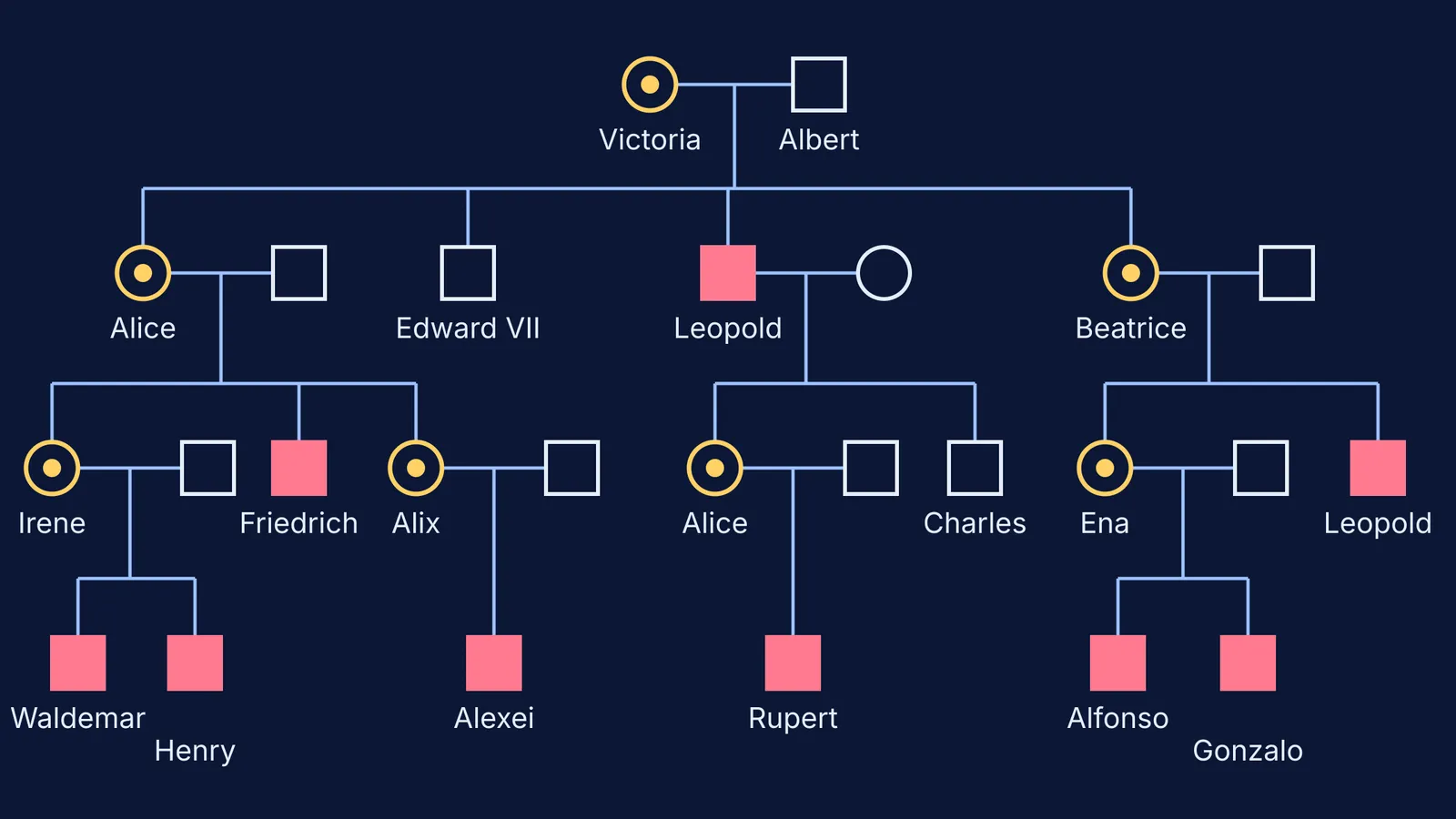
The names and dates below come from the Wikipedia summary of haemophilia in European royalty; the Russian branch is confirmed by the DNA study above.
Generation I: Queen Victoria (1819-1901) was a carrier. No earlier case is known in her family, so the summary describes it as most likely a new mutation inherited from one of her parents.
Generation II: her youngest son, Leopold, Duke of Albany (1853-1884), was affected. Her sons Edward VII, Alfred and Arthur were not. Her daughters Alice and Beatrice were carriers.
Generation III: Alice's son Friedrich (1870-1873) was affected and her daughters Irene and Alix were carriers. Beatrice's son Leopold Mountbatten was affected and her daughter Victoria Eugenie (Ena) was a carrier. Leopold's daughter Alice, Countess of Athlone, was a carrier.
Generation IV: Irene's sons Waldemar and Henry of Prussia, Alix's son Tsarevich Alexei, Alice of Athlone's son Rupert, and Ena's sons Alfonso and Gonzalo of Spain were all affected.
The Science paper checked the Russian line directly. Rogaev's team found both normal and mutant copies of F9 in Empress Alexandra (Alix), typical of a carrier; only the mutant copy in Alexei; and one of his sisters, presumed to be Anastasia, was also a carrier.
Why is there no male-to-male transmission in the royal pedigree?
Prince Leopold is the test case. He had haemophilia, and his son Charles Edward, born four months after Leopold died, did not, while his daughter Alice inherited the gene and passed it to her son Rupert, as Leopold's biography records. That is exactly what the X-linked rule predicts. Leopold gave his only X to his daughter, so she had to be a carrier, and his Y to his son, so the son was safe.
Across the whole chart, every affected person is male, every affected boy got the gene from his mother, and the trait skips generations through carrier daughters. Together, that is the signature of X-linked recessive inheritance. To compare it with autosomal patterns, read how to tell if a pedigree is dominant or recessive.
How do you solve a pedigree like this in an exam?
Use this five-step checklist on any chart:
Count who is affected. Mostly or only affected males point towards X-linked recessive.
Look for father-to-son transmission. If you find it, rule out X-linked.
Check the daughters of affected males. Under X-linked recessive, every one of them must carry the allele: a carrier, or affected if her mother also carried it.
Check whether affected sons have unaffected parents. If yes, the trait is recessive.
Write genotypes beside every symbol: X^H Y, X^h Y, X^H X^H, X^H X^h or X^h X^h.
Now practise on the royal family. Cover the answers first.
Ena (X^H X^h) married Alfonso XIII (X^H Y). Chance each son is affected? Answer: 1/2, and each daughter is a carrier with chance 1/2.
Leopold (X^h Y) married Helen (assume X^H X^H). What about their children? Answer: every daughter a carrier, no son affected.
Why could Edward VII not pass on Victoria's mutation? Answer: he was X^H Y, with no h allele to give.
For more crosses of this kind, work through how to solve X-linked crosses for colour blindness and haemophilia.
If the jump from chromosomes to genotypes still feels shaky, the Fermi Concept Library covers every concept in biology, each with its own lesson. And when you get a pedigree question wrong, the Fermi Problem Library has worked problems with a step-by-step solver that explains the reasoning rather than printing an answer.
This chart is a history lesson, not medical guidance: if haemophilia runs in your family, talk to a doctor or genetic counsellor.
Next step: redraw the four generations from memory, mark every carrier, and check yourself against the list above.


