

On this page
When a factory coats a lens, a solar cell or a chip with a metal film a few nanometres thick, someone has to know how thick the film is while it is still being deposited. No ordinary balance can weigh a nanometre of gold. A quartz crystal microbalance can. It is a thin quartz plate vibrating at about 5 MHz, and every bit of mass that lands on it lowers that frequency by a tiny, countable amount. The physics is a standing wave with half a wavelength across the plate.
How does a quartz plate vibrate in a microbalance?
The crystal is a thin disc of AT-cut quartz with a metal electrode on each face. Quartz is piezoelectric, so an alternating voltage on the electrodes makes it deform, and the deformation in turn produces a voltage. How that effect was found is told in Pierre Curie and piezoelectricity. Here it only drives and senses the vibration. The weighing itself is pure mechanics.
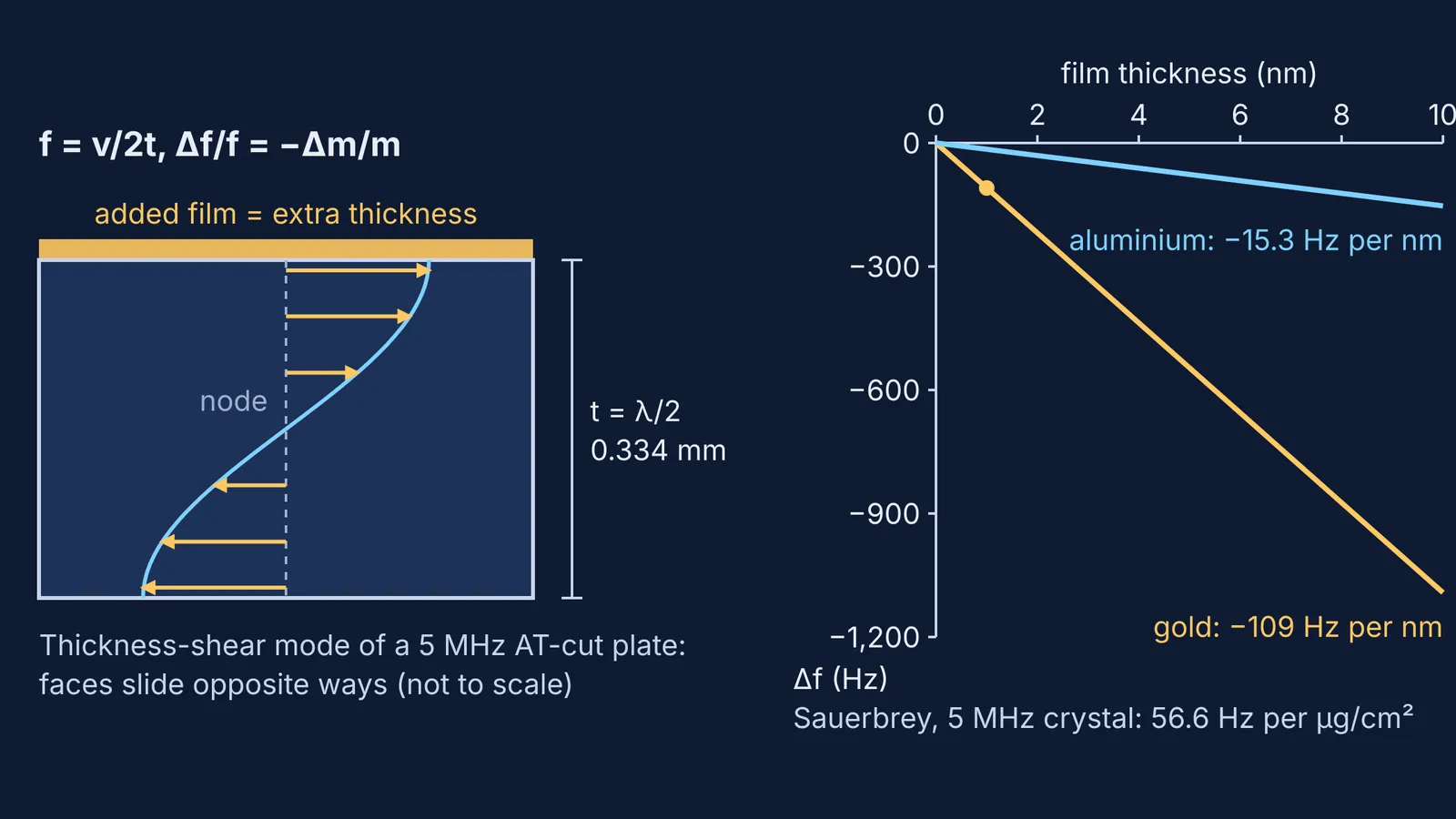
The plate vibrates in thickness shear. The two faces slide sideways in opposite directions, and the middle plane stays still. A shear wave runs back and forth across the thickness t, and both faces are free, so both are antinodes. The lowest mode has half a wavelength across the plate, just like the fundamental of a pipe open at both ends, which you can compare with open and closed pipe harmonics:
f = v/2t
where v is the speed of shear waves in quartz.
This is a different job from the quartz in a wristwatch. As why watches use a quartz crystal explains, a watch needs a frequency that never changes. A microbalance wants a frequency that changes in a precise way when mass is added.
How thick is a 5 MHz crystal?
The shear wave speed is v = √(μ/ρ). Stanford Research Systems, which makes QCM instruments, gives ρ = 2.648 g/cm³ and μ = 2.947 × 10¹¹ g cm⁻¹ s⁻² for AT-cut quartz. In SI units that is ρ = 2,648 kg/m³ and μ = 2.947 × 10¹⁰ Pa.
v = √(2.947 × 10¹⁰ ÷ 2,648) = 3,336 m/s.
t = v/2f = 3,336 ÷ (2 × 5 × 10⁶) = 3.34 × 10⁻⁴ m = 0.334 mm.
Mass of quartz per area: m = ρt = 2,648 × 3.34 × 10⁻⁴ = 0.883 kg/m², which is 88.3 mg per cm².
So the plate is about a third of a millimetre thick, and every square centimetre of it holds 88.3 mg of quartz.
Why does added mass lower the frequency?
A thin, rigid film stuck to the face moves with the face. To the wave it looks like a little more quartz: the plate is effectively thicker. Since f = v/2t, a thicker plate has a lower frequency.
Take logs and differentiate: Δf/f = −Δt/t. The mass per area of the plate is m = ρt, so Δt/t = Δm/m. That gives
Δf/f = −Δm/m, or Δf = −(f/m) × Δm.
Put in m = ρv/2f and √(ρμ) = ρv, and you get the Sauerbrey equation:
Δf = −2f² Δm / √(ρμ).
The constant 2f²/√(ρμ) is the sensitivity factor. For f = 5 MHz it works out to 56.6 Hz per µg/cm², the same value SRS quotes in its QCM theory note. That is 0.0566 Hz for every nanogram on each square centimetre. Note the minus sign: the frequency falls as mass is added. It never rises.
The sensitivity goes as f². A 6 MHz crystal is thinner (0.278 mm) and gives 81.5 Hz per µg/cm², 1.44 times as much. Thinner crystals are more sensitive but more fragile.
Worked example: how much does 1 nm of gold shift the frequency?
A 5 MHz crystal sits in an evaporator next to a lens being coated with gold (density 19.3 g/cm³).
Mass per area of 1 nm of gold. Δm = ρ × thickness = 19.3 g/cm³ × 1 × 10⁻⁷ cm = 1.93 × 10⁻⁶ g/cm² = 1.93 µg/cm².
Frequency shift. Δf = −56.6 × 1.93 = −109 Hz.
New frequency. 5,000,000 Hz → about 4,999,891 Hz. A second nanometre takes it to about 4,999,782 Hz.
Same layer of aluminium (2.70 g/cm³): 0.270 µg/cm², so Δf = −15.3 Hz. Denser films give bigger shifts per nanometre.
Resolution. A counter that resolves 0.1 Hz detects 0.1 ÷ 0.0566 = 1.8 ng/cm². One atomic layer of gold, about 0.24 nm thick, is roughly 450 ng/cm², so the crystal sees well under a hundredth of a layer.
Now run it backwards. During an aluminium coating the frequency falls by 350 Hz. The mass per area is 350 ÷ 56.6 = 6.18 µg/cm², and the thickness is 6.18 × 10⁻⁶ ÷ 2.70 = 2.29 × 10⁻⁶ cm, or 22.9 nm. The crystal measures mass per area; you need the film's density to turn that into thickness.
When does the Sauerbrey equation stop working?
The equation assumes a thin film that is rigid and moves exactly with the face. SRS states it is accurate for thin films when the frequency change is less than 2% of the unloaded crystal's frequency. For a 5 MHz crystal that is 100 kHz, about 1.77 mg/cm², or roughly 0.9 µm of gold. Beyond that the film's own elastic properties matter, and instruments apply a correction (SRS calls it the Z-factor).
Soft films, such as polymers, and crystals working in a liquid also lose energy to friction. The vibration is damped, and Δf no longer measures mass alone, so other formulas are needed. Sauerbrey's original analysis was for rigid films in air or vacuum.
The concept of standing waves with fixed and free ends is set out step by step in the Concept Library, if you want to revise it before tackling questions like these.
Quick checklist
Thickness-shear mode: half a wavelength across the plate, f = v/2t, with v = √(μ/ρ) = 3,336 m/s for AT-cut quartz.
A 5 MHz crystal is 0.334 mm thick and carries 88.3 mg of quartz per cm².
Sauerbrey: Δf/f = −Δm/m, or Δf = −2f²Δm/√(ρμ); 56.6 Hz per µg/cm² at 5 MHz.
1 nm of gold lowers a 5 MHz crystal by 109 Hz; 1 nm of aluminium by 15.3 Hz.
Sensitivity goes as f².
Valid for thin, rigid films with a frequency shift under about 2%.


