

On this page
For centuries, watchmakers relied on a mechanical balance wheel swinging back and forth to keep time. Today, almost every watch in the world relies on a tiny, tuning-fork-shaped piece of quartz crystal.
Why quartz? The answer lies in a property of the crystal that allows it to act as an incredibly stable electronic metronome, beating exactly 32,768 times every second.
How does the piezoelectric effect work?
Piezoelectricity is the property of certain materials to convert mechanical stress into electricity, and to convert an electrical voltage into mechanical movement.
The direct piezoelectric effect was discovered in 1880 by brothers Jacques and Pierre Curie. They found that when they applied mechanical weight to crystals such as quartz, topaz, and Rochelle salt, positive and negative electrical charges appeared on opposite faces of the crystal. The amount of charge was directly proportional to the applied pressure. The following year, they proved the reverse effect: applying a voltage across the crystal makes it physically change shape.
In a modern watch, a small battery sends an electric current to the quartz crystal. The reverse piezoelectric effect causes the crystal to deform and vibrate. As it vibrates, the direct piezoelectric effect generates a tiny, oscillating electrical signal. Because quartz is a very hard mineral, it vibrates at a highly stable frequency regardless of normal temperature changes or the position of the watch, making it far more accurate than a mechanical spring.
Why do quartz watches use exactly 32,768 Hz?
Watchmakers cut the quartz crystal into a microscopic tuning fork tailored to vibrate exactly 32,768 times per second (Hz).
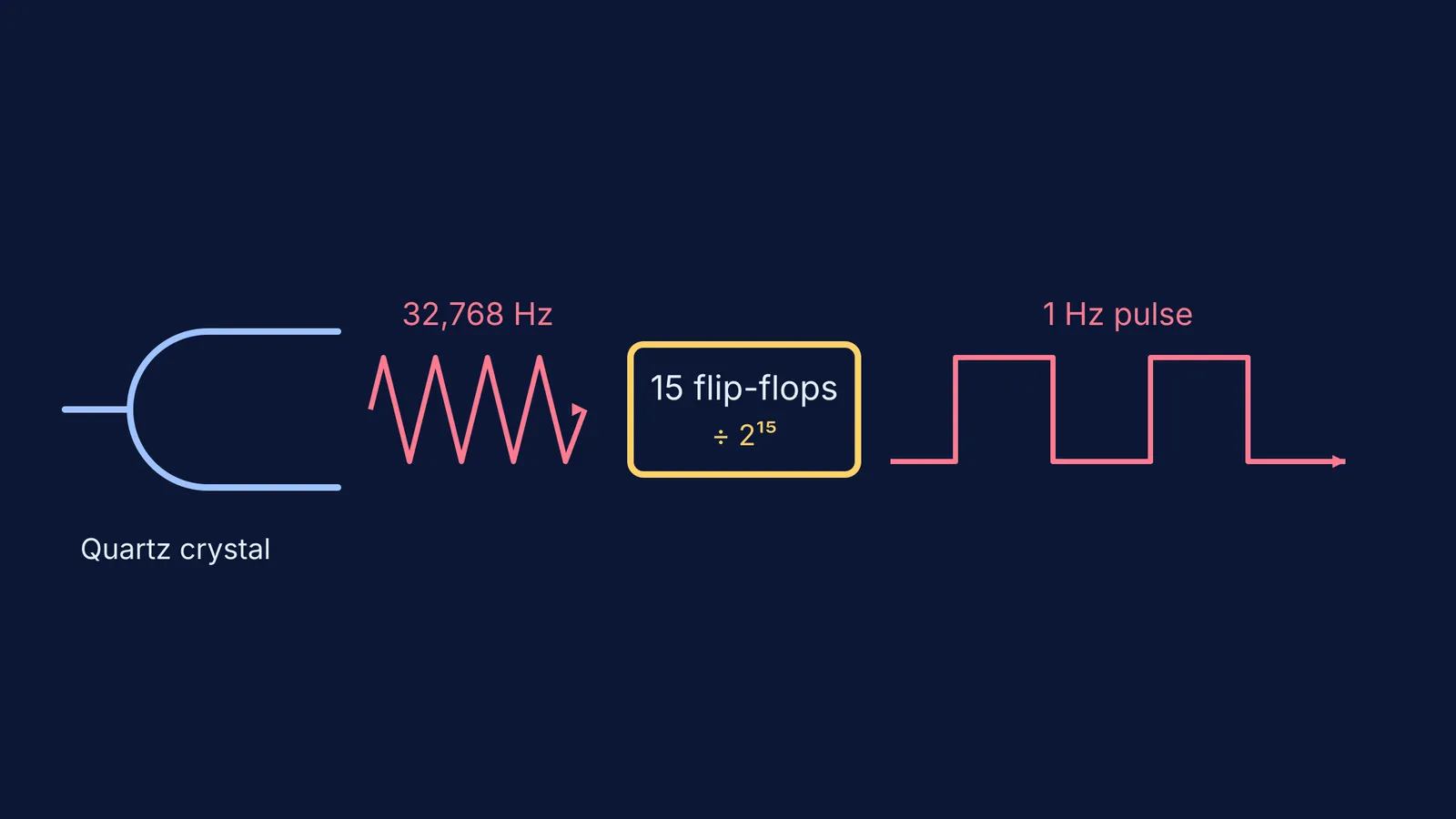
This specific frequency was chosen because of the way simple digital circuits count. The number 32,768 is exactly 2¹⁵. A digital component called a flip-flop circuit divides the frequency of an incoming signal by two. By chaining 15 flip-flop circuits together in a series, the watch repeatedly halves the frequency until the signal reaches exactly 1 Hz.
How does the watch circuit count one second?
Understanding how a watch turns a high-frequency vibration into a one-second tick is a great worked example of binary logic. Here is the step-by-step process happening inside the integrated circuit on your wrist:
The oscillator: The battery applies a voltage, and the quartz tuning fork oscillates at 32,768 Hz.
The input signal: This mechanical vibration generates a weak, alternating electrical signal at the same frequency.
The amplifier: An amplifier circuit boosts this weak signal into a clear, square-wave electrical pulse.
The divider chain: The signal enters a chain of 15 flip-flop circuits. Each circuit requires two input pulses to produce one output pulse, effectively dividing the frequency by 2.
The halving process: The frequency steps down exponentially (16,384 Hz, 8,192 Hz, 4,096 Hz) until the 15th circuit outputs a 1 Hz pulse.
The output: In an analogue watch, this pulse drives a tiny stepper motor that pushes the gears exactly one second forward. In a digital watch, it updates the time on the screen.
If you are exploring the physics of waves, oscillations and electric circuits, it helps to see them in action. In the Fermi Simulation Lab, you can manipulate frequencies and watch how wave properties change in real time, rather than just reading about them.
When was the first quartz watch made?
The first quartz clock was built in 1927 at Bell Labs by Joseph W. Horton and Warren A. Marrison. However, it was the size of a large piece of furniture. During the 1960s, a fierce race began between watchmakers in Japan and Switzerland to miniaturize this technology into a device small enough to wear on the wrist and efficient enough to run on a tiny battery.
On 25 December 1969, Seiko launched the world's first commercial quartz wristwatch, the Seiko Quartz Astron 35SQ. It was roughly 100 times more accurate than mechanical watches of the era. However, it was highly exclusive, costing as much as a medium-sized car, and its crystal vibrated at 8,192 Hz.
In 1971, the Swiss watchmaker Girard-Perregaux introduced a quartz movement that vibrated at 32,768 Hz. This frequency proved so reliable and efficient that it was quickly adopted by manufacturers globally, becoming the universal standard that still runs the watches we wear today.


