

On this page
Close your eyes, stretch one arm out to the side, and bring your fingertip to the tip of your nose. Most people get close without a single glance. Something other than vision is telling your brain where your hand is: proprioception.
What is proprioception?
Proprioception is the sense of where your body parts are and how they are moving, without looking at them. A 2012 review in Physiological Reviews by Uwe Proske and Simon Gandevia describes proprioceptive receptors in the skin, muscles and joints, and explains that limb position is signalled by whole populations of nerve fibres rather than by any single receptor (Proske and Gandevia, 2012). The same review notes that these senses decline with age and that the decline is linked to a higher risk of falls in older people.
Three kinds of sensor do most of the work (Kenhub):
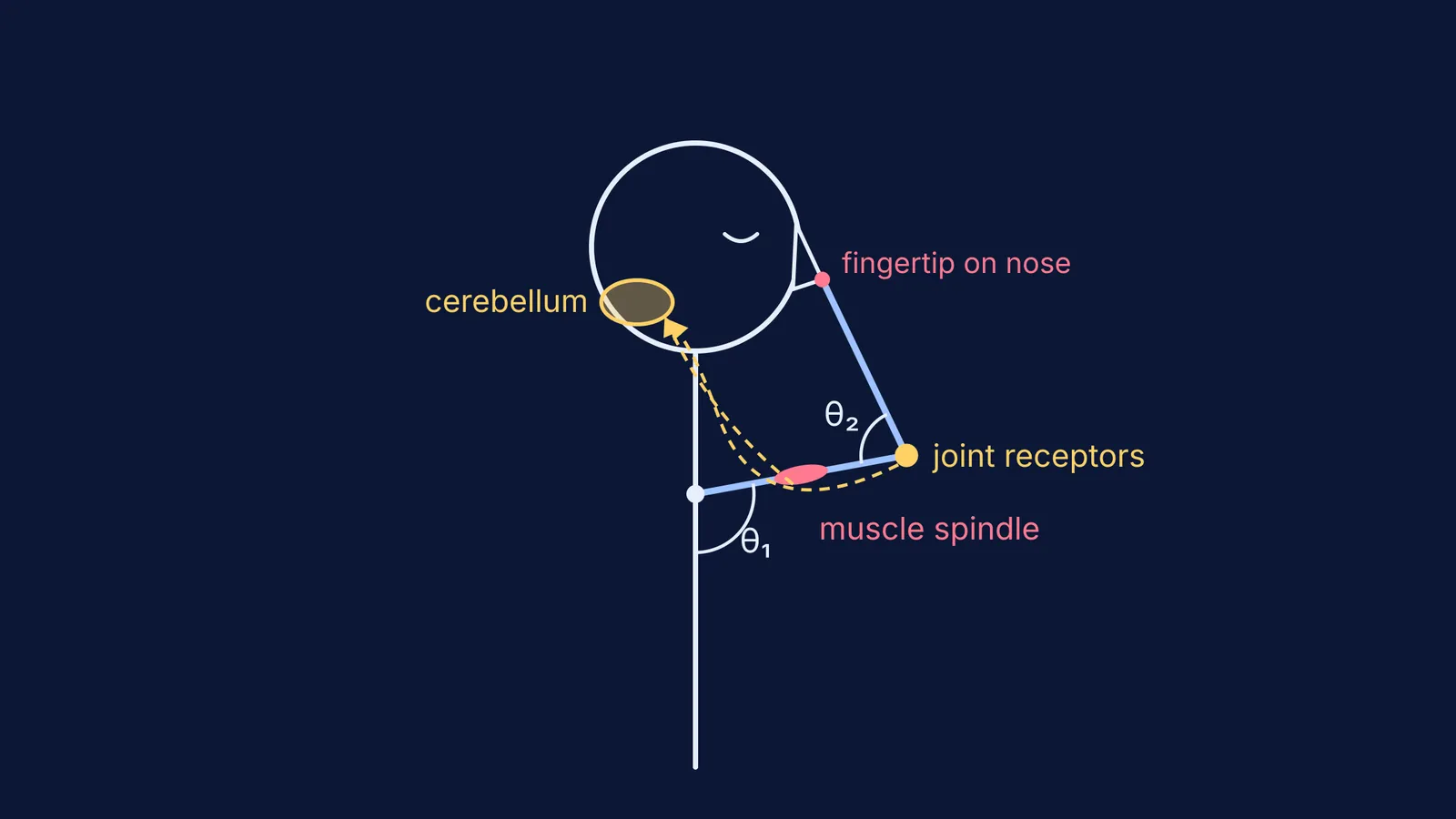
Muscle spindles sit inside the muscle and respond to changes in muscle length and how fast it is stretching.
Golgi tendon organs sit where muscle meets tendon and respond to the tension a contracting muscle produces.
Joint receptors detect joint angle, pressure and movement.
Their signals travel up the spinal cord by two routes. The dorsal column pathway carries conscious position sense to the cerebral cortex, and the spinocerebellar tracts carry unconscious signals to the cerebellum (Kenhub).
How can you touch your nose with your eyes closed?
Think of your arm as a chain of two rods: the upper arm and the forearm. If your brain knows the angle at your shoulder, the angle at your elbow and the length of each rod, the position of your fingertip follows by plain geometry. Muscle spindles in muscles such as your biceps and triceps report how stretched each muscle is, which helps tell the brain the elbow angle. Your nose is part of the same body map, so the brain can steer the fingertip towards it.
Here is a worked example of why accuracy matters. Suppose the distance from your elbow to your fingertip is 40 cm and your brain misjudges the elbow angle by 5 degrees. The fingertip moves along an arc, so the error is arc length = radius × angle in radians = 40 × (5 × π/180), which is about 3.5 cm. That could be enough to land on your cheek instead of your nose.
What does the cerebellum do in proprioception?
Nerve signals take time to arrive, so controlling a moving arm needs prediction as well as sensing. Researchers at Johns Hopkins tested 11 people with cerebellar damage and 11 matched controls in a robotic arm rig, with the arm hidden from view (Bhanpuri, Okamura and Bastian, 2013). When the robot moved the arm, both groups judged its position about equally well. When people moved the arm themselves, 64% of controls but only 18% of patients showed a significant improvement (full text). The authors concluded that the cerebellum predicts the outcome of a movement, and that this prediction sharpens your sense of position during movement.
This is why doctors use a finger-to-nose test in a cerebellar exam: the patient fully extends an arm and then touches their nose, and an abnormal result is called dysmetria (Stanford Medicine 25). For more on this part of the brain, see our explainer on what the cerebrum, cerebellum and medulla each do and how the cerebellum builds muscle memory for motor skills.
Three proprioception tests you can try at home
Do these with a friend or parent watching, on a clear floor.
Nose touch. Eyes closed, arm straight out to the side, then touch your nose tip with your index finger. Do it five times with each hand, slowly. Your partner notes where each touch lands.
Mirror match. With your eyes closed, your partner bends one of your arms into a position. Copy it with the other arm, then open your eyes and compare. With vision removed, you are relying on proprioception.
Feet-together stand. Stand next to a wall with feet together and arms by your sides, eyes open, then close your eyes while your partner stands close. This is the idea behind Romberg's test, which checks position sense; the clinical version is watched for a full minute (Romberg's test; Khasnis and Gokula, 2003). Removing vision makes you rely on proprioception and your inner ear.
How does proprioception connect to other biology topics?
Proprioception ties together several nervous-system ideas: receptors, sensory pathways, reflexes and the cerebellum. The muscle spindle is also the sensor behind the stretch reflex in our post on the knee-jerk reflex. If the pathways or the cerebellum's role still feel fuzzy, the Fermi Concept Library gives each biology concept its own lesson and shows where it sits in the map of related ideas.
Try the nose test tonight with your eyes shut, then explain to someone at home which sensors just did the work.


