

On this page
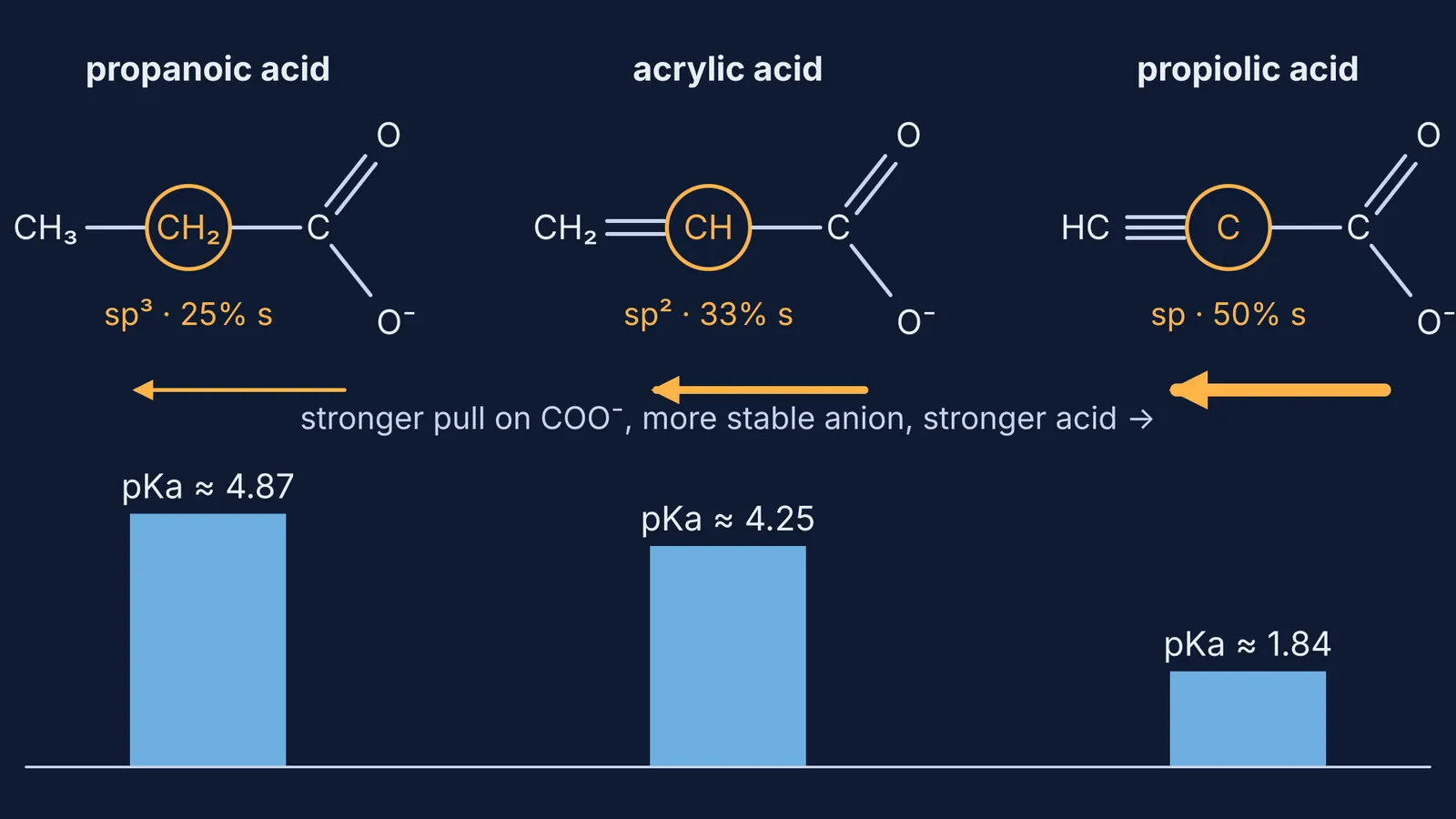
Propanoic acid, acrylic acid and propiolic acid all have three carbons and one COOH group. The only real difference is the carbon joined to the COOH group, the α-carbon. In propanoic acid it is sp³, in acrylic acid it is sp², and in propiolic acid it is sp. That one change takes the pKa from about 4.87 down to about 1.84. Propiolic acid is a weak acid, but it is far stronger than acetic acid, and it is a favourite JEE example of hybridisation controlling acidity.
Which acid is stronger: propanoic, acrylic or propiolic acid?
Approximate literature pKa values at 25 °C (tables differ by a few hundredths):
Propanoic acid, CH₃CH₂COOH: α-carbon sp³, pKa about 4.87
Acrylic acid (prop-2-enoic acid), CH₂=CH–COOH: α-carbon sp², pKa about 4.25
Propiolic acid (prop-2-ynoic acid), HC≡C–COOH: α-carbon sp, pKa about 1.84 (some tables give 1.89)
So the order of acid strength is propiolic > acrylic > propanoic. A lower pKa means a larger Ka. Each pKa unit is a factor of 10 in Ka, so:
Acrylic vs propanoic: 4.87 − 4.25 = 0.62, and 10^0.62 ≈ 4.2. Acrylic acid is about 4 times stronger.
Propiolic vs propanoic: 4.87 − 1.84 = 3.03, and 10^3.03 ≈ 1,070. Propiolic acid is about 1,000 times stronger.
Watch the names. Propiolic acid has a triple bond. Propionic acid is just the old name for propanoic acid. One letter changes the answer by a factor of a thousand.
Why does s-character make the α-carbon more electronegative?
An s orbital holds its electrons closer to the nucleus than a p orbital does. An sp hybrid is 50% s, an sp² hybrid is about 33% s, and an sp³ hybrid is 25% s. The more s-character a carbon uses in a bond, the more tightly it holds the bonding electrons, so the more electronegative it behaves. This is worked out with C–H acidity (ethane, ethene, ethyne) in why sp carbon is more electronegative than sp³ carbon.
The same idea explains the three acids. The bond between the α-carbon and the carboxyl carbon uses an sp³, sp² or sp hybrid from the α-carbon. An sp carbon pulls the shared electrons towards itself more strongly. In group terms, ethynyl (HC≡C–) is an electron-withdrawing group, vinyl (CH₂=CH–) is weakly withdrawing, and ethyl (CH₃CH₂–) is weakly electron-donating.
How does the inductive effect stabilise the carboxylate ion?
An acid is stronger when its conjugate base is more stable. When the acid loses H⁺, the negative charge is shared between the two oxygen atoms of COO⁻.
In propiolate, HC≡C–COO⁻, the sp carbon pulls electron density away from COO⁻ through the σ bond. The negative charge is spread over more of the ion, so the ion is more stable. This is a −I effect.
In propanoate, CH₃CH₂–COO⁻, the ethyl group pushes a little electron density towards COO⁻ (+I). That concentrates the charge, so the ion is less stable than acetate, and propanoic acid (4.87) is slightly weaker than acetic acid (about 4.76).
The order of −I and +I groups, checked against pKa data, is in the order of inductive effect of groups. Ethynyl and vinyl fit into that list as electron-withdrawing groups, ethynyl the stronger of the two.
Is it resonance with the C=C or C≡C instead?
No. This is a common wrong answer. The negative charge of a carboxylate sits on the O–C–O unit, and no reasonable resonance structure moves it onto the C=C or C≡C. Conjugation of the multiple bond with C=O also stabilises the neutral acid, not only the anion, so it does not favour ionisation. The extra strength comes from the inductive pull of the more electronegative α-carbon.
Worked example: rank four acids by strength
Rank these from strongest to weakest: cyclohexanecarboxylic acid (pKa about 4.90), benzoic acid (about 4.20), acrylic acid (about 4.25) and propiolic acid (about 1.84).
Find the α-carbon in each. Cyclohexanecarboxylic acid: a ring CH, sp³. Benzoic acid: a ring carbon, sp². Acrylic acid: CH=, sp². Propiolic acid: C≡, sp.
Put the sp acid first. Propiolic acid, with 50% s-character, is by far the strongest.
Next come the two sp² acids. Benzoic and acrylic acid differ by only about 0.05 pKa units. That is a factor of about 1.1 in Ka, too small to argue from theory. Use the data: benzoic is very slightly stronger, but treat the two as roughly equal.
Last is the sp³ acid. Cyclohexyl is an alkyl group with a +I effect, so cyclohexanecarboxylic acid is the weakest, close to propanoic acid.
Answer: propiolic > benzoic ≈ acrylic > cyclohexanecarboxylic.
The comparison of benzoic acid with formic and acetic acid is covered in acidity order of formic, acetic and benzoic acid.
What is the pH of 0.10 M propiolic acid?
Take Ka = 10^−1.84 ≈ 1.45 × 10⁻².
Try the shortcut. [H⁺] ≈ √(Ka × C) = √(1.45 × 10⁻² × 0.10) ≈ 0.038 M. That would mean 38% of the acid has ionised.
Check the 5% rule. 38% is far above 5%, so the assumption that C − x ≈ C fails. You must solve the full equation.
Set up the quadratic. HC≡C–COOH ⇌ HC≡C–COO⁻ + H⁺, so Ka = x² / (0.10 − x), which gives x² + 0.01445x − 0.001445 = 0.
Solve. x = [−0.01445 + √(0.01445² + 4 × 0.001445)] / 2 ≈ 0.0315 M.
Find pH. pH = −log(0.0315) ≈ 1.50. About 31% of the acid is ionised.
The shortcut gives pH 1.42, which is wrong in the first decimal place. For comparison, 0.10 M propanoic acid (Ka ≈ 1.35 × 10⁻⁵) has pH about 2.94 and is only about 1.2% ionised, so there the shortcut works. If you want to go the other way, from a measured pH to Ka, see how to find Ka from the pH of a weak acid.
When a question mixes acidity order with a pH calculation, the Fermi Problem Library has a step-by-step solver that explains the reasoning, including when the 5% check fails.
Does the effect weaken as the triple bond moves away?
Yes. The inductive effect falls off quickly along a chain of σ bonds. If a CH₂ group sits between the triple bond and COOH, as in but-3-ynoic acid (HC≡C–CH₂–COOH), the α-carbon is sp³ again and the sp carbon is one bond further away. The acid is still stronger than butanoic acid, but much less strong than propiolic acid. In exam questions, the rule is simple: the closer the electronegative sp or sp² carbon is to COOH, the stronger the acid.
Quick checklist
More s-character in the α-carbon means a more electronegative carbon: sp (50%) > sp² (33%) > sp³ (25%).
Acid strength: propiolic (pKa about 1.84) > acrylic (about 4.25) > propanoic (about 4.87).
A pKa gap of 3.03 means a Ka ratio of about 1,070.
The reason is the −I effect stabilising COO⁻, not resonance.
Benzoic and acrylic acid are within 0.05 pKa units; call them roughly equal.
For 0.10 M propiolic acid, the 5% rule fails: use the quadratic, pH ≈ 1.50.
Propiolic (triple bond) is not propionic (propanoic).


