

On this page
Principles of Inheritance and Variation is Chapter 4 of NCERT Class 12 Biology, and the NMC syllabus for NEET (UG) 2026 places it under Unit 7, Genetics and Evolution. The slips below are not arithmetic errors. They are ideas that feel right and are not.
For the arithmetic side of crosses, see our step-by-step method for Mendelian genetics problems.
Which of Mendel's laws is which?
"Segregation and independent assortment are two names for one idea."
Both laws talk about alleles going into gametes, and both appear in the same dihybrid square. In NCERT 4.2.2, segregation is about the two alleles of one gene parting so that each gamete gets just one. In 4.3.1, independent assortment is about one gene pair parting without regard to a second pair.
Check: in an AaBb plant, A parts from a; then A ends up with B in some gametes and with b in others. Which law covers each step?
Habit: ask "one gene or two?" before you name the law.
"A pink snapdragon means the red and white colours blended."
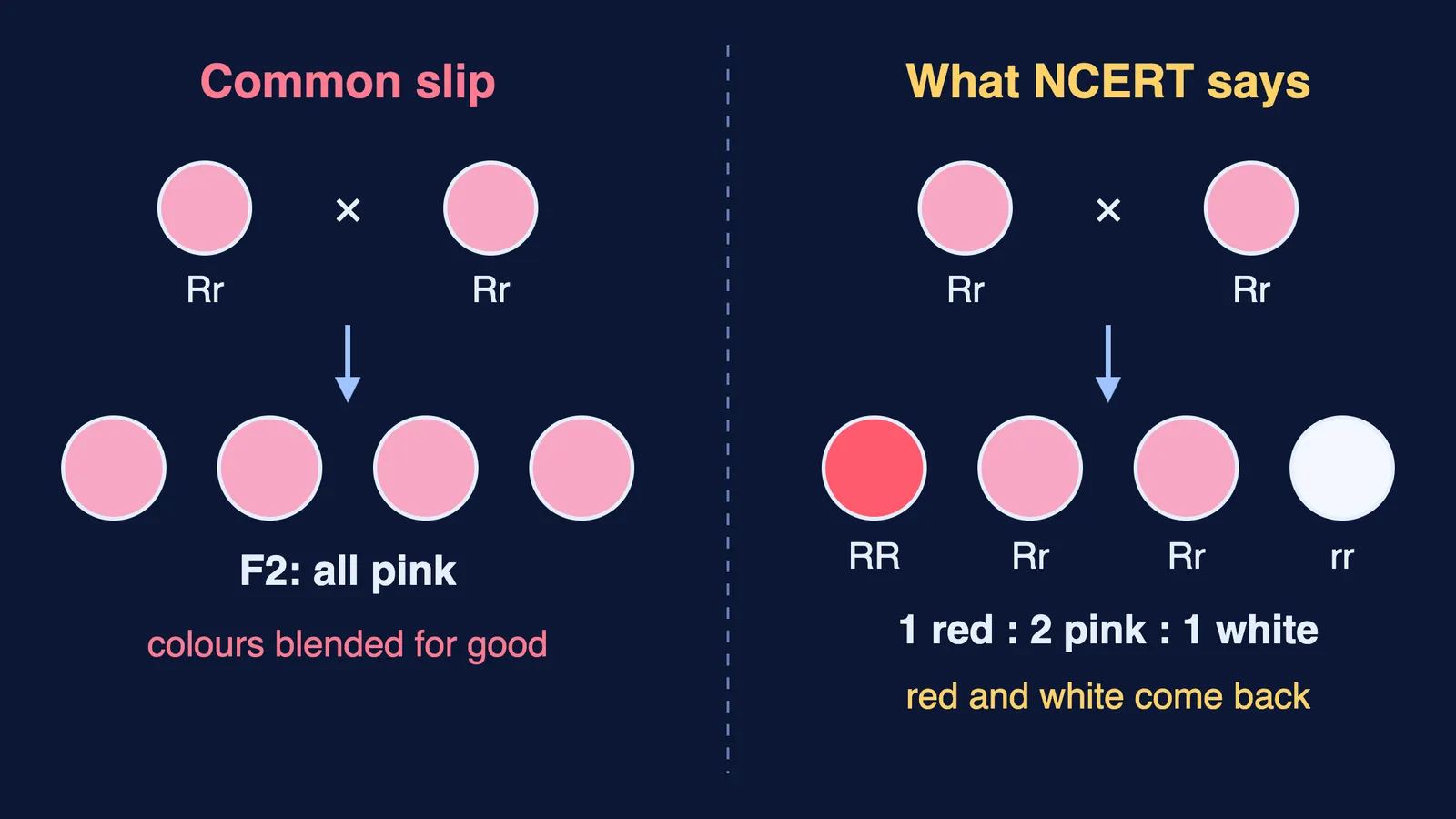
The F1 looks like mixed paint, so blending feels obvious. NCERT 4.2.2.1 says the Rr plant is pink because R is not fully dominant over r. Selfing the pink plants gives 1 red : 2 pink : 1 white, so the alleles stayed intact.
Check: if colours really blended, what should pink × pink give? Only pink. The real F2 has red and white plants too.
Habit: judge blending by the F2, never by the F1.
What do dominant and recessive really mean?
"A recessive allele is simply a broken allele."
Recessive examples often involve a missing enzyme. NCERT 4.2.2.1 lists three things a modified allele might do: make a normal or less efficient enzyme, make a non-functional one, or make none. In the first case it behaves like the unmodified allele and the phenotype stays the same; the recessive trait comes from the second or third case.
Check: sort three modified alleles. One makes a slower enzyme that still converts substrate S, one makes an inactive enzyme, one makes no enzyme. Which can show up as a recessive trait? The last two.
Habit: tie "recessive" to the phenotype it shows, not to the word "changed".
"Three ABO alleles and six genotypes mean six blood groups."
Six genotypes in NCERT Table 4.2 tempt students to expect six groups. NCERT 4.2.2.2 says each person carries any two of the three alleles. Each of IA and IB dominates i, while IA with IB is co-dominant, so the six genotypes collapse into four groups: A, B, AB and O.
Check: which two genotypes hide behind group B? IBIB and IBi.
Habit: list the genotypes, then group them by the sugars on the red cell.
One gene or many genes?
"Pleiotropy and polygenic inheritance are the same 'many' idea."
Both words sound like "many". In NCERT 4.4, a polygenic trait such as human skin colour is controlled by three or more genes whose effects add up, and environment plays a part as well. In 4.5, a pleiotropic gene is a single gene with several phenotypic effects; phenylketonuria, from a mutation in the gene for phenylalanine hydroxylase, is the example. This is a study summary, not medical advice.
Check: in NCERT's three-gene skin colour model, where each dominant allele adds darkness, how many shades can AaBbCc × AABBCC give, and can any child be lighter than the AaBbCc parent? Four shades (3, 4, 5 or 6 dominant alleles) in a 1:3:3:1 ratio; no child is lighter.
Habit: many genes, one trait is polygenic; one gene, many effects is pleiotropy.
Which numbers and family trees get misread?
"A bigger recombination percentage means the genes are more tightly linked."
A big number feels like a strong bond. NCERT 4.3.3 says the opposite: tightly linked genes show low recombination. In Morgan's flies, white and yellow were tightly linked and rarely recombined, while white and miniature wing recombined far more often. His student Sturtevant turned these frequencies into gene distances to map a chromosome.
Check: genes D and E recombine at 4 per cent; E and F at 28 per cent. Which pair sits closer? In a test cross for E and F, what share of offspring is parental? D and E; 72 per cent.
Habit: read recombination as distance, not as strength.
"Drones have no father, so they have no grandfather either."
The family tree breaks one step up, so students assume it stops there. NCERT 4.6.2 says a drone grows from an unfertilised egg and is haploid, with 16 chromosomes to a female's 32. It makes sperm by mitosis, has no father and cannot have sons, but it does have a grandfather and can have grandsons.
Check: who is a drone's grandfather, and through which of his offspring can he get grandsons? The drone that mated with his mother's mother; through his daughters, whose unfertilised eggs become drones.
Habit: draw two generations up before any honey bee family question.
"A colour-blind daughter needs only a carrier mother."
For sons that is enough, so the rule gets copied across. NCERT 4.8.2 says the gene is recessive and sits on the X chromosome, so a daughter is normally affected only when two conditions meet: her father is colour blind and her mother carries the allele.
Check: a colour-blind girl has a mother with normal vision. What must be true of each parent? Her father is colour blind; her mother is a carrier.
Habit: for a daughter, check the X from each parent.
A 60-second self-check before you mark
For the full chapter plan, from monohybrid crosses to pedigrees, use our guide to preparing Principles of Inheritance for NEET.
Not sure which of these slips is yours? Fermi's AI tutor works out what you already know and builds a plan for the session.


