

On this page
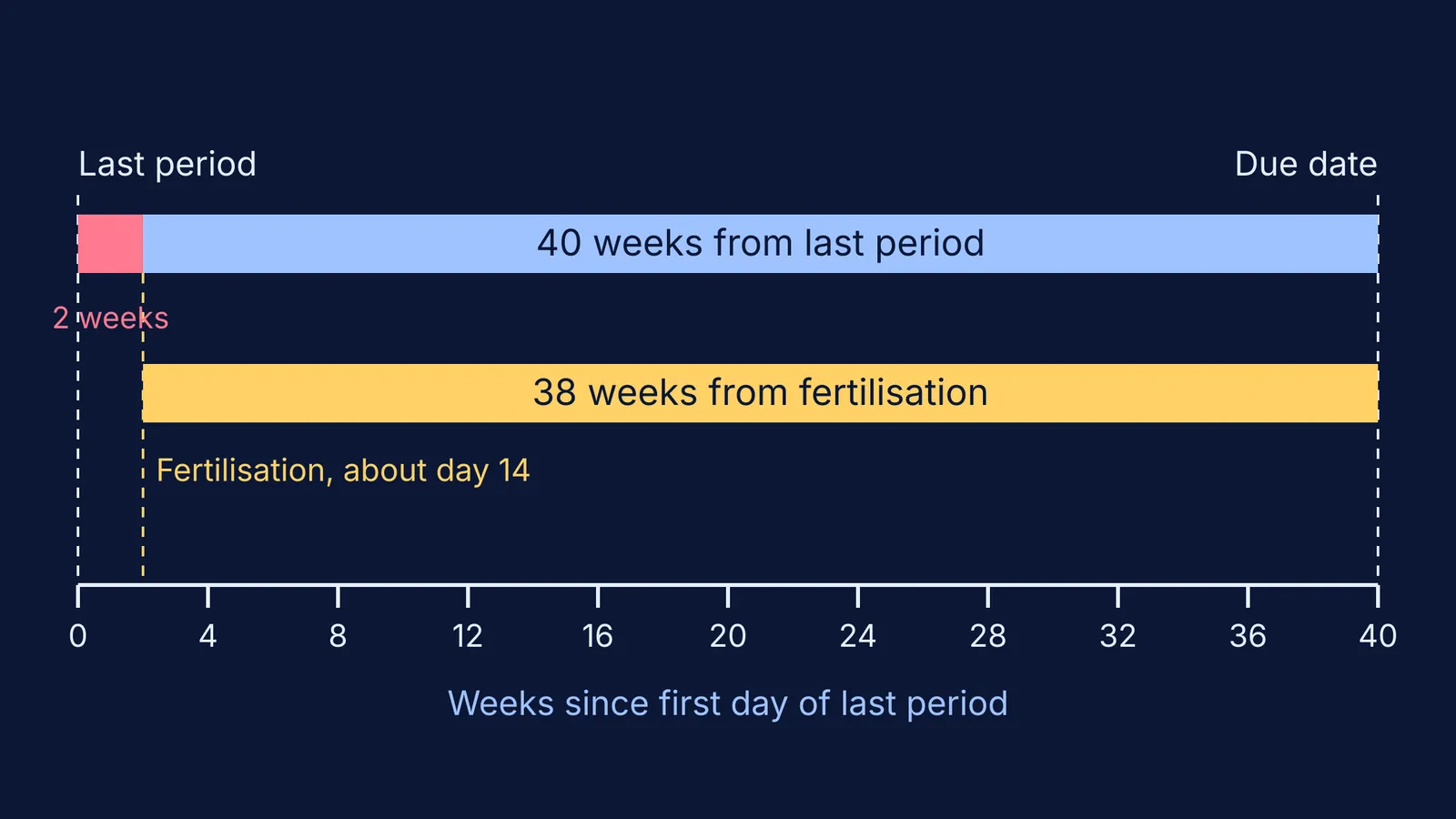
If a doctor says someone is six weeks pregnant, the embryo is only about four weeks old. That is not a mistake. Pregnancy is dated from the first day of the last menstrual period (LMP), and in a regular 28-day cycle fertilisation comes about two weeks later, which is why the MSD Manual gives both an LMP + 280 days rule and a conception + 266 days rule. Here is why, with the dates worked out both ways.
Why is pregnancy counted from the last menstrual period?
Because it is the one date people can actually tell you. A period is easy to mark on a calendar; ovulation and fertilisation happen with no outward sign.
Gestational age is "measured in weeks, from the first day of the woman's last menstrual cycle to the current date", according to MedlinePlus from the US National Library of Medicine.
Ovulation also moves around more than textbooks suggest. In a BMJ study by Allen Wilcox and colleagues, only about 30% of women had a fertile window entirely within days 10 to 17 of the cycle, and the authors wrote that its timing "can be highly unpredictable, even if their cycles are usually regular."
So the last period is a convention: a shared, recordable starting line, even though nothing has been fertilised on that day.
How many weeks is pregnancy from conception?
About 38 weeks. The MSD Manual lists equivalent ways to reach the estimated due date for a regular 28-day cycle:
LMP + 280 days (40 weeks)
Date of conception + 266 days (38 weeks)
Naegele's rule: subtract 3 months from the LMP and add 7 days
The 14-day gap between 280 and 266 is the assumed time from the start of the period to ovulation.
Direct measurement comes close. In a 2013 study in Human Reproduction that pinpointed ovulation with urine hormone tests in 125 natural pregnancies, the median time from ovulation to birth was 268 days (38 weeks, 2 days). The NHS says pregnancy normally lasts 37 to 42 weeks from the first day of the last period, so a due date is an estimate, not an appointment.
How do you calculate the due date from the last period?
Using the three MSD Manual rules, say the last period started on 5 February 2026 and cycles are a regular 28 days.
LMP + 280 days: 23 days remain in February; running totals at each month's end are March 54, April 84, May 115, June 145, July 176, August 207, September 237, October 268. Then 280 minus 268 is 12, so the due date is 12 November 2026.
Naegele's rule: 5 February minus 3 months is 5 November; add 7 days. Same answer, much faster.
Conception + 266 days: ovulation and fertilisation are assumed 14 days after the LMP, on 19 February. Count 9 days left in February, 254 by the end of October, and 12 more: 12 November again.
For other regular cycles, the MSD Manual uses LMP + 280 days + (cycle length minus 28 days). A 32-day cycle gives 284 days, so 16 November 2026. Check: ovulation 18 days after the LMP is 23 February, and 23 February + 266 days is also 16 November. For more on cycle length, see our post on how to calculate the ovulation day from cycle length.
How far along is a pregnancy on a given date?
Take 20 April 2026 with the same LMP, using the 14-day offset from the MSD Manual:
Days since LMP: 23 (February) + 31 (March) + 20 (April) = 74 days, which is 10 weeks 4 days of gestational age.
Days since fertilisation: 74 minus 14 = 60 days, which is 8 weeks 4 days of fertilisation age.
Both describe the same pregnancy. Doctors use the first; when a text describes development since fertilisation, check which clock it uses. For what follows, read from fertilisation to implantation and how a pregnancy test detects hCG.
Where do students slip up?
Check your working against the MSD Manual rules for these errors:
Reading "week 1 of pregnancy" as a week when an embryo exists. In gestational weeks 1 and 2, fertilisation has not happened yet.
Mixing the rules: LMP with 280 days, fertilisation with 266, never LMP with 266.
Skipping the correction for cycles that are not 28 days.
Treating the calendar date as final. Guidance from the American College of Obstetricians and Gynecologists (Committee Opinion 700) recommends checking the date against an ultrasound, and says a pregnancy without one confirming or revising the due date before 22 weeks "should be considered suboptimally dated."
If date arithmetic trips you up, the Fermi Problem Library has worked problems with a step-by-step solver that explains the reasoning rather than printing an answer. To revise the biology around it, the Fermi Concept Library gives every concept in biology its own lesson and its place in the map.


