

On this page
If you have met AM ≥ GM in Class 11, the power mean inequality is the bigger picture it belongs to. It puts four common averages, and infinitely many in between, on one line. For the two-number case first, start with our guide to sequences and series with AP, GP and AM-GM.
What is the power mean inequality?
For positive numbers x₁, …, xₙ and a non-zero real p, the power mean is M_p = ((x₁^p + x₂^p + … + xₙ^p)/n)^(1/p), and M₀ is defined as the geometric mean (Wikipedia, Generalized mean). MathWorld also calls it the Hölder mean (MathWorld, Power Mean). The familiar means are special values of p:
p = 2: the quadratic mean or root mean square, QM = √((x₁² + … + xₙ²)/n)
p = 1: the arithmetic mean, AM = (x₁ + … + xₙ)/n
p = 0: the geometric mean, GM = (x₁x₂…xₙ)^(1/n), reached as the limit p → 0
p = −1: the harmonic mean, HM = n/(1/x₁ + … + 1/xₙ)
p → +∞ and p → −∞: the largest and the smallest number
The inequality itself: if p < q, then M_p ≤ M_q, and the two are equal only when x₁ = x₂ = … = xₙ (Wikipedia, Generalized mean). Reading off the special cases gives min ≤ HM ≤ GM ≤ AM ≤ QM ≤ max (Wikipedia, QM-AM-GM-HM inequalities).
Try it with 9 and 4: AM = 6.5, GM = √36 = 6, HM = 72/13 ≈ 5.54 and QM = √48.5 ≈ 6.96, in exactly the promised order.
How does a semicircle show QM ≥ AM ≥ GM ≥ HM?
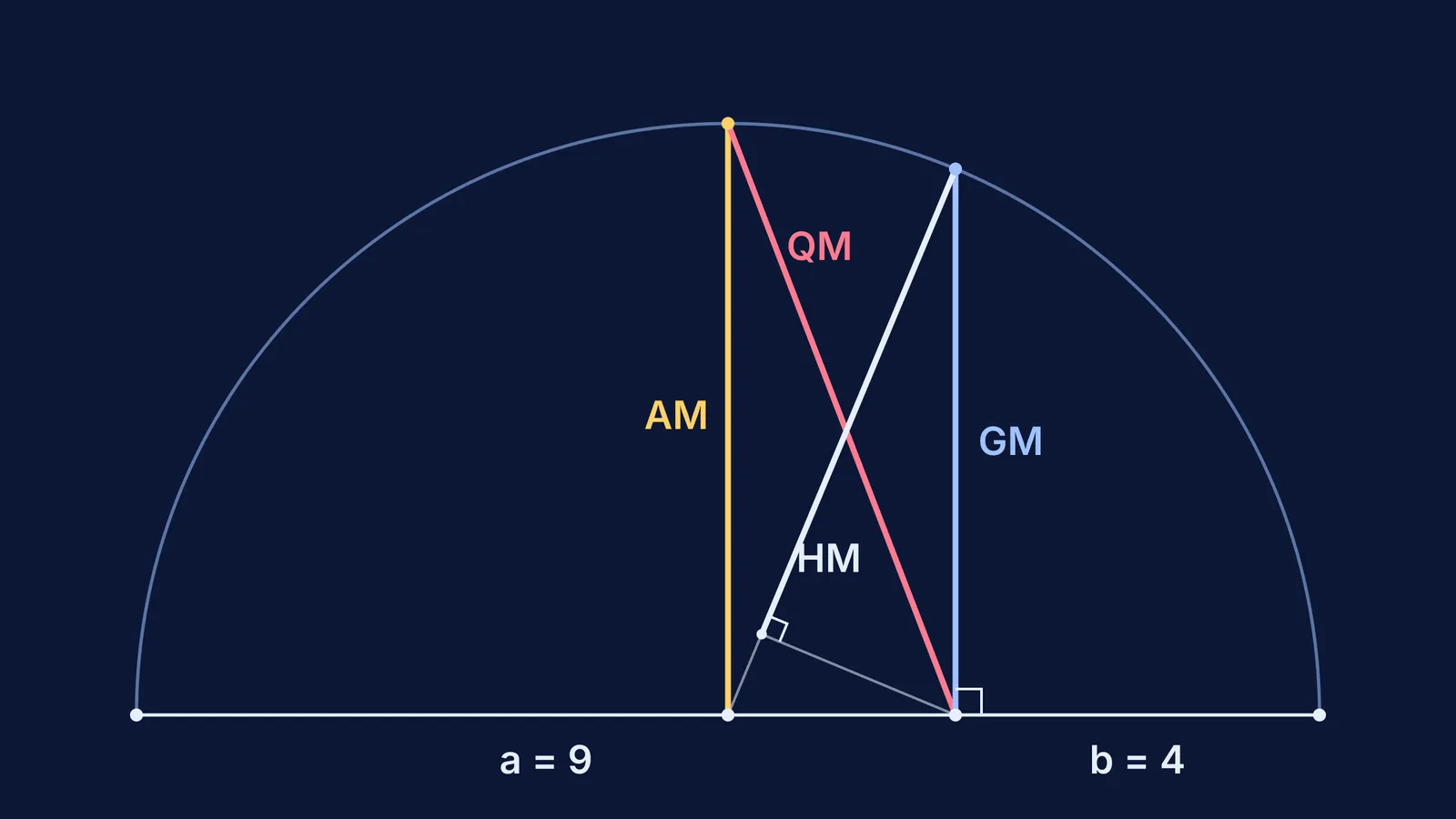
One figure holds all four means of two numbers a and b. The construction is from Wikipedia's QM-AM-GM-HM article; the picture at the top of this post draws it to scale for a = 9 and b = 4.
Draw a segment AB of length a + b, with C on it so that AC = a and CB = b.
Draw the semicircle on AB with centre D, the midpoint of AB.
Raise perpendiculars to AB at D and at C; they meet the semicircle at E and F.
Join CE and DF, and drop a perpendicular from C to DF, meeting it at G.
Now measure. DE is a radius, so DE = (a + b)/2, the AM. CE is the hypotenuse of a right triangle with legs DE and DC = |a − b|/2, so by Pythagoras CE = √((a² + b²)/2), the QM. The angle AFB is a right angle (Thales), so CF² = AC × CB = ab and CF is the GM. Triangles CGF and DCF are similar, so GF = CF²/DF = ab ÷ ((a + b)/2) = 2ab/(a + b), the HM.
Why does M_p increase as p increases?
A larger power gives the bigger numbers more weight, pulling the mean towards the maximum; a negative power pulls it towards the minimum. The standard proof uses convexity through Jensen's inequality (Wikipedia, Generalized mean), which we work through in how to use Jensen's inequality.
With 9 and 4 you can watch the climb: M₋₂ ≈ 5.17, HM ≈ 5.54, GM = 6, AM = 6.5, QM ≈ 6.96 and M₃ ≈ 7.35, always between 4 and 9. If the limit at p = 0 or the idea of convexity is the gap, the Fermi Concept Library covers every concept in mathematics, each with its own lesson.
Which mean should you compare in a problem?
Pick the pair of means that links what the problem gives to what it asks for:
A fixed sum and a product to maximise (or a fixed product and a sum to minimise): AM ≥ GM.
A sum of squares against a plain sum: QM ≥ AM.
A sum of reciprocals, or a sum times a sum of reciprocals: AM ≥ HM, which rearranges to (x₁ + … + xₙ)(1/x₁ + … + 1/xₙ) ≥ n².
A product against reciprocals: GM ≥ HM.
Three worked examples, all for positive numbers:
Minimise x + 9/x. The product of x and 9/x is fixed at 9, so AM ≥ GM gives (x + 9/x)/2 ≥ 3. The minimum is 6, reached at x = 3.
If a + b + c = 3, show a² + b² + c² ≥ 3. QM ≥ AM gives √((a² + b² + c²)/3) ≥ (a + b + c)/3 = 1; square both sides and multiply by 3.
Show (a + b + c)(1/a + 1/b + 1/c) ≥ 9. AM ≥ HM gives (a + b + c)/3 ≥ 3/(1/a + 1/b + 1/c); cross-multiply.
To practise choosing the right pair, the Fermi Problem Library has worked problems with a step-by-step solver that explains the reasoning rather than printing an answer.
When two sequences are multiplied together, the means stop being enough; that is where Hölder's inequality takes over.


