

On this page
"Preparation of potash alum from aluminium scrap" is one of the most common CBSE chemistry investigatory projects. It uses foil or drink-can strips, every step shows a visible change, and the yield calculation is short. Here is the chemistry of each step, a full yield calculation, and why real yields fall well below 100%.
How is this different from the double salt practical?
In the Class 12 practical you make potash alum by mixing two ready-made salts, K₂SO₄ and Al₂(SO₄)₃·18H₂O. That version, with its mass calculations, is covered in preparing Mohr's salt and potash alum in the chemistry practical.
The project starts from the metal, so you make the aluminium salt yourself. The product is the same: potash alum, KAl(SO₄)₂·12H₂O, also written K₂SO₄·Al₂(SO₄)₃·24H₂O.
Why dissolve aluminium in KOH and not in acid?
Aluminium is covered by a thin, tough oxide layer, and dilute acids attack it slowly. Al₂O₃ is amphoteric, so a hot alkali strips the layer quickly, and the metal underneath then reacts with water and hydroxide ions. The reason this works for aluminium and zinc but not iron is explained in why zinc and aluminium react with NaOH but iron does not.
With potassium hydroxide the equation is:
2Al + 2KOH + 6H₂O → 2K[Al(OH)₄] + 3H₂
Check it: 2 K, 2 Al, 8 O and 14 H on each side. The product is potassium aluminate (often written KAlO₂ in older books; K[Al(OH)₄] keeps the water attached).
Why KOH and not NaOH? Alum needs potassium. KOH supplies it in the very first step, one K for every Al, which is exactly the 1 : 1 ratio in KAl(SO₄)₂. NaOH would give sodium alum, NaAl(SO₄)₂·12H₂O, which is far more soluble in water and much harder to crystallise.
What happens at each step of the procedure?
Follow your school's lab manual for exact volumes and concentrations. The chemistry of each step is:
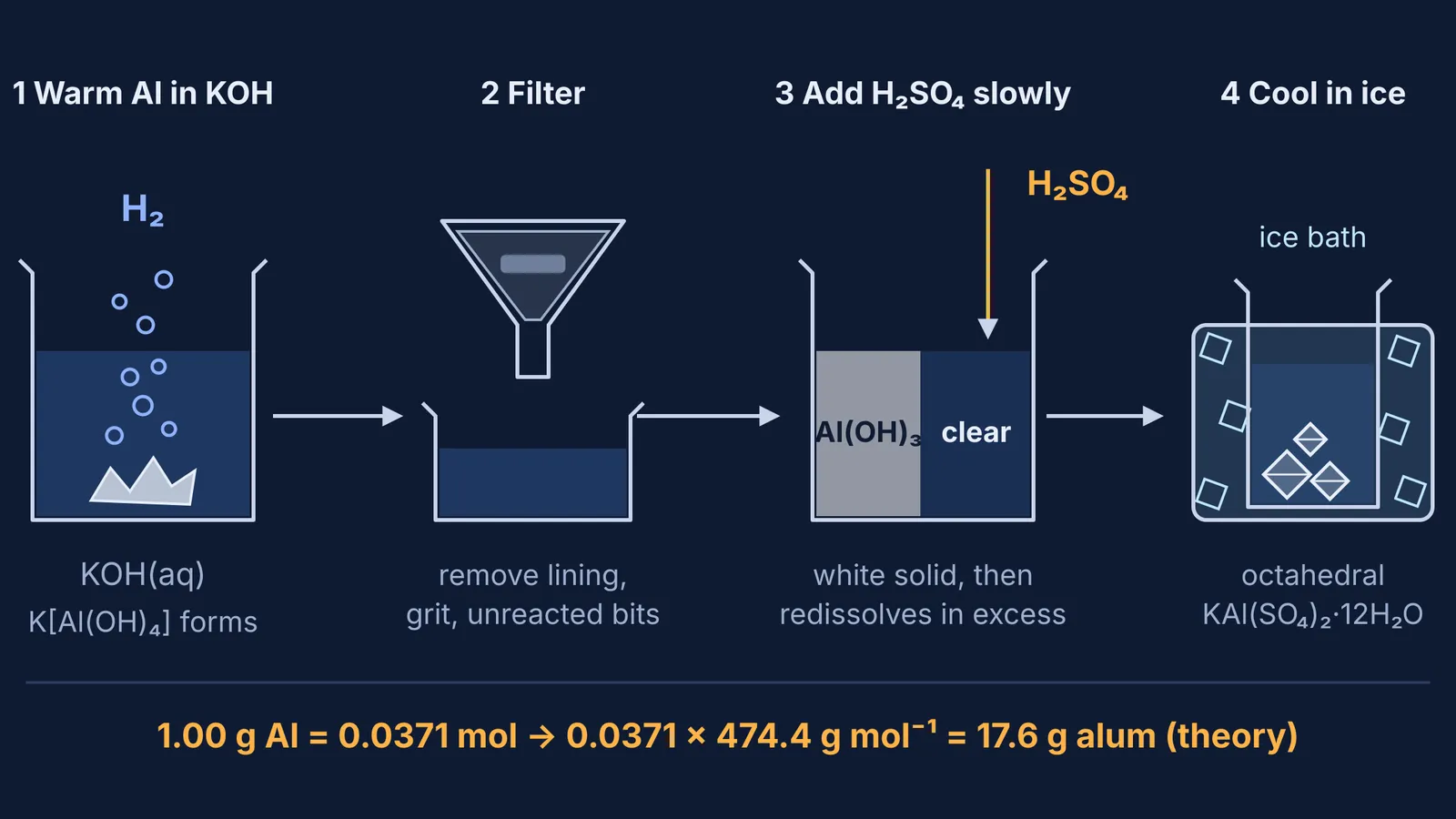
Dissolve the metal. Cut about 1 g of foil or can into small pieces, weigh it, and warm it gently in KOH solution. Hydrogen bubbles off steadily. The step is done when the fizzing stops and no shiny metal is left.
Filter. Drink cans have a plastic lining and paint, and foil can carry grease. These do not dissolve. Filter the warm solution to remove them, along with any dark specks from alloying metals. The filtrate should be clear and colourless.
Acidify slowly. Add dilute H₂SO₄ a little at a time with stirring. First a white, jelly-like precipitate of Al(OH)₃ appears: 2K[Al(OH)₄] + H₂SO₄ → 2Al(OH)₃ + K₂SO₄ + 2H₂O. Keep adding acid and it dissolves again: 2Al(OH)₃ + 3H₂SO₄ → Al₂(SO₄)₃ + 6H₂O.
Crystallise. The solution now holds K⁺, Al³⁺ and SO₄²⁻. If it is dilute, heat it gently to reduce its volume. Then cool it in an ice bath. Alum is much more soluble in hot water than in cold, so colourless octahedral crystals of KAl(SO₄)₂·12H₂O separate: K₂SO₄ + Al₂(SO₄)₃ + 24H₂O → 2KAl(SO₄)₂·12H₂O.
Collect and dry. Filter off the crystals and wash them with a little ice-cold water or a cold alcohol–water mixture, in which alum dissolves poorly. Dry them between filter papers, then weigh.
Adding the overall equation for steps 3 and 4: K[Al(OH)₄] + 2H₂SO₄ + 8H₂O → KAl(SO₄)₂·12H₂O. So the acid needed is 2 mol per mol of Al, plus extra to neutralise any KOH that was in excess.
How much alum should 1 g of aluminium give?
Every aluminium atom ends up in one formula unit of alum, so the mole ratio Al : alum is 1 : 1. Here is the full working.
Molar masses. Al = 26.98 g mol⁻¹. KAl(SO₄)₂·12H₂O = 39.10 + 26.98 + 2(32.06 + 64.00) + 12(18.02) = 474.4 g mol⁻¹.
Moles of Al. 1.00 g ÷ 26.98 g mol⁻¹ = 0.0371 mol.
Theoretical yield. 0.0371 mol × 474.4 g mol⁻¹ = 17.6 g of alum.
Percentage yield. A student collects 12.3 g of dry crystals. 12.3 ÷ 17.6 × 100 = 70%.
Hydrogen released. 3 mol H₂ per 2 mol Al, so 0.0371 × 1.5 = 0.0556 mol H₂. At STP on the 1 bar standard (273.15 K, 22.7 L mol⁻¹), that is 0.0556 × 22.7 = 1.26 L. With the older 22.4 L mol⁻¹ value (1 atm) you get 1.25 L.
Minimum KOH. 1 mol per mol of Al: 0.0371 × 56.1 = 2.08 g. Labs use an excess so the metal dissolves fully.
1 g of metal giving 17.6 g of product is not an error: about 46% of alum's mass is water of crystallisation, and most of the rest is sulphate.
Write the result as "yield based on the mass of metal taken". A drink can is an alloy that contains small amounts of manganese and magnesium, plus a coating, so 1 g of can is not exactly 1 g of aluminium. If you weigh the strips after scraping off paint and lining, say so in your report.
Why is the real yield less than 100%?
Yields well below 100% are normal. Discuss the losses in your project, because examiners ask about them:
Alum left in the mother liquor. Alum is still somewhat soluble even in ice-cold water, so some always stays in solution. Cooling well and using less water reduce it.
Metal that did not dissolve. If you stop heating while small flakes remain, that aluminium never reaches the product.
Losses on transfer and washing. Crystals stick to glass and filter paper, and every wash dissolves a little more.
Incomplete redissolving of Al(OH)₃. Too little acid leaves a white haze. That aluminium is filtered off with the residue, and the crystals that do form may be cloudy.
Things that make the yield look too high are wet crystals and trapped mother liquor, so dry them well before weighing.
What safety precautions matter here?
KOH is caustic. It damages skin and especially eyes. Wear safety goggles and gloves, and wash any splash with plenty of water.
Hydrogen is flammable. About 1.3 L of H₂ comes off per gram of aluminium. Work in a ventilated area or a fume hood, and keep flames away from the beaker. Use a water bath or hot plate, not a burner, for warming.
The reaction speeds up as it warms. Add the aluminium in portions so the frothing stays under control.
Acid addition is exothermic. Neutralising the alkali releases heat, so add the H₂SO₄ slowly, with stirring, and never add water to concentrated acid.
What questions come up in the viva?
Why KOH and not NaOH? What is the white precipitate, and why does it disappear? Why cool in ice? Why filter before adding acid? For more mole and yield problems with the reasoning shown, the Fermi Problem Library has a step-by-step solver that explains each line.
Once you have your crystals, you can test what they do: alum's Al³⁺ ions are behind its use in water treatment, explained in how alum makes muddy water clear.
Checklist for your project file
Equation for Al with KOH, balanced, with H₂ named.
Equations for Al(OH)₃ forming and redissolving.
Molar mass of alum as the dodecahydrate, 474.4 g mol⁻¹.
Theoretical yield, percentage yield and litres of H₂, with the molar volume stated.
Yield based on metal mass, with the can's coating mentioned.
Two or three reasons for losses.
Safety notes for KOH, H₂ and acid addition.


