On this page
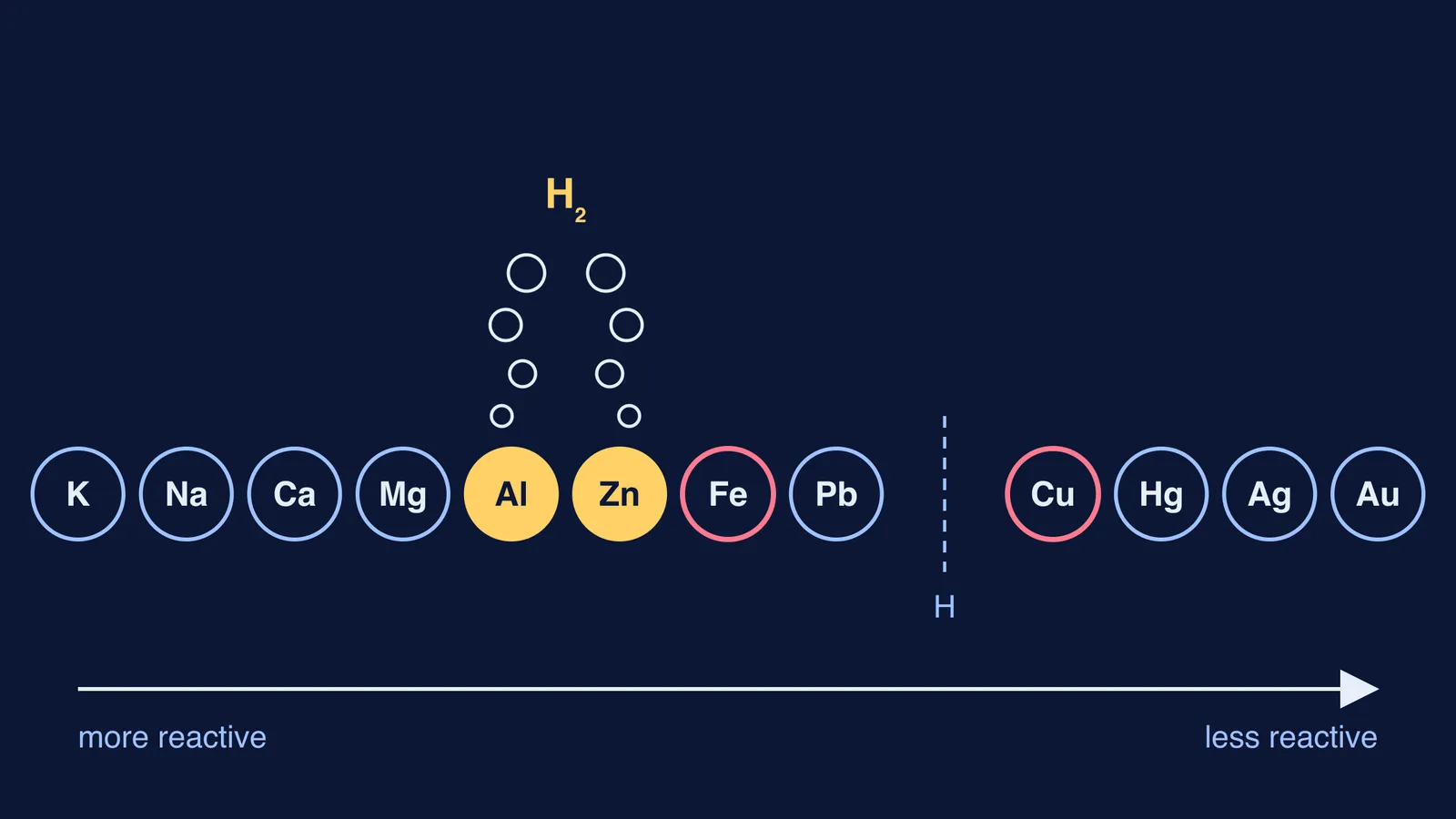
You add zinc granules to sodium hydroxide, warm the tube, and bubbles appear. An iron nail gives no such fizz. The difference is not how reactive each metal is, but what kind of oxide it forms.
Why do zinc and aluminium react with sodium hydroxide?
The answer is one word: amphoteric. NCERT's Class 10 chapter Metals and Non-metals defines amphoteric oxides as metal oxides that react with both acids and bases to produce salts and water, and names aluminium oxide and zinc oxide as examples.
That matters because, as the same NCERT chapter notes, metals such as aluminium and zinc are covered with a thin layer of oxide at ordinary temperature. With an acid, that layer behaves as a base. With sodium hydroxide, it behaves as an acid:
Al₂O₃ + 2NaOH → 2NaAlO₂ + H₂O, where NaAlO₂ is sodium aluminate.
Once the alkali has removed the oxide, the metal underneath reacts with the water and hydroxide ions, and hydrogen is released. For zinc, NCERT's activity asks you to warm the tube.
What are the equations for zinc and aluminium with NaOH?
For zinc, NCERT Class 10 Activity 2.4 puts granulated zinc in 2 mL of sodium hydroxide solution, warms it, and writes:
2NaOH(aq) + Zn(s) → Na₂ZnO₂(s) + H₂(g), where Na₂ZnO₂ is sodium zincate.
The textbook then adds a line worth remembering: such reactions are not possible with all metals.
For aluminium, a University of Wisconsin–Madison chemistry demonstration places an aluminium can in 3 M NaOH and records hydrogen gas and NaAl(OH)₄ as the products. Balanced, that is:
2Al(s) + 2NaOH(aq) + 6H₂O(l) → 2NaAl(OH)₄(aq) + 3H₂(g)
NCERT writes sodium aluminate as NaAlO₂ in its aluminium oxide equation, and many answers use the matching simpler form, 2Al + 2NaOH + 2H₂O → 2NaAlO₂ + 3H₂. Both describe sodium aluminate; NaAl(OH)₄ just keeps the water attached. Use whichever form your textbook uses, and balance hydrogen and oxygen last.
Why don't iron and copper react with NaOH?
Iron sits just below zinc in NCERT's activity series (Table 3.2), so reactivity alone cannot explain the difference. The oxide does. The same chapter says metal oxides are basic in nature, and gives aluminium oxide and zinc oxide as examples of oxides that also show acidic behaviour. Iron and copper are not among those examples, so at Class 10 and JEE Main level you treat them as metals that do not release hydrogen with sodium hydroxide.
Copper has a second reason. In NCERT's Activity 3.11, copper in dilute hydrochloric acid showed no bubbles and no change in temperature: it does not react with dilute HCl at all, and it lies below hydrogen in the series.
How much hydrogen do zinc and aluminium give?
Here is a worked example. 2.7 g of aluminium and 6.5 g of zinc each react completely with excess NaOH. Which gives more hydrogen? Take Al = 27 and Zn = 65.
Moles of metal: aluminium 2.7 ÷ 27 = 0.10 mol; zinc 6.5 ÷ 65 = 0.10 mol.
Read the ratios from the equations: 2 Al give 3 H₂, so 0.10 mol Al gives 0.15 mol H₂. One Zn gives one H₂, so 0.10 mol Zn gives 0.10 mol H₂.
Aluminium gives more, because each Al atom loses three electrons (Al³⁺) and each Zn atom loses two (Zn²⁺).
That last line is the check worth keeping: moles of H₂ = moles of electrons lost ÷ 2.
If your answer came out the other way, the usual slip is the 2:3 ratio. The Fermi Problem Library has a step-by-step solver that explains the reasoning, so you can see exactly which line of a stoichiometry problem went wrong.
How do you remember which metals react with NaOH?
A quick checklist for board and JEE Main questions:
Ask whether the oxide is amphoteric, not whether the metal is reactive.
Aluminium and zinc: yes, so expect hydrogen plus an aluminate or zincate.
Iron and copper: no hydrogen with sodium hydroxide at your level.
The salt name ends in -ate: sodium zincate, sodium aluminate.
Test the gas: a burning candle brought near a hydrogen-filled soap bubble gives a pop sound, as in NCERT Figure 2.1.
For more oxides that behave both ways, read our guide to amphoteric oxides such as Al₂O₃ and ZnO. To see the same zinc producing hydrogen from an acid, read how hydrogen is prepared in the lab from zinc, and for the precipitate side of this topic, our note on NaOH and NH₄OH tests for metal ions.
If amphoteric still feels like a word you memorised rather than understood, the Fermi Concept Library covers every concept in chemistry, so you can read acids, bases and oxides as one connected idea.