

On this page
In many Indian homes the water for the shower comes from a tank on the roof. On the ground floor there are several metres of height between the tank and the shower, and the water gushes. On the top floor there may be only two or three metres, and every bit of that pressure has to push water through the pipe. Some of it is used up by friction against the pipe wall. How much depends very strongly on the pipe's width. This post works out the friction loss in a real household pipe and shows why a pipe a few millimetres wider can make the difference between a dribble and a proper shower.
Is water in a house pipe laminar or turbulent?
Check the Reynolds number:
Re = vD/ν
Here v is the average speed, D the inner diameter (the bore) and ν the kinematic viscosity, about 1.0 × 10⁻⁶ m²/s for water near 20 °C. Flow in a pipe stays laminar only below about Re = 2300. A shower taking 9 litres a minute through a 13.6 mm bore has Re of about 14,000, so the flow is turbulent. The story of how Reynolds found this switch with a dye streak is in Osborne Reynolds and the dye streak that showed turbulence.
This matters because Poiseuille's law, the R⁴ law covered in why flow through a narrow tube depends on radius to the fourth, is only for laminar flow. Household pipes need a different tool.
How do you calculate friction loss in a pipe?
Engineers use the Darcy–Weisbach equation for the head lost to friction:
h_f = f × (L/D) × v²/(2g)
h_f is the head lost, in metres of water.
L is the pipe length and D its bore.
v²/(2g) is the velocity head, the kinetic energy per unit weight.
f is the Darcy friction factor, a pure number.
For laminar flow f = 64/Re. For turbulent flow in a smooth pipe, a simple fit by Blasius is f ≈ 0.316 Re^(−1/4), valid for Re from about 4000 to 100,000. Both formulas, and the Moody chart that covers rough pipes, are set out in Purdue University's lecture notes on pipe flows (C. Wassgren, Pipe Flows, Purdue ME 308).
Copper and plastic pipes count as smooth. Old galvanised iron does not, which we come back to below.
How much head does 20 m of 15 mm pipe lose?
Worked example
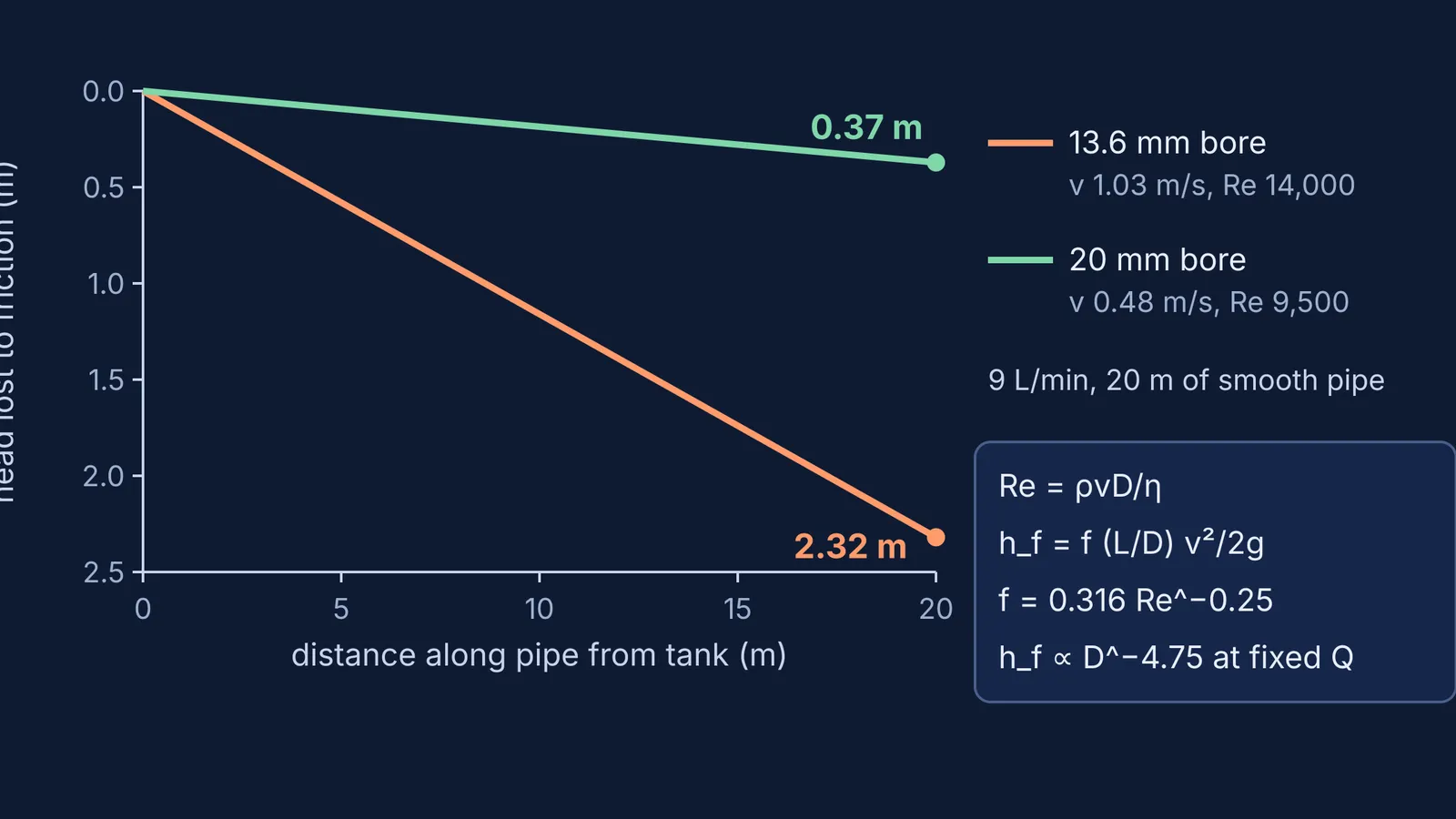
A shower draws 9 L/min through 20 m of pipe from the tank. Compare two thin-walled copper pipes. A 15 mm tube with a 0.7 mm wall has a bore of 13.6 mm, and a 22 mm tube has a bore of about 20 mm (EN 1057 copper tube dimensions). These sizes are illustrative: CPVC and GI pipes sold in India have different bores, so use the real bore of your pipe.
Flow rate in SI units. Q = 9 L/min = 9 × 10⁻³/60 = 1.5 × 10⁻⁴ m³/s.
Speed in the 15 mm pipe. Area = π(0.0136)²/4 = 1.453 × 10⁻⁴ m². So v = Q/A = 1.03 m/s.
Reynolds number. Re = 1.03 × 0.0136/(1.0 × 10⁻⁶) = 14,000. Turbulent, and inside the Blasius range.
Friction factor. f = 0.316 × 14,000^(−0.25) = 0.029.
Velocity head. v²/(2g) = 1.03²/19.62 = 0.0543 m.
Head loss. h_f = 0.029 × (20/0.0136) × 0.0543 = 2.32 m.
Now repeat for the 20 mm bore:
Area = 3.14 × 10⁻⁴ m², so v = 0.48 m/s.
Re = 0.48 × 0.020/(1.0 × 10⁻⁶) = 9,500.
f = 0.316 × 9,500^(−0.25) = 0.032.
h_f = 0.032 × (20/0.020) × (0.48²/19.62) = 0.37 m.
The wider pipe loses 6.2 times less head for the same flow. If your top-floor shower has only 2 to 3 m of height below the tank, the thin pipe has spent almost all of it on friction before the water reaches the shower head.
Why does pipe width matter even more than Poiseuille's law says?
At a fixed flow rate, v = 4Q/(πD²), so v ∝ D⁻². Put that into Darcy–Weisbach with the Blasius friction factor:
f ∝ Re^(−1/4) ∝ (vD)^(−1/4) ∝ D^(1/4)
h_f ∝ f × (1/D) × v² ∝ D^(1/4) × D⁻¹ × D⁻⁴ = D^(−4.75)
So the loss scales as about D^(−4.75) in smooth turbulent flow, steeper than the D⁻⁴ of laminar flow. Check: (20/13.6)^4.75 = 6.2, the same ratio as the full calculation.
Laminar thinking also gets the size of the loss badly wrong. Poiseuille's law for the 15 mm pipe would predict only 0.36 m of head lost, more than six times too little, because turbulent eddies carry momentum to the wall far more effectively than smooth layers do.
How much water comes out if the tank gives only 2 m of head?
Now turn the question round. Suppose the height available for friction is 2.0 m. With the Blasius factor, h_f ∝ Q^1.75 for a given pipe, so Q ∝ h_f^(4/7).
15 mm pipe: Q = 9 × (2.0/2.32)^(4/7) = 8.3 L/min.
22 mm pipe: Q = 9 × (2.0/0.37)^(4/7) = 23.6 L/min. Its Reynolds number rises to about 25,000, still inside the Blasius range.
The wider pipe can pass nearly three times the flow from the same tank. In practice the shower head itself, bends, tees and valves also use up head, so real flows are lower than these straight-pipe figures. Shower heads also need some minimum pressure to spray properly, which is why a thin pipe on the top floor often gives a feeble dribble.
What about old galvanised iron pipes?
Rust and scale make the wall rough, and roughness raises f. A typical new galvanised iron pipe has a roughness of about 0.15 mm (from the same Purdue roughness table). In a 13.6 mm bore at Re = 14,000, the Colebrook equation behind the Moody chart gives f ≈ 0.043 instead of 0.029. The loss in our example rises from 2.32 m to about 3.4 m. Old pipes with scale narrowing the bore do even worse, because the bore appears to the power −4.75.
If you want to practise more flow and friction numericals like this one, the Fermi Problem Library has a step-by-step solver that explains the reasoning. For simpler sums on flow rate and filling time from a tap, see time to fill a tank from a pipe's flow rate.
Quick checklist
Find Re = vD/ν first. Household water flow is turbulent (Re in the thousands).
Head loss: h_f = f(L/D)(v²/2g).
Smooth turbulent pipe: f ≈ 0.316 Re^(−1/4) for Re from about 4000 to 100,000.
At fixed flow, h_f ∝ D^(−4.75). A slightly wider pipe cuts the loss a lot.
9 L/min through 20 m: 2.32 m lost in a 13.6 mm bore, 0.37 m in a 20 mm bore.
Rough or scaled pipes, bends and valves add more loss than the straight-pipe sum.


