

On this page
How long should the motor run before the overhead tank is full? The same question turns up in Class 11 fluid mechanics and in JEE Main numericals. The physics fits in one line. The unit conversions are where answers usually go wrong.
What is volume flow rate?
The OpenStax College Physics 2e textbook defines flow rate Q as the volume of fluid passing a location in a given time, so Q = V/t.
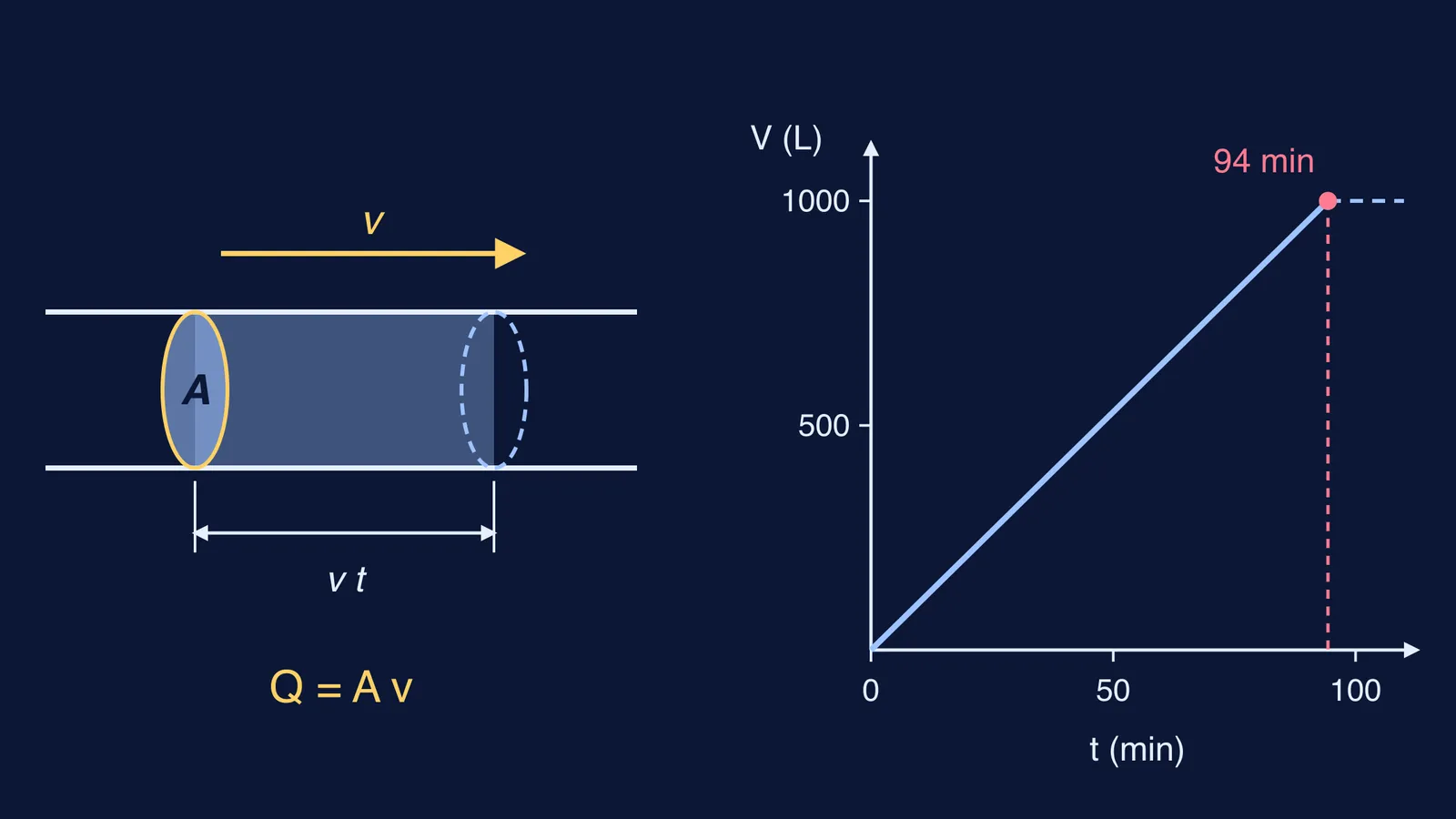
The same OpenStax chapter shows that flow rate equals cross-sectional area times average speed: Q = Av.
Here is why. In time t, the water moves a distance vt, so the volume that crosses a section is a cylinder of base A and length vt: V = Avt. Divide by t and you get Q = Av.
The SI unit of flow rate is m³/s, but other units are in common use, such as litres per minute, as OpenStax notes.
How do you convert m³/s to litres per second?
One litre is one cubic decimetre: 1 L = 1 dm³ = 1000 cm³ = 10⁻³ m³, according to NIST's guide to the SI. Three conversions follow from that:
m³/s to L/s: multiply by 1000.
cm³/s to L/s: divide by 1000 (1 cm³ is 1 mL).
L/s to L/min: multiply by 60.
For more practice with cube-of-ten jumps, our explainer on converting cubic centimetres to litres for tank problems goes through them one at a time.
How long does it take to fill a tank from a pipe?
Rearrange the OpenStax definition Q = V/t, and filling time is volume divided by flow rate: t = V/Q = V/(Av).
Worked example 1: a household tap
A tap pipe has an inner diameter of 1.5 cm, and water leaves it at 1.0 m/s. How long does it take to fill a 20-litre bucket, and a 1,000-litre overhead tank?
Radius, not diameter, in metres: r = 0.75 cm = 0.0075 m.
Area: A = πr² = π × (0.0075)² ≈ 1.77 × 10⁻⁴ m².
Flow rate: Q = Av = 1.77 × 10⁻⁴ m³/s. Multiply by 1000 to get about 0.177 L/s, which is about 10.6 L/min.
Time: bucket, t = 20 ÷ 0.177 ≈ 113 s, just under 2 minutes. Tank, t = 1000 ÷ 0.177 ≈ 5,660 s, about 94 minutes.
With a steady flow rate, the volume rises in a straight line whose slope is Q.
Worked example 2: a pipe from a pump
A 2.5 cm diameter pipe carries water at 2.0 m/s into a tank measuring 2 m × 1.5 m × 1 m. How long does it take to fill?
Tank volume: 2 × 1.5 × 1 = 3 m³ = 3,000 L.
r = 0.0125 m, so A = π × (0.0125)² ≈ 4.91 × 10⁻⁴ m².
Q = 4.91 × 10⁻⁴ × 2.0 ≈ 9.82 × 10⁻⁴ m³/s ≈ 0.982 L/s.
t = 3,000 ÷ 0.982 ≈ 3,056 s, about 51 minutes.
Why does water speed up when a pipe narrows?
For an incompressible fluid, the same Q passes every section of a pipe, so A₁v₁ = A₂v₂. This is the equation of continuity, and the OpenStax chapter works through it with a garden hose. The hose has a radius of 0.900 cm and carries 0.500 L/s. Water moves at about 1.96 m/s in the hose and about 25.5 m/s through a nozzle of radius 0.250 cm.
A narrow nozzle makes a faster jet, but it does not fill your bucket faster. Filling time depends on Q, not on how fast the jet looks.
What mistakes cost marks in flow-rate problems?
Each of these slips breaks the OpenStax relation Q = Av:
Using the diameter in πr². That makes the area four times too big.
Converting cm² to m² by dividing by 100 instead of 10,000.
Mixing L/s and L/min, or giving the answer in seconds when the question asks for minutes.
Using the jet speed at a nozzle with the pipe's area. Q = Av only works if A and v are measured at the same section.
Once single pipes feel easy, the next step is several pipes at once. See pipes and cisterns with a leak, using the net rate method, or the reverse problem, the time taken to empty a tank through a small hole, where the speed changes as the level falls.
If you get the setup right but the answer comes out by a power of ten, try the Fermi Problem Library. It has worked problems with a step-by-step solver that explains the reasoning rather than printing an answer. If continuity itself feels shaky, the Fermi Concept Library gives each idea in physics and mathematics its own lesson.


