

On this page
Monographs in the Indian Pharmacopoeia (IP) for many inorganic salts carry lines such as "Chlorides: not more than ... ppm". The tests behind them are the Class 12 salt-analysis reactions: silver nitrate for chloride, barium chloride for sulphate. What changes is the question. Salt analysis asks "is chloride there?" A limit test asks "is there less chloride than the limit allows?" and answers it by comparing two tubes side by side.
What is a limit test in the pharmacopoeia?
A limit test is a pass-or-fail check for a small amount of an impurity. You do not measure how much impurity is present. You prepare a standard that contains exactly the amount the limit allows, treat the sample in exactly the same way, and compare.
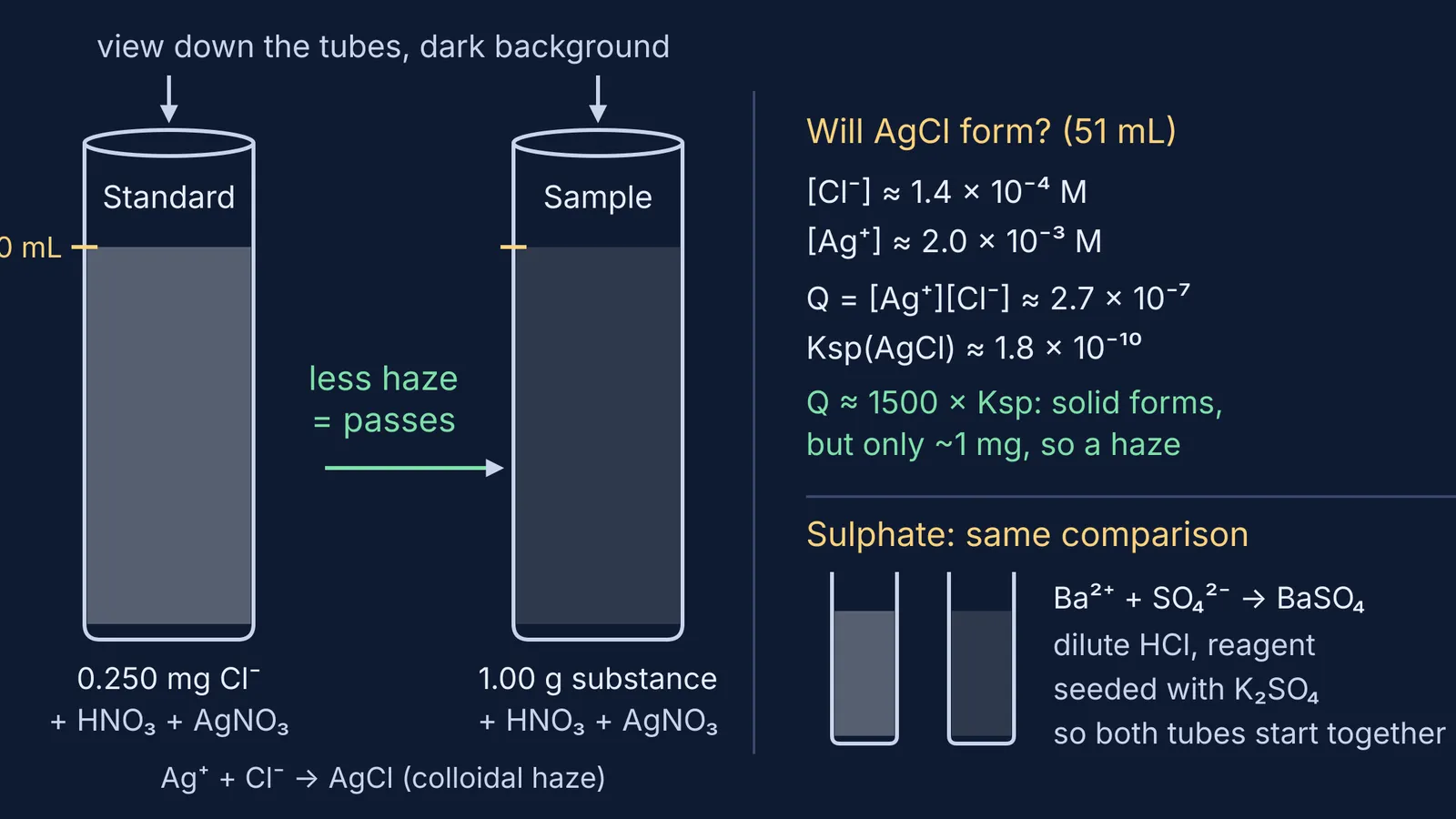
If the sample tube shows less haze (opalescence or turbidity) than the standard, the sample passes.
If it shows the same or more, it does not pass.
The IP's appendix on limit tests gives the cylinder size, reagents, standard solutions and waiting times; each monograph says how much substance to take. Exact volumes and standard solutions differ between editions, so in a practical follow the edition your lab uses. The chemistry below is the same in all of them, and the same compare-with-a-standard idea is used for other impurities such as iron and arsenic.
How is the chloride limit test done?
In outline, as it is usually written:
Dissolve the stated mass of the substance in water in a Nessler cylinder, a flat-bottomed glass tube with a 50 mL mark.
Add dilute nitric acid.
Make up to 50 mL with water and add 1 mL of silver nitrate solution. Stir.
Leave both tubes for about 5 minutes, protected from light.
Look down the length of the tubes against a dark background and compare the opalescence.
The standard tube gets the same acid, volume and silver nitrate, but its chloride comes from a measured volume of dilute sodium chloride solution of known strength. In both tubes:
Ag⁺(aq) + Cl⁻(aq) → AgCl (colloidal haze)
Light is kept away because silver chloride darkens in light as it decomposes to silver, which would change the look of a tube for a reason unrelated to chloride.
Why nitric acid, and why a haze instead of a precipitate?
Nitric acid is there for the same reason as in the nitric acid step before silver nitrate in Lassaigne's test. In a neutral solution, silver ions also precipitate carbonate (Ag₂CO₃), phosphate (yellow Ag₃PO₄) and hydroxide (as brown Ag₂O). These anions come from weak acids, so the H⁺ of nitric acid protonates them and keeps them in solution. Chloride comes from a strong acid, so it stays free to meet Ag⁺. Hydrochloric acid is useless here because it would add chloride of its own.
The amounts are tiny: a limit of a few hundred ppm on a 1 g sample means well under a milligram of chloride in 50 mL. Silver chloride still forms, because the ionic product is far above Ksp (the worked example shows by how much). But a few micromoles spread through 50 mL give very many small particles that stay suspended and scatter light (the Tyndall effect). You see a milky opalescence, not curds. Looking down the full depth of the tube makes small differences easier to see.
How does the sulphate limit test work, and why the seed?
The sulphate test runs the same way with a different pair of ions:
Ba²⁺(aq) + SO₄²⁻(aq) → BaSO₄ (turbidity)
The solution is acidified with dilute hydrochloric acid, not nitric. Here chloride does no harm, and the acid stops barium carbonate, sulphite and phosphate from forming, as in the barium chloride test for sulphate.
The extra step is the reagent. IP-style barium sulphate reagents contain a little alcohol and a very small amount of potassium sulphate. The potassium sulphate makes a few tiny BaSO₄ crystals in the reagent itself. These act as seeds.
At limit-test levels the solution is only slightly supersaturated with BaSO₄. Forming new crystals from scratch (nucleation) is slow and erratic at low supersaturation, so two tubes with the same sulphate could turn cloudy at different times. With seeds present, BaSO₄ grows on them at once in both tubes, and the turbidity develops at a similar rate. The alcohol lowers BaSO₄'s solubility a little further. The standard gets the same reagent, so the seed's own small contribution cancels.
Worked example: setting up a 250 ppm chloride standard
Suppose a monograph sets a chloride limit of 250 ppm and tells you to test 1.00 g of the substance. (These are example numbers for practice, not a quote from a specific monograph.)
(a) How much chloride goes into the standard?
250 ppm means 250 mg of Cl⁻ per kg, which is 0.250 mg per g. If ppm conversions are rusty, that link walks through them.
For a 1.00 g sample, the allowed chloride is 0.250 mg Cl⁻.
As sodium chloride: 0.250 × 58.44 ÷ 35.45 = 0.412 mg NaCl.
From a solution containing 0.100 mg NaCl per mL, you need 0.412 ÷ 0.100 = 4.12 mL.
(b) Will AgCl form at this level?
Moles of Cl⁻ = 0.250 mg ÷ 35.45 g/mol = 7.05 µmol.
After adding 1 mL of 0.1 M AgNO₃, the volume is 51 mL. [Cl⁻] = 7.05 µmol ÷ 51 mL ≈ 1.4 × 10⁻⁴ M.
[Ag⁺] = 0.1 mmol ÷ 51 mL ≈ 2.0 × 10⁻³ M, a large excess.
Ionic product Q = [Ag⁺][Cl⁻] ≈ 2.0 × 10⁻³ × 1.4 × 10⁻⁴ ≈ 2.7 × 10⁻⁷.
Ksp(AgCl) is about 1.8 × 10⁻¹⁰ at 25 °C (tables vary slightly). Q is roughly 1500 times Ksp, so AgCl must form.
Nearly all 7 µmol of chloride precipitates: about 1.0 mg of AgCl in 51 mL, a haze rather than a heap.
(c) What if the sample were made up to 25 mL instead of 50 mL?
The same 0.250 mg of chloride in 25 mL gives [Cl⁻] ≈ 2.8 × 10⁻⁴ M, twice as concentrated. Its haze would look denser than the 50 mL standard, and a sample exactly at the limit could appear to fail.
Why must both tubes be treated exactly alike?
The standard and the sample must differ in one thing only, the amount of chloride or sulphate. So everything else is matched:
same cylinder size and the same 50 mL final volume
same acid, same reagent, added in the same order
same standing time, same temperature, same protection from light
same viewing: down the tubes, side by side, against a dark background
If the substance is coloured or slightly cloudy on its own, monographs adjust the procedure (for example, filtering) so that the impurity is still the only difference.
To practise the Q versus Ksp step, the Fermi Problem Library has worked problems with a step-by-step solver that explains the reasoning.
Quick checklist
Less haze than a standard holding exactly the allowed amount means pass.
Chloride: dilute HNO₃ plus AgNO₃, 50 mL, about 5 minutes, away from light.
HNO₃ stops carbonate, phosphate and hydroxide precipitating Ag⁺; HCl would add chloride.
Sulphate: dilute HCl plus a seeded barium reagent, so both tubes form BaSO₄ at the same rate.
Q is far above Ksp, but the tiny amount of solid stays as a colloidal haze.
Same volume, reagents, time and light, or the comparison means nothing.


