

On this page
Turn a clear drinks bottle over and you will usually find code 1: PET, short for poly(ethylene terephthalate). India now requires brand owners to put recycled plastic back into rigid packaging, and much of that rigid packaging is PET. PET is a chain of ester links, and water can cut every one of them: Class 12 ester hydrolysis. That single fact explains why recyclers dry PET flakes so carefully, and also how chemical recycling turns old bottles back into monomers.
What does India's rule on recycled plastic in packaging say?
The Plastic Waste Management (Amendment) Rules, 2022, notified by the Ministry of Environment, Forest and Climate Change as G.S.R. 133(E) on 16 February 2022, added Extended Producer Responsibility (EPR) guidelines as Schedule II. Their table of "mandatory use of recycled plastic in plastic packaging", as a percentage of the plastic made for the year, reads:
Category I (rigid plastic packaging): 30% in 2025-26, 40% in 2026-27, 50% in 2027-28 and 60% from 2028-29.
Category II (flexible packaging): 10%, 10%, 20% and 20% over the same years.
Category III (multilayered packaging): 5%, 5%, 10% and 10%.
Do not mix these up with the recycling targets in the same schedule, which set how much collected plastic must be recycled, not how much recycled plastic goes into new packaging. The rules have been amended since 2022, so check the current text on the Central Pollution Control Board's EPR portal before you quote a deadline. If you are unsure which plastic code 1 is, see what the plastic recycling numbers 1 to 7 mean.
Why can water break a PET chain?
PET is a condensation polymer of terephthalic acid and ethylene glycol. Each time an acid group and an alcohol group join, an ester link forms and a water molecule leaves. The idealised repeat unit is –[O–CH₂CH₂–O–CO–C₆H₄–CO]–, formula C₁₀H₈O₄, molar mass 192.17 g/mol. Real bottle PET also contains small amounts of comonomers such as isophthalic acid and diethylene glycol, according to Wikipedia's PET article, so treat the formula as idealised.
Run the condensation backwards and you get hydrolysis:
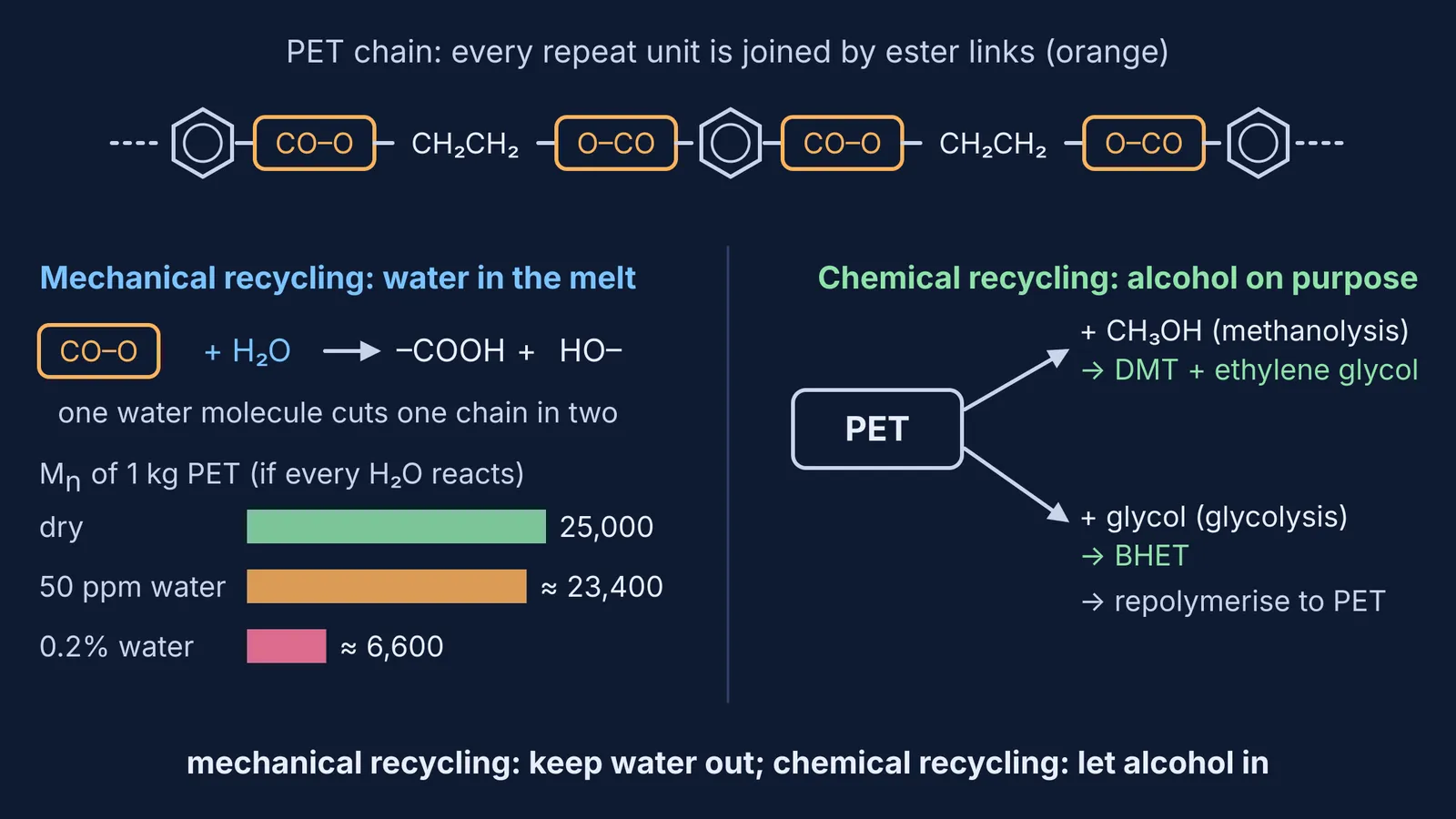
~CO–O–CH₂~ + H₂O → ~COOH + HO–CH₂~
Atoms balance: the water's H goes to one end and its OH to the other. In a bottle on a shelf it is extremely slow. In the melt, above PET's melting point of roughly 250–260 °C, it is fast. The same Wikipedia article notes that PET is hygroscopic and that if the moisture level is too high, hydrolysis reduces the molecular weight by chain scission and the plastic becomes brittle.
The key counting idea is simple. Each ester link cut adds one chain. The total mass barely changes, but it is now shared among more molecules, so the number-average molar mass, Mₙ = total mass ÷ number of chains, falls.
How much does a trace of water lower the molar mass?
Take 1 kg of dry PET with Mₙ = 25,000 g/mol. That value is for illustration, not a resin specification. Its number-average degree of polymerisation is 25,000 ÷ 192.17 ≈ 130 repeat units, the same division you meet in degree of polymerisation from molar mass.
Count the chains. Moles of chains = 1000 g ÷ 25,000 g/mol = 0.0400 mol, or 40.0 mmol.
Add 50 ppm of water. 50 ppm of 1 kg is 0.050 g. Moles = 0.050 ÷ 18.02 = 2.78 mmol. If every water molecule cuts one link, chains = 40.0 + 2.78 = 42.8 mmol.
New Mₙ. 1000 g ÷ 0.0428 mol ≈ 23,400 g/mol, a fall of about 6.5%.
Now try 0.2% water. 0.2% of 1 kg is 2.0 g, which is 111 mmol. Chains = 40.0 + 111 = 151 mmol.
New Mₙ. 1000 ÷ 0.151 ≈ 6,600 g/mol, about a quarter of the original.
Treat these numbers as an upper bound. They assume every water molecule reacts. In practice some water leaves as steam and some ester links re-form, so the real drop is smaller. Still, a fall from about 130 to about 34 repeat units turns tough bottle plastic into something weak and brittle.
The industry tracks chain length through intrinsic viscosity. Wikipedia lists about 0.70–0.78 dL/g for general-purpose bottles, 0.78–0.85 dL/g for fizzy-drink bottles and 0.40–0.70 dL/g for textile fibre. That is one reason recycled PET that has lost chain length is often spun into polyester fibre instead of new bottles. A US patent on processing PET states the usual drying target: a maximum of 50 ppm water by weight, and preferably about 30 ppm, before moulding.
If chain-counting questions trip you up, the Fermi Problem Library has a step-by-step solver that explains the reasoning at each line, not just the final number.
Why do recyclers dry PET flakes before melting them?
Mechanical recycling keeps the polymer intact. Bottles are sorted, washed, shredded into flakes, melted and pushed through an extruder into pellets. Washed flakes are wet and PET absorbs moisture from air, so flakes are dried in hot, dry air before melting. Skip that step and the worked example above happens inside the extruder.
Chain length can also be built back. Heating pellets below their melting point under vacuum or nitrogen lets chain ends react with each other, giving off water and ethylene glycol. Removing those small molecules pulls the condensation equilibrium towards longer chains, which is Le Chatelier's principle at work on a polymer.
How does chemical recycling turn PET back into monomers?
Chemical recycling uses the same ester chemistry on purpose. Instead of keeping water out, you let an alcohol in, in excess. The alcohol swaps places with the glycol part of each ester link, which is transesterification, the ester exchange reaction used to make biodiesel.
Methanolysis, per repeat unit:
C₁₀H₈O₄ + 2CH₃OH → C₆H₄(COOCH₃)₂ + HOCH₂CH₂OH
The products are dimethyl terephthalate (DMT, 194.19 g/mol) and ethylene glycol (62.07 g/mol). Check the atoms: the left side holds C₁₂H₁₆O₆ and so does the right.
Glycolysis uses ethylene glycol itself:
C₁₀H₈O₄ + HOCH₂CH₂OH → C₁₂H₁₄O₆
The product is bis(2-hydroxyethyl) terephthalate, BHET (254.24 g/mol), which can be heated to give off glycol and form PET again.
Per kilogram of PET, which is 1000 ÷ 192.17 = 5.204 mol of repeat units:
Methanolysis needs at least 2 × 5.204 × 32.04 = 333 g of methanol and gives 5.204 × 194.19 ≈ 1.01 kg of DMT plus 5.204 × 62.07 = 323 g of glycol. Mass in, 1.333 kg; mass out, 1.333 kg.
Glycolysis needs at least 323 g of glycol and gives 5.204 × 254.24 ≈ 1.323 kg of BHET.
Real plants use a large excess of alcohol and a catalyst, because these exchanges are equilibria. Chemical recycling costs more energy and solvent than melting flakes, but its monomers can be purified of dyes and contaminants before they are made into PET again.
Your PET recycling checklist
PET is a polyester; every ester link can be hydrolysed.
One water molecule reacting means one cut and one extra chain.
Mₙ = mass ÷ moles of chains, so Mₙ falls as cuts add up.
Mechanical recycling: dry flakes to tens of ppm water before melting.
Chemical recycling: excess methanol gives DMT + glycol; excess glycol gives BHET.
Balance each equation per repeat unit, C₁₀H₈O₄.
Polymers are on the JEE Advanced syllabus; ester hydrolysis and transesterification work for JEE Main and NEET too.


