On this page
You have a polymer's molar mass and need the number of units in one chain. The calculation is a single division. The only real trap is choosing what to divide by, and for a condensation polymer like nylon-6,6 that means remembering the water that leaves.
What is the degree of polymerisation?
The degree of polymerisation is the number of monomeric units in one polymer molecule, as summarised from the IUPAC definition in Wikipedia's entry on degree of polymerization. The IUPAC terms come from the Glossary of basic terms in polymer science (Pure and Applied Chemistry, 1996).
Real samples contain chains of different lengths, so the molar mass you are given is usually the number-average molar mass, Mn. The number-average degree of polymerisation is Mn divided by the mass of one unit, M0, as the same Wikipedia entry sets out. If the averaging is new to you, our explainer on number-average and weight-average molar mass walks through it.
How do you find degree of polymerisation from molar mass?
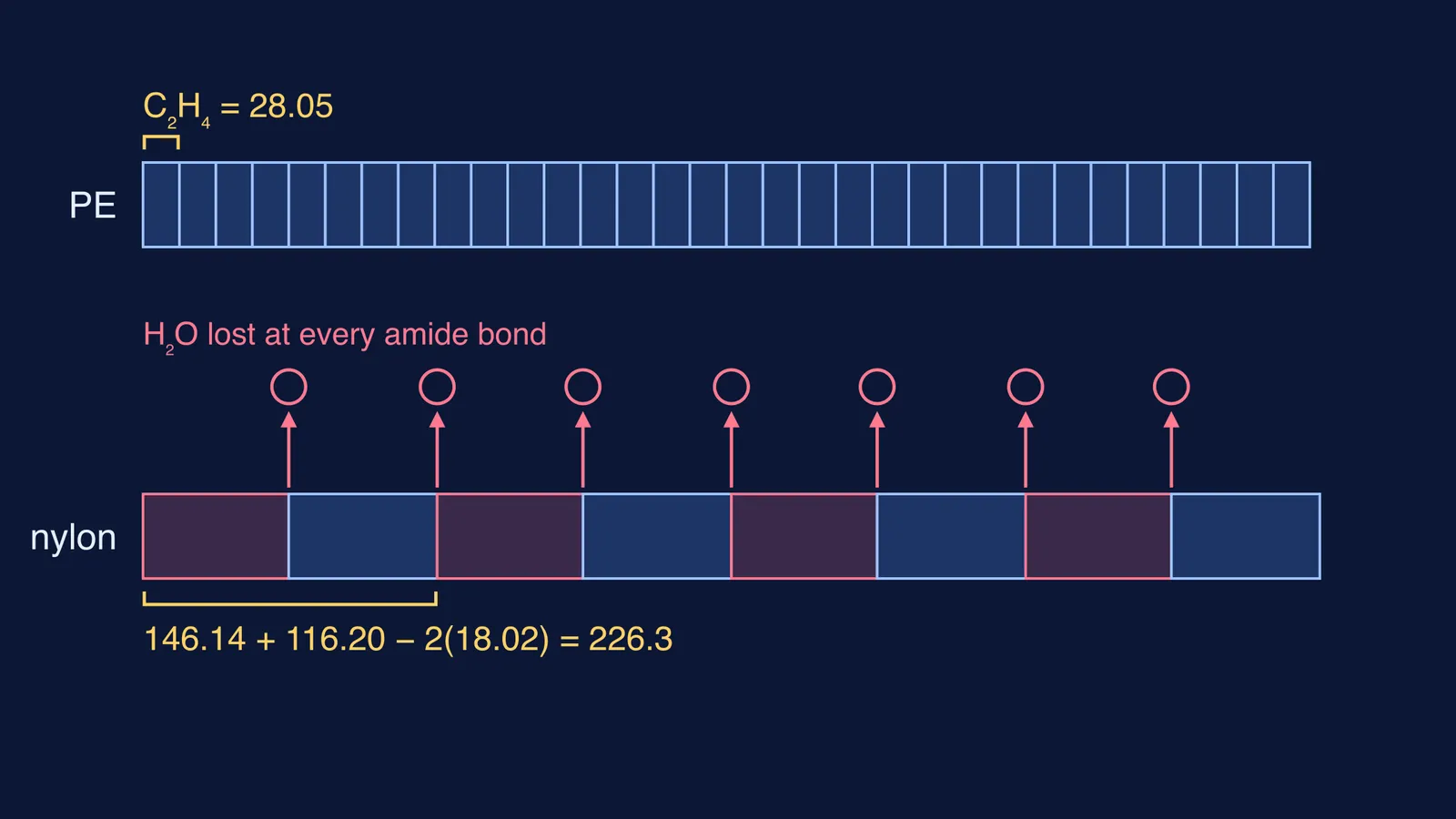
Polythene is the easy case because it is an addition polymer. The double bond in ethene opens and the units join with no by-product, n CH2=CH2 to [-CH2-CH2-]n, as shown on Wikipedia's polyethylene page. So the repeat unit has exactly the formula of the monomer, C2H4.
PubChem lists ethylene, C2H4, at 28.05 g/mol. Exam questions often round to C = 12 and H = 1, giving 28 g/mol; the CIAAW standard atomic weights for carbon and hydrogen sit close enough to those values that the rounding barely changes n.
Worked example: ultra-high-molecular-weight polythene has molecular weights usually between 3.5 and 7.5 million, according to Wikipedia's polyethylene page. Take 3,500,000 g/mol.
Repeat unit: C2H4 = 28.05 g/mol.
n = 3,500,000 / 28.05 ≈ 124,800.
At 7,500,000 g/mol, n = 7,500,000 / 28.05 ≈ 267,400.
So one chain of this material holds roughly 125,000 to 267,000 ethene units.
How do you handle the water lost in nylon-6,6?
Nylon-6,6 is a condensation polymer. It forms from hexamethylenediamine and adipic acid, and water is removed as each amide bond forms, according to Wikipedia's nylon 66 page. Its repeat unit is C12H22N2O2.
Build the repeat-unit mass from PubChem's values:
Adipic acid, C6H10O4: 146.14 g/mol
Hexamethylenediamine, C6H16N2: 116.20 g/mol
Water, H2O: 18.015 g/mol
Each repeat unit is held together by two amide bonds, so two waters go per unit: 146.14 + 116.20 - 2(18.015) = 226.31 g/mol. Check the atoms too: C6H10O4 + C6H16N2 = C12H26N2O4, and taking away 2 H2O leaves C12H22N2O2, the formula above.
Worked example: a nylon-6,6 sample has Mn = 20,000 g/mol (an exam-style value, not a measured one).
Repeat-unit mass = 226.3 g/mol.
n = 20,000 / 226.3 ≈ 88 repeat units.
The two usual wrong answers both come from the water. Dividing by 262.34 (both monomers, no water removed) gives about 76. Removing only one water (244.33) gives about 82.
Repeat units or monomer units: which does the question want?
Here is a subtlety that is easy to miss. IUPAC counts monomeric units, and each nylon-6,6 repeat unit contains two of them, -NH(CH2)6NH- and -OC(CH2)4CO-. So a chain of 1000 monomeric units is 500 repeat units, as Wikipedia's degree of polymerization entry explains. By that count, the sample above has about 177 monomeric units.
Many school and entrance-exam questions ask for n, the number outside the bracket, which counts repeat units. Read the wording: "number of repeat units" or "value of n" means divide by 226.3; "number of monomer molecules" means double that answer. For polythene the two counts are the same.
To revise why the two classes behave differently, see our post on addition and condensation polymers. For how nylon came about, read the story of Wallace Carothers and nylon.
What should you check before you divide?
Addition or condensation? For addition, the repeat unit equals the monomer. For condensation, subtract the small molecule lost.
Count the bonds formed per repeat unit and subtract one small molecule for each (two waters for nylon-6,6).
Check the repeat-unit formula atom by atom, as we did above.
Decide whether the question wants repeat units or monomer units.
Sanity-check the size: if n comes out tiny, you probably divided the wrong way round.
If the bottom of the fraction keeps tripping you up, work a few more in the Fermi Problem Library, where the step-by-step solver explains the reasoning rather than printing an answer. For the ideas underneath, the Fermi Concept Library covers every concept in chemistry, each with its own lesson.