On this page
If your polymers chapter gives you two chain lengths and asks for Mn, Mw and PDI, you need two different averages of the same sample: one counts molecules, the other counts mass. Here is what each means, a full worked example, and the checks that catch wrong answers.
What is the difference between number average and weight average molar mass?
Chains in a polymer sample stop growing at different lengths, so its molar mass has to be an average, and there is more than one sensible way to take it.
The number-average molar mass is Mn = ΣNiMi / ΣNi, where Ni is the number of chains with molar mass Mi (DoITPoMS, University of Cambridge, on LibreTexts). It is the total mass of the sample divided by the total number of chains: the ordinary mean you already know.
The weight-average molar mass is Mw = ΣNiMi² / ΣNiMi, which can also be written Mw = ΣwiMi, where wi is the mass fraction of each chain length (DoITPoMS on LibreTexts). Squaring Mi means each chain is weighted by its own mass, so long chains pull Mw upward.
The ratio Mw/Mn is the polydispersity index (PDI), and it equals 1 only when every molecule has the same mass (DoITPoMS on LibreTexts). A 2009 IUPAC recommendation coined the word dispersity, symbol Đ, to replace the misleading but widely used name polydispersity index (Stepto, Pure and Applied Chemistry, 2009). Your textbook may still say PDI; the number is the same.
If weighted averages feel new, the idea matches how to calculate your weighted average marks: a subject with more credits counts for more, and here a heavier chain counts for more.
How do you calculate Mn, Mw and PDI for two chain lengths?
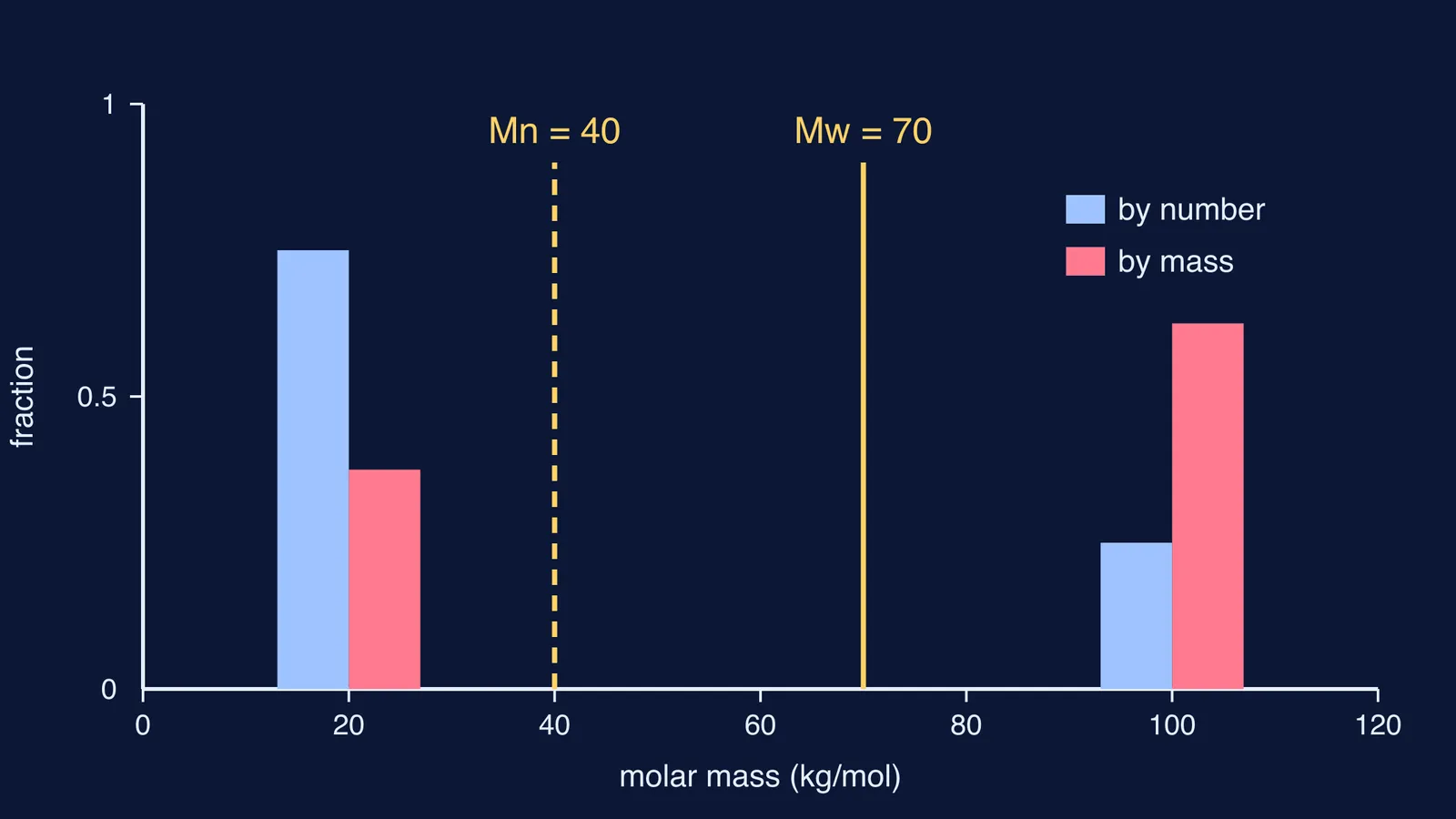
The problem: a sample contains 3 mol of chains with M = 20,000 g/mol and 1 mol of chains with M = 100,000 g/mol. Find Mn, Mw and the PDI, using the DoITPoMS formulas above.
Total number of chains: ΣNi = 3 + 1 = 4 mol.
Total mass: ΣNiMi = 3 × 20,000 + 1 × 100,000 = 160,000 g.
Mn = 160,000 / 4 = 40,000 g/mol.
Sum of NiMi²: 3 × (20,000)² + 1 × (100,000)² = 1.2 × 10⁹ + 1.0 × 10¹⁰ = 1.12 × 10¹⁰.
Mw = 1.12 × 10¹⁰ / 160,000 = 70,000 g/mol.
PDI = Mw / Mn = 70,000 / 40,000 = 1.75.
Look at what happened. Three quarters of the chains are short, so Mn sits close to 20,000. But the long chains carry 100,000 g of the 160,000 g, five-eighths of the mass, so Mw sits much nearer 100,000.
What if the question gives masses instead of numbers of chains?
Many questions mix equal masses of two fractions. Then work with mass fractions and the form Mw = ΣwiMi (DoITPoMS on LibreTexts). Take 1 g of the 20,000 g/mol polymer mixed with 1 g of the 100,000 g/mol polymer.
Mw = ΣwiMi = 0.5 × 20,000 + 0.5 × 100,000 = 60,000 g/mol.
For Mn, convert to moles first: 1/20,000 = 5.0 × 10⁻⁵ mol and 1/100,000 = 1.0 × 10⁻⁵ mol, so Mn = 2 g / 6.0 × 10⁻⁵ mol ≈ 33,300 g/mol.
PDI = 60,000 / 33,333 ≈ 1.8.
The trap is that equal masses are not equal numbers of chains. Averaging 20,000 and 100,000 directly gives 60,000, which is Mw here, not Mn.
Why does the difference matter in the lab?
Different experiments measure different averages. Osmometry and end-group determination give Mn, while static light scattering gives Mw (Wikipedia, Molar mass distribution). That is why the method in finding molar mass from osmotic pressure returns a number average when the solute is a polymer: osmotic pressure depends on how many particles are dissolved, not how heavy each one is.
As the spread of chain masses narrows, Mw approaches Mn and the ratio moves towards 1 (LibreTexts, Molecular Weights of Polymers/Polymers/Molecular_Weights_of_Polymers)). A larger PDI means a broader spread. For how the chains form in the first place, see addition and condensation polymers.
How do you practise this until it is automatic?
Write the three sums ΣNi, ΣNiMi and ΣNiMi² as a small column before dividing anything.
Decide first whether the question gives numbers of chains (moles or molecules) or masses; convert masses to moles for Mn.
Run the two checks: both averages between the extremes, and PDI at least 1.
Redo the worked example with 1 mol of each chain length. You should get Mn = 60,000 g/mol, Mw ≈ 86,700 g/mol and PDI ≈ 1.44.
If you want more numericals like this, the Fermi Problem Library has worked problems with a step-by-step solver that explains the reasoning rather than printing an answer, so you can see where a squared term went missing. If the definitions are shaky, the Fermi Concept Library covers every concept in chemistry, so you can go back one step first.