

On this page
When high-school courses or university modules carry different credit points, a simple average of your percentages will give you the wrong answer. A final exam carrying half the weight of the course pulls the final grade more than a minor quiz.
Here is how to calculate a weighted average and why doing it right matters for your academic planning.
What is a weighted average?
A weighted average accounts for the fact that some assessments count for more than others. Instead of treating every number equally, it multiplies each mark by a "weight" that reflects its importance in the final calculation. This weight could be the number of credit points a university subject is worth, or the percentage value assigned to a term paper in a class syllabus.
How to calculate the weighted average of marks?
To calculate the Weighted Average Mark (WAM), multiply each subject's mark by its credit points, sum those values, and divide by the total credit points attempted, according to the University of Melbourne.
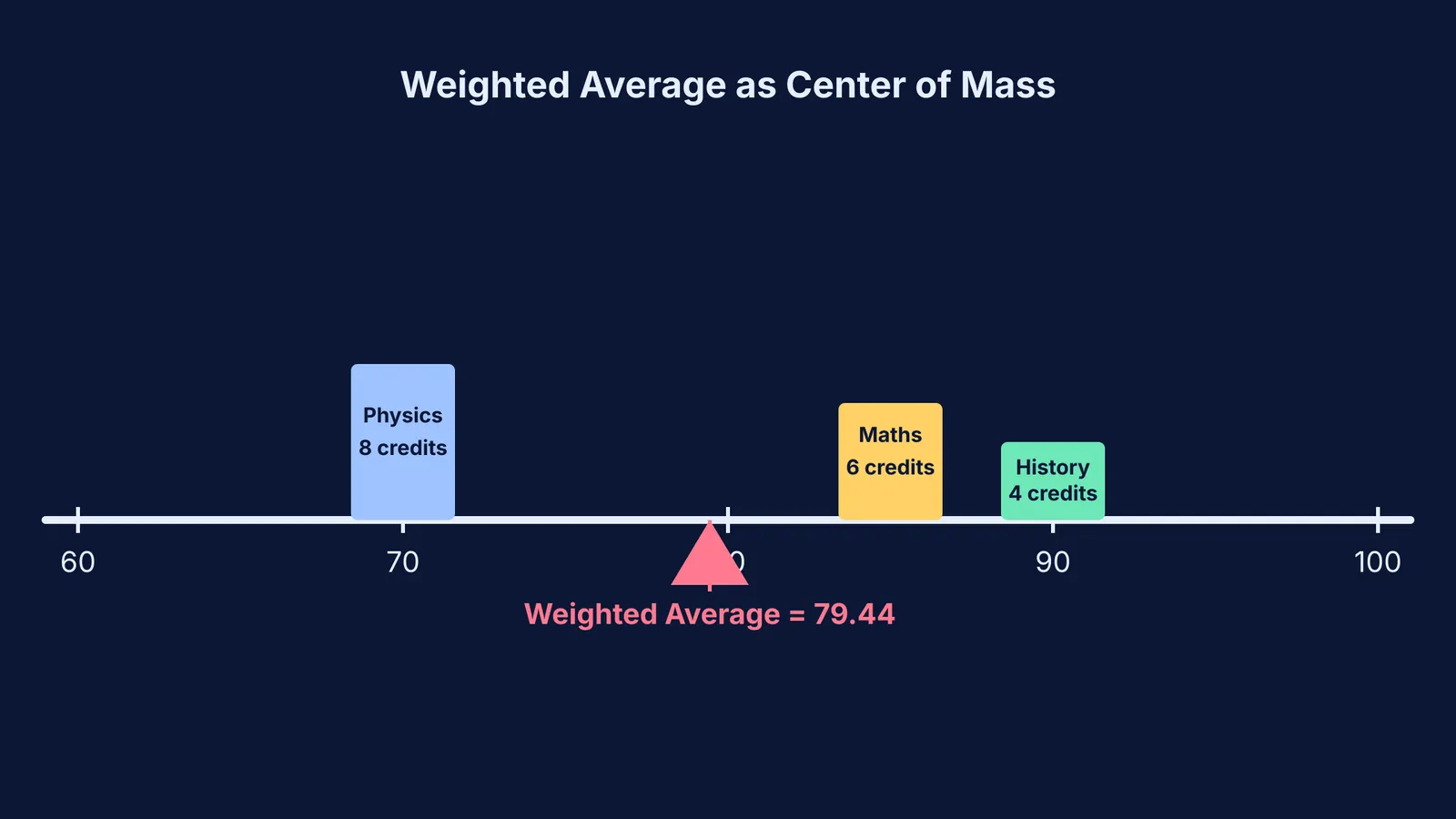
Here is a step-by-step example to find your WAM across a semester. Say you have three subjects with different credit values:
Mathematics (6 credits): 85 marks
Physics (8 credits): 70 marks
History (4 credits): 90 marks
Multiply each mark by its weight:
Mathematics: 85 × 6 = 510
Physics: 70 × 8 = 560
History: 90 × 4 = 360
Add these weighted points together: 510 + 560 + 360 = 1430.
Add the total weights (credit points): 6 + 8 + 4 = 18.
Divide the total weighted points by total weights: 1430 / 18 = 79.44.
Your weighted average is 79.44.
Why does a simple average mislead?
If you took a simple average, you would simply add the percentages (85 + 70 + 90 = 245) and divide by 3 to get 81.66.
The simple average ignores that History, where you scored 90, is a smaller 4-credit course, while Physics, where you scored 70, is a massive 8-credit course. By pulling the average toward the heavier subjects, the weighted average reflects your true standing. Because heavier subjects anchor the final score so firmly, doing well in them is the fastest way to raise your grade.
If you ever need help visualising the math behind averages, distributions, or the centre of mass in physics, the Fermi Concept Library has a lesson for every mathematical concept and its place in the map.
How to calculate a running grade during a term?
Often, you need to know your current standing before all assignments are complete. To calculate a running average, you only divide the weighted points you have earned by the total weights of the assignments graded so far.
Imagine you are in a class with a midterm carrying a weight of 30 and a final carrying a weight of 70. You scored 80 on the midterm, and the final has not happened yet. Your current weighted points are 80 × 30 = 2400. Since you have only completed 30 out of the 100 total weight points, your running total weight is 30. Dividing 2400 by 30 gives a running average of 80. You are sitting at an 80, not a 24 out of 100.
How to calculate the grade needed on a final exam?
If you want to know what you need on an upcoming final exam to hit a specific target average, you can run the formula in reverse.
Required Mark = ((Target Average × Total Weight) − Current Weighted Points) / Weight of Final Exam.
Let us say your target average is 75 for the entire course (which has a total weight of 100). You have completed assignments worth 60 of those weight points, and your running average on them is 70.
Find your current weighted points from completed work: 70 × 60 = 4200.
Calculate the target weighted points for the whole course: 75 × 100 = 7500.
Find the points needed from the final exam: 7500 − 4200 = 3300.
Divide the needed points by the final exam's weight (40 points): 3300 / 40 = 82.5.
You must score 82.5 on the final exam to finish the semester with a 75.
For more advanced statistics practice, see how adding to or scaling data changes the mean and variance. We also use weighted averages in science, such as calculating the weighted Cv method with an example to find the properties of a gas mixture.


