

On this page
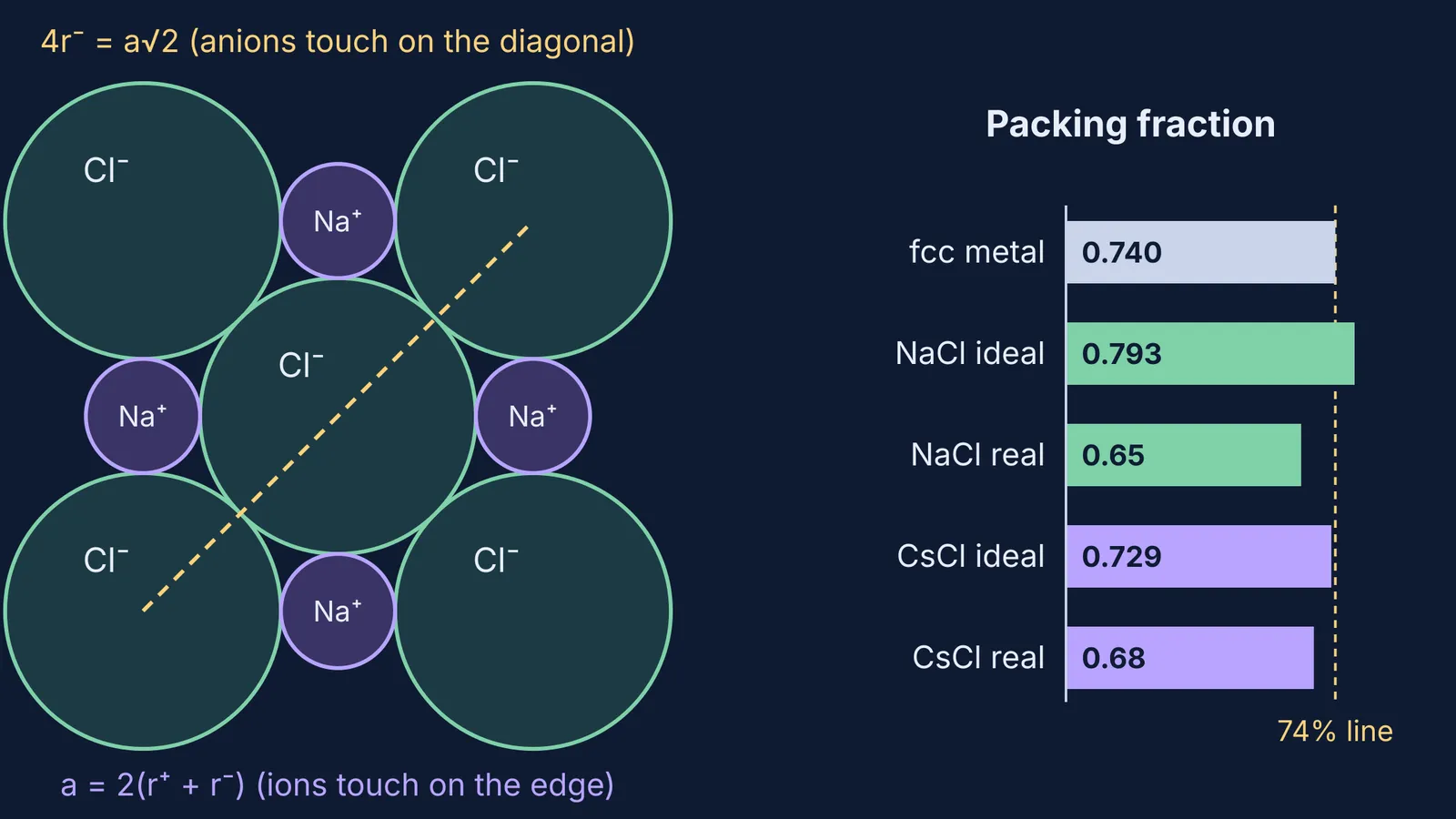
The 74% packing efficiency of fcc is a hard ceiling, but only for spheres that are all the same size. An ionic crystal has two sizes of sphere, and the small ions sit in the gaps between the large ones. In ideal rock salt the ions fill 79.3% of the cell, yet real NaCl and CsCl reach only about 65% and 68%. Here is how to get each number, and why more neighbours does not mean denser packing.
Can an ionic crystal pack more densely than 74%?
Yes, in principle. The 74% limit, worked out in our post on packing efficiency of fcc, bcc and simple cubic, is about identical spheres. In the rock-salt structure the Cl⁻ ions form an fcc array and the Na⁺ ions sit in its octahedral holes.
Suppose each cation fits its hole exactly. Then the anions still touch one another, so they alone fill 74.0% of the cell, just like an fcc metal. The cations fill space that was empty before, without making the cell any bigger. They add another 5.3%, which gives 79.3% in total. That only works if the cation slips in without pushing the anions apart.
How do you calculate packing efficiency for an ionic solid?
Use the same three steps as for a metal, but count both ions.
Count the ions in one cell. NaCl has Z = 4, which means 4 Na⁺ and 4 Cl⁻. CsCl has Z = 1, which means 1 Cs⁺ and 1 Cl⁻.
Find which ions touch, and write the edge length a in terms of the radii.
Divide the total volume of all the ions by a³.
Step 2 depends on the radius ratio r⁺/r⁻, which our post on the radius ratio rule for NaCl, CsCl and ZnS explains.
Rock salt, r⁺/r⁻ at or below 0.414: the anions touch along the face diagonal, so 4r⁻ = a√2.
Rock salt, r⁺/r⁻ above 0.414: cation and anion touch along the edge, so a = 2(r⁺ + r⁻).
CsCl structure: Cl⁻ sits at the corners and Cs⁺ at the body centre. Cation and anion touch along the body diagonal, so a√3 = 2(r⁺ + r⁻). At exactly 0.732 the anions also touch along the edge, so a = 2r⁻ as well.
Worked example: what is the packing efficiency of ideal NaCl?
Take r⁻ = 1 and r⁺/r⁻ = 0.414, so r⁺ = 0.414.
Edge length. a = 2(r⁺ + r⁻) = 2 × 1.414 = 2.828. The face diagonal check gives 4r⁻/√2 = 2.828 too, so both contacts are made at once.
Volume of the ions. One pair of ions takes up (4/3)π(1³ + 0.414³) = 4.189 × 1.071 = 4.486. Four pairs take up 17.94.
Cell volume. a³ = 2.828³ = 22.63.
Packing fraction. 17.94 ÷ 22.63 = 0.793, or 79.3%.
Split it up: the four Cl⁻ alone give 4 × 4.189 ÷ 22.63 = 0.740. The four Na⁺ add 0.053.
What is the packing efficiency of real NaCl?
Use Shannon's radii for coordination number 6: Na⁺ is 102 pm and Cl⁻ is 181 pm, as listed in the Wikipedia ionic radius table, which is taken from Shannon's 1976 paper.
Ratio. 102 ÷ 181 = 0.564, which is above 0.414. Na⁺ is too big for a hole between touching chlorides, so it pushes them apart.
Edge length. The contact is along the edge: a = 2(102 + 181) = 566 pm. The measured edge is 564.02 pm, according to the Wikipedia page on sodium chloride, so the radii are consistent.
Volume of the ions. (4/3)π(102)³ = 4.45 × 10⁶ pm³ and (4/3)π(181)³ = 2.48 × 10⁷ pm³. Four of each give 1.171 × 10⁸ pm³.
Cell volume. 566³ = 1.813 × 10⁸ pm³.
Packing fraction. 1.171 ÷ 1.813 = 0.646. With the measured edge of 564 pm instead, you get 0.653. Either way it is about 65%.
That is well below 74%, because the chlorides no longer touch: their centres are a/√2 = 400 pm apart, against 362 pm for touching ions.
The radius set matters. The same Wikipedia page quotes Shannon's "crystal radii", 116 pm for Na⁺ and 167 pm for Cl⁻. They have the same 283 pm sum, but give a packing fraction of about 0.58. Always say which table you used.
Why is CsCl not packed more densely than NaCl?
CsCl has 8 : 8 coordination and NaCl 6 : 6, so many students expect CsCl to be denser. Check the ideal case.
Ratio. At the limit, r⁺/r⁻ = 0.732. Take r⁻ = 1, so r⁺ = 0.732.
Edge length. The anions touch along the edge, so a = 2. Check the body diagonal: 2(1 + 0.732) = 3.464, and 2√3 = 3.464.
Volume of the ions. (4/3)π(1 + 0.732³) = 4.189 × 1.392 = 5.832.
Packing fraction. 5.832 ÷ 8 = 0.729, or 72.9%.
That is less than ideal NaCl (79.3%), and even less than an fcc metal (74.0%). The reason is the anion framework. In CsCl the anions form a simple cubic array, which fills only 52.4% of space on its own. The large cation in the cube centre adds a lot, but it cannot make up the difference. Coordination number counts neighbours. It does not measure how full the cell is.
For real CsCl, use Cs⁺ = 174 pm (the radius for coordination number 8) and Cl⁻ = 181 pm.
a = 2(174 + 181) ÷ √3 = 409.9 pm. The Wikipedia page on caesium chloride gives a measured edge of 411.9 pm.
The ion volume is 4.69 × 10⁷ pm³, and the cell volume is 409.9³ = 6.89 × 10⁷ pm³.
The packing fraction is 0.681. With the measured edge it is 0.671.
So real CsCl (about 0.68) does end up a little fuller than real NaCl (about 0.65). That is because Cs⁺ is nearly as big as Cl⁻, not because of the 8 : 8 coordination.
The hard-sphere picture has limits. Real ions can be squeezed, and NaCl takes up the CsCl structure under very high pressure, which rigid spheres cannot explain.
Which mistakes cost marks on ionic packing questions?
Counting one kind of ion. NaCl has 8 ions per cell, not 4.
Using anion contact for real NaCl. 4r⁻ = a√2 holds only when r⁺/r⁻ is 0.414 or less. For an anion-contact case worked through in full, see finding the Cl⁻ radius from LiCl's unit cell.
Putting the CsCl contact on the edge. Cs⁺ and Cl⁻ touch along the body diagonal, so a√3 = 2(r⁺ + r⁻).
Mixing radius sets or coordination numbers. Cs⁺ is 174 pm for coordination number 8. Do not mix Shannon and Pauling radii.
Assuming ionic solids always beat 74%. Only an ideal small cation does that. Real NaCl and CsCl do not.
If you keep choosing the wrong contact direction, the Fermi Problem Library has worked problems with a step-by-step solver that explains the reasoning. To go back over voids and close packing, the Concept Library gives each idea its own lesson.
Quick checklist
Count both ions: 4 + 4 for NaCl, 1 + 1 for CsCl.
Compare r⁺/r⁻ with 0.414 or 0.732 to find which ions touch.
Rock salt: use 4r⁻ = a√2 or a = 2(r⁺ + r⁻). CsCl: use a√3 = 2(r⁺ + r⁻).
The ideal values to know are 0.793 for NaCl, 0.729 for CsCl and 0.740 for fcc.
State which radius set you used.


