

On this page
Most rock-salt questions use one relation: the edge length equals twice the cation–anion distance, a = 2(r⁺ + r⁻). That works for NaCl. It does not work when you are given only the edge length of LiCl and asked for the radius of Cl⁻, because you do not know r(Li⁺) separately. The way out is to notice that in LiCl the chloride ions are packed so tightly that they touch each other. Once you see which ions touch, the radius drops out of the geometry of a single face.
Why do Cl⁻ ions touch each other in LiCl?
LiCl has the rock-salt (NaCl-type) structure. The Cl⁻ ions form a face-centred cubic arrangement, and every octahedral hole holds a cation. If you need a refresher on why rock salt has coordination number 6, see how the radius ratio rule predicts NaCl, CsCl and ZnS structures.
The size of each octahedral hole is fixed by the anions around it. When the anions touch, the largest sphere that fits in the hole has radius 0.414 r⁻. A cation larger than that pushes the anions apart. A cation smaller than that would rattle.
Li⁺ is tiny. On the Shannon scale (coordination number 6), r(Li⁺) is about 76 pm and r(Cl⁻) about 181 pm, so r⁺/r⁻ ≈ 0.42. That is only just above 0.414. The Li⁺ ions are barely big enough to fill the holes, so they hardly push the chlorides apart, and the Cl⁻ ions end up touching, or very nearly touching, their Cl⁻ neighbours.
Which ions touch along the face of a rock-salt cell?
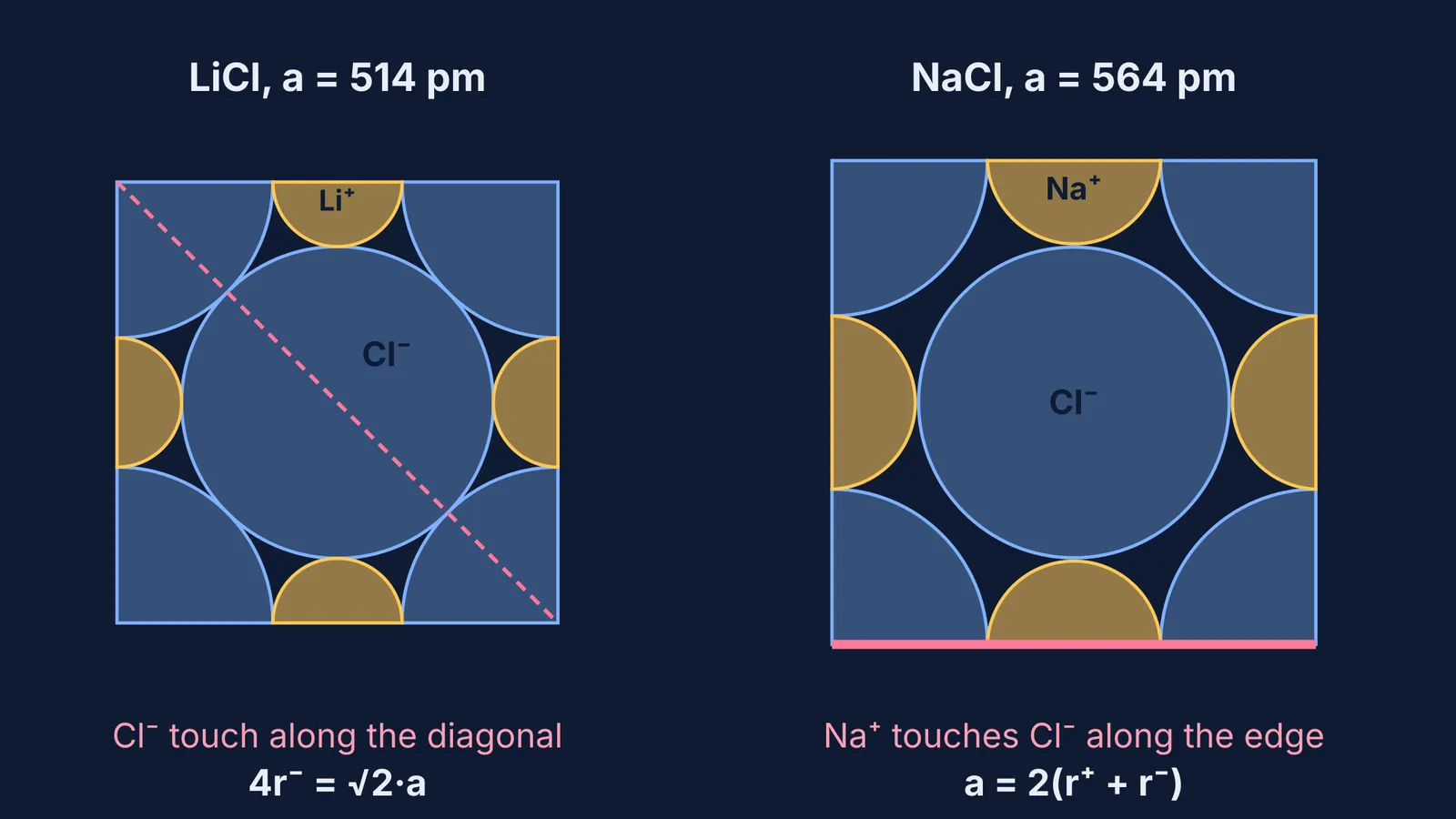
Look at one face of the cubic unit cell. Anions sit at the four corners and at the centre of the face. Cations sit at the midpoints of the four edges.
Along an edge the order is anion, cation, anion. If cation and anion touch, the edge length is a = 2(r⁺ + r⁻).
Along the face diagonal the order is anion, anion, anion, with no cation in between. If anions touch, the diagonal holds four anion radii. The diagonal of a square of side a is √2·a, so 4r⁻ = √2·a, which gives r⁻ = √2·a/4.
Only one of these is the true contact in a given crystal. The other distance has a small gap. Your job is to decide which.
How do you find the radius of Cl⁻ from LiCl's edge length?
LiCl's cubic lattice constant at room temperature is about 513–514 pm, as listed in standard crystallographic tables. A quick check that this value is sensible: with 4 formula units per cell, the density comes out as 4 × 42.39 g mol⁻¹ ÷ (6.022 × 10²³ mol⁻¹ × (514 × 10⁻¹⁰ cm)³) ≈ 2.07 g cm⁻³, which matches the measured density of LiCl.
Worked example. The edge length of LiCl is 514 pm. Assuming the Cl⁻ ions touch, find r(Cl⁻) and the largest cation that fits in the octahedral hole.
Decide which ions touch. r⁺/r⁻ for LiCl is close to 0.414, so the anions are in contact along the face diagonal.
Write the contact relation. Four anion radii span the face diagonal: 4r⁻ = √2·a.
Solve for r⁻. r⁻ = √2 × 514 / 4 = 1.4142 × 128.5 = 181.7 pm. The tabulated Shannon value for Cl⁻ (CN 6) is 181 pm, so the answer is right.
Find the room left for Li⁺. Along the edge, a/2 is the distance from a Cl⁻ centre to the Li⁺ centre. The space for the cation is a/2 − r⁻ = 257 − 181.7 = 75.3 pm.
Compare with Li⁺. The Shannon radius of Li⁺ (CN 6) is about 76 pm. So Li⁺ fills the hole almost exactly. The cation and anion nearly touch as well.
Check the ratio. 75.3 / 181.7 = 0.414. This is not a coincidence. Whenever anions touch, the hole radius is exactly (√2 − 1) times r⁻.
Step 5 matters. Li⁺ does not float loosely in an oversized hole. In LiCl both contacts are almost made at once, which is why 2(76 + 181) = 514 pm also reproduces the measured edge length.
Ionic radii depend on the scale used. Shannon and Pauling radii differ by a few picometres, so always say which scale you are comparing with.
What goes wrong if you use the same formula for NaCl?
NaCl has a = 564 pm. Try the anion-contact relation anyway.
Apply 4r⁻ = √2·a. r⁻ = √2 × 564 / 4 = 199.4 pm.
Compare with the table. The Cl⁻ radius is about 181 pm. The formula overshoots by about 18 pm.
Find the real gap. The Cl⁻–Cl⁻ centre distance across half the face diagonal is √2 × 564 / 2 = 398.8 pm. Two touching Cl⁻ would need only 2 × 181 = 362 pm. So the chlorides in NaCl are about 37 pm apart, surface to surface.
Use the correct relation. Na⁺ and Cl⁻ touch along the edge, so a = 2(r⁺ + r⁻). With r(Cl⁻) = 181 pm, r(Na⁺) = 564/2 − 181 = 101 pm, close to the Shannon value of 102 pm.
The reason is the radius ratio. For Na⁺, r⁺/r⁻ ≈ 102/181 = 0.56, well above 0.414. Na⁺ is too big for a hole between touching chlorides, so it pries them apart. KCl is the same story with a larger gap: K⁺ (about 138 pm) gives r⁺/r⁻ ≈ 0.76.
How do you decide which relation to use in an exam?
Use this three-step check on any rock-salt question.
Estimate r⁺/r⁻. Use the radii given, or known values if none are given.
Decide which ions touch. If r⁺/r⁻ is at or below 0.414, the anions touch along the face diagonal. If it is above 0.414, the cation and anion touch along the edge.
Pick the relation. Anion contact: 4r⁻ = √2·a. Cation–anion contact: a = 2(r⁺ + r⁻).
If the question itself says "the anions touch each other" or "assume anion–anion contact", that settles step 2 for you. JEE questions on LiCl and similar lithium halides usually phrase it that way. For the matching relations in metals made of one kind of atom, where every atom is the same size, see edge length and atomic radius in simple cubic, bcc and fcc. For harder mixed questions, including a check on whether anions touch in a zinc blende cell, try the solid state JEE Advanced practice questions with solutions.
If you want to see why the face diagonal, not the edge, carries the anion contact, sketching the face helps more than memorising. The Concept Library covers ionic crystal geometry, and the Fermi Problem Library has a step-by-step solver that explains the reasoning on edge-length problems like this one.
Quick checklist
In a rock-salt face, anions sit at corners and the centre; cations sit at edge midpoints.
Anion contact: 4r⁻ = √2·a. Cation–anion contact: a = 2(r⁺ + r⁻).
LiCl, a ≈ 514 pm: r(Cl⁻) = 181.7 pm, hole radius 75.3 pm, and Li⁺ (about 76 pm) nearly fills it.
NaCl, a = 564 pm: the anion-contact formula gives 199 pm, which is too large. Use a = 2(r⁺ + r⁻).
Check r⁺/r⁻ against 0.414 before choosing a formula.
Name the radius scale (Shannon, CN 6) when you compare with tables.


