

On this page
Oxygen takes its first electron easily. O(g) + e⁻ → O⁻(g) releases about 141 kJ/mol. The second electron is a different story: O⁻(g) + e⁻ → O²⁻(g) absorbs roughly 780 kJ/mol. That is the NCERT value; other data tables give anything from about 744 to 844 kJ/mol. So a free oxide ion is less stable than an O⁻ ion and a loose electron. Yet magnesium oxide, calcium oxide and sodium oxide are made of O²⁻ ions, and MgO is so stable it is used to line furnaces. This post shows where the energy comes from, with a full Born–Haber cycle for MgO.
Why is the second electron gain enthalpy of oxygen positive?
The first electron is attracted by the oxygen nucleus. Oxygen is small, so that pull is strong, and energy is released. Why the first value for O (−141) is smaller in size than for S is a separate story, covered in why chlorine has a more negative electron gain enthalpy than fluorine.
The second electron is added to an ion that is already negative. Two things work against it:
Charge repulsion. The incoming electron is pushed away by the whole −1 charge of O⁻.
Crowding. It has to enter the small 2p subshell, which already holds five electrons packed close together.
Together these cost more energy than the nucleus pays back, so the step is endothermic and ΔegH is positive.
There is a detail most textbooks skip. An isolated O²⁻ ion in the gas phase is not stable at all: it would throw off its extra electron on its own. So nobody can measure the +780 directly in an experiment. The number is worked out backwards from Born–Haber cycles of oxides, using lattice energies calculated from theory. Different oxides and different models give slightly different answers, which is why the tables disagree.
Where does the energy to make O²⁻ come from?
It comes from the crystal. Once the ions are formed, bringing gaseous Mg²⁺ and O²⁻ together into a solid releases a huge amount of energy, the lattice energy.
The attraction between two ions depends on the product of their charges divided by the distance between them. For Mg²⁺ and O²⁻ the charge product is 2 × 2 = 4, four times that of a 1+/1− pair such as Na⁺Cl⁻ at a similar distance. Both ions are also small, so they sit close together. The full trend is explained in how ion charge and size decide the lattice energy of a crystal.
In the rock-salt structure of MgO, each O²⁻ is surrounded by six Mg²⁺ ions. That positive neighbourhood is what holds the second electron in place. The O²⁻ ion exists because of the lattice, not in spite of it.
How do you calculate the lattice enthalpy of MgO?
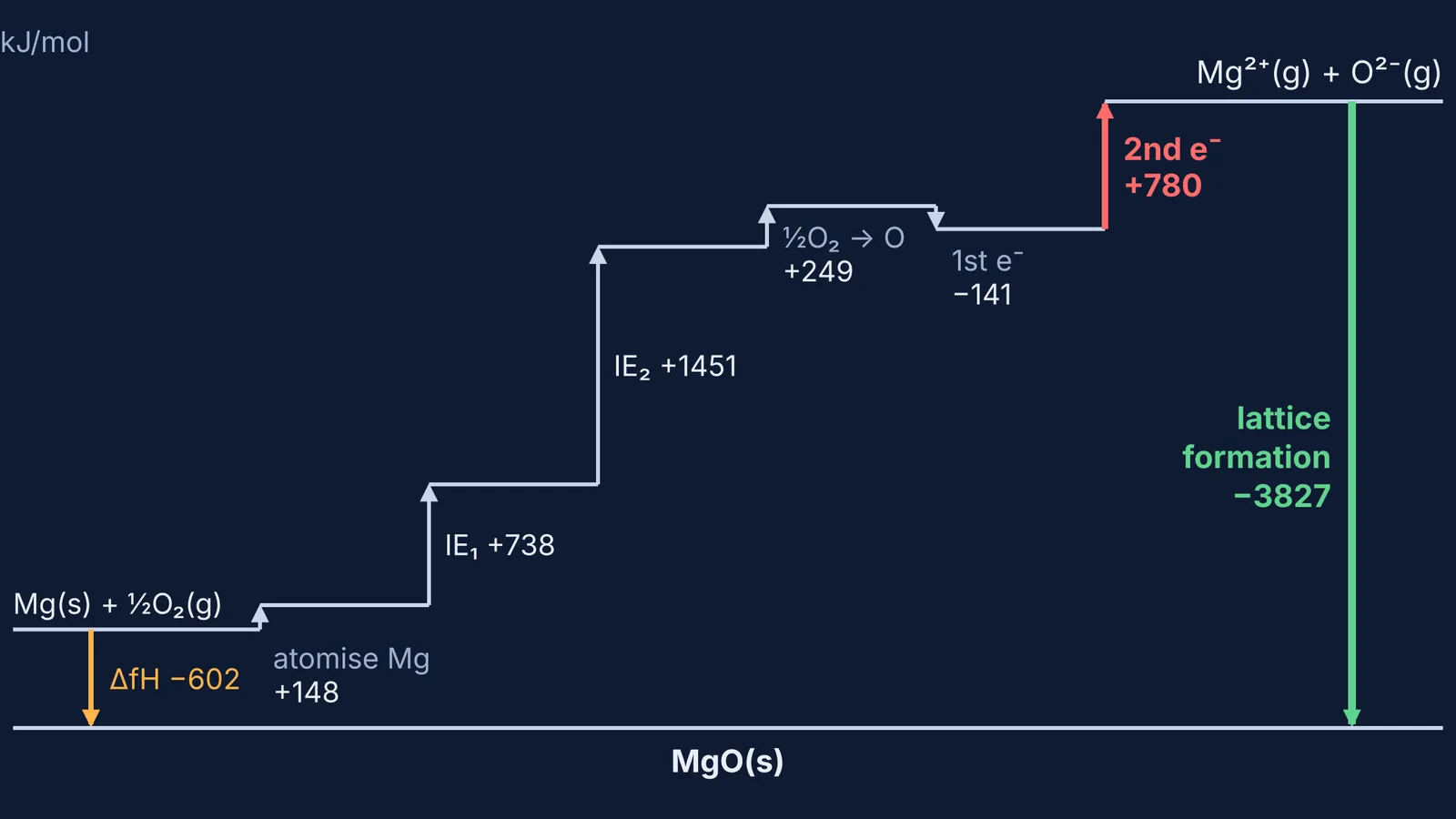
If the basic idea of a Born–Haber cycle is new to you, start with lattice enthalpy and the Born–Haber cycle in Class 11 chemistry, which uses a 1+/1− example. Here is the 2+/2− version. Values are approximate standard data in kJ/mol.
The data
Atomisation of magnesium: Mg(s) → Mg(g), +148
First ionisation: Mg(g) → Mg⁺(g) + e⁻, +738
Second ionisation: Mg⁺(g) → Mg²⁺(g) + e⁻, +1451
Half the O=O bond enthalpy: ½O₂(g) → O(g), +249
First electron gain: O(g) + e⁻ → O⁻(g), −141
Second electron gain: O⁻(g) + e⁻ → O²⁻(g), +780
Enthalpy of formation: Mg(s) + ½O₂(g) → MgO(s), −602
Worked example, step by step
Write Hess's law. Going from the elements to MgO directly must give the same ΔH as going through the gaseous ions. So ΔfH = (sum of the six steps) + ΔH for Mg²⁺(g) + O²⁻(g) → MgO(s).
Add the six steps. 148 + 738 + 1451 + 249 − 141 + 780 = +3225 kJ/mol. Making gaseous Mg²⁺ and O²⁻ from the elements is steeply uphill.
Solve for the lattice step. ΔH(lattice formation) = −602 − 3225 = −3827 kJ/mol, about −3,800 kJ/mol. As a lattice dissociation enthalpy (the NCERT convention, solid → gaseous ions) the same number is +3827 kJ/mol.
Check how much the uncertain value matters. With 744 for the second electron gain you get −3791 kJ/mol; with 844 you get −3891 kJ/mol. The answer moves by about 2–3%, and the conclusion does not change.
Read the cycle. The two steps that exist only because the ions are doubly charged are the second ionisation of Mg (+1451) and the second electron gain of O (+780), together +2231 kJ/mol. The lattice step releases 3827 kJ/mol, enough to pay for all six uphill steps and still leave MgO 602 kJ/mol below its elements.
Why doesn't magnesium form Mg⁺O⁻ instead?
A fair question: if the second ionisation and the second electron gain cost 2231 kJ/mol, why not stop at Mg⁺ and O⁻?
Try a rough estimate. Mg⁺O⁻ would need only atomisation, the first ionisation, bond breaking and the first electron gain: 148 + 738 + 249 − 141 = +994 kJ/mol. With a charge product of 1 instead of 4, its lattice energy would be at most about a quarter of MgO's, roughly −957 kJ/mol, and less in reality because Mg⁺ and O⁻ are larger ions. That gives ΔfH ≈ 994 − 957 ≈ +37 kJ/mol, or worse.
Treat these numbers as a sketch, not data. The message is still clear: Mg⁺O⁻ would barely form, if at all, while Mg²⁺O²⁻ sits at −602 kJ/mol. Doubling both charges quadruples the lattice energy, and that gain outruns the extra ionisation and electron gain costs. The same reasoning explains why you find O²⁻ in Na₂O and CaO, S²⁻ in sulphides and N³⁻ in Mg₃N₂, where even more uphill electron gain steps are paid for by the lattice.
If you want to practise more cycles like this, the Fermi Problem Library has a step-by-step solver that explains the reasoning at each stage, including which signs to use.
Why doesn't O²⁻ survive in water?
Outside a crystal, the oxide ion has nothing to hold its extra charge. In water it grabs a proton at once:
O²⁻ + H₂O → 2OH⁻
This is why soluble metal oxides such as Na₂O and CaO dissolve to give hydroxide solutions. Free O²⁻ exists in ionic solids and in molten oxides, where it is surrounded by cations, not in solution and not as a lone gas-phase ion.
Quick checklist
O(g) + e⁻ → O⁻(g): about −141 kJ/mol. O⁻(g) + e⁻ → O²⁻(g): about +780 kJ/mol.
The second value is positive because of repulsion by the −1 charge and crowding in the 2p subshell.
It is not measured directly; it is derived from Born–Haber cycles, so tables differ.
For MgO the six gas-phase steps add to +3225 kJ/mol, and the lattice formation step is about −3827 kJ/mol.
The 2+/2− lattice energy pays for the second ionisation and the second electron gain.
O²⁻ exists in solids and melts; in water it becomes OH⁻.


