

On this page
Heat a pot of juice on a stove and the heat has to travel in from the hot metal wall. The juice at the wall gets hot first; the middle waits. Ohmic heating does something different. Two electrodes push an electric current straight through the juice, and the juice itself becomes the resistor. Every cubic centimetre makes its own heat at the same moment. Food engineers study this for heating liquid foods, and the physics is Class 12 current electricity: Joule heating written per unit volume.
What is ohmic heating?
Ohmic heating (also called Joule heating or electroconductive heating) passes an alternating current through a food that conducts electricity. Juices, milk and soups conduct because they contain dissolved ions such as potassium, chloride and organic acids. The food's own resistance turns electrical energy into heat.
A review in the Journal of Food Science and Technology, Varghese and co-workers (2014), "Technology, applications and modelling of ohmic heating", describes how heat is generated "in the whole mass of the food material" and lists conductivities of foods at 25 °C, for example about 0.52 S/m for full-cream milk and 0.027 S/m for margarine, which it marks as unsuitable because its conductivity is too low.
How much heat does each cubic metre make?
You know Joule's law for a wire, H = I²Rt; its history is in Joule's law of heating. For a food in a pipe, the useful version is per unit volume.
Take a block of length L and cross-section A, with conductivity σ (unit S/m, the reciprocal of resistivity). Its resistance is R = L/(σA). With field E along it, the voltage is V = EL and the current density is J = σE (this is Ohm's law in its local form).
Power P = V²/R = (EL)² × σA/L = σE² × AL
Volume = AL, so P/V = σE² = J²/σ
Units check: (S/m)(V/m)² = (A/V·m)(V²/m²) = W/m³. If the food is uniform, σ and E are the same everywhere, so the heat is made uniformly through the whole volume.
The temperature then rises at
dT/dt = σE²/(ρc)
where ρc is the heat capacity per unit volume. Juice is mostly water, so ρc ≈ 4.0 × 10⁶ J/(m³ K) is a reasonable round value (water's is 4.19 × 10⁶).
How fast does orange juice heat in a 20 V/cm field?
Real data first. Lamsal and Jindal (2014), in Applied Science and Engineering Progress, measured the conductivity of lab-squeezed orange juice during continuous ohmic heating. It rose linearly with temperature, from a mean of 0.343 S/m at 25 °C to 0.971 S/m at 80 °C, with about 10% variation between fruit from different places.
For the field, Icier and Ilicali (2005), in European Food Research and Technology, heated orange juice concentrates ohmically at voltage gradients from 20 to 60 V/cm. Take the low end: E = 20 V/cm = 2,000 V/m.
Worked example: 25 °C to 80 °C
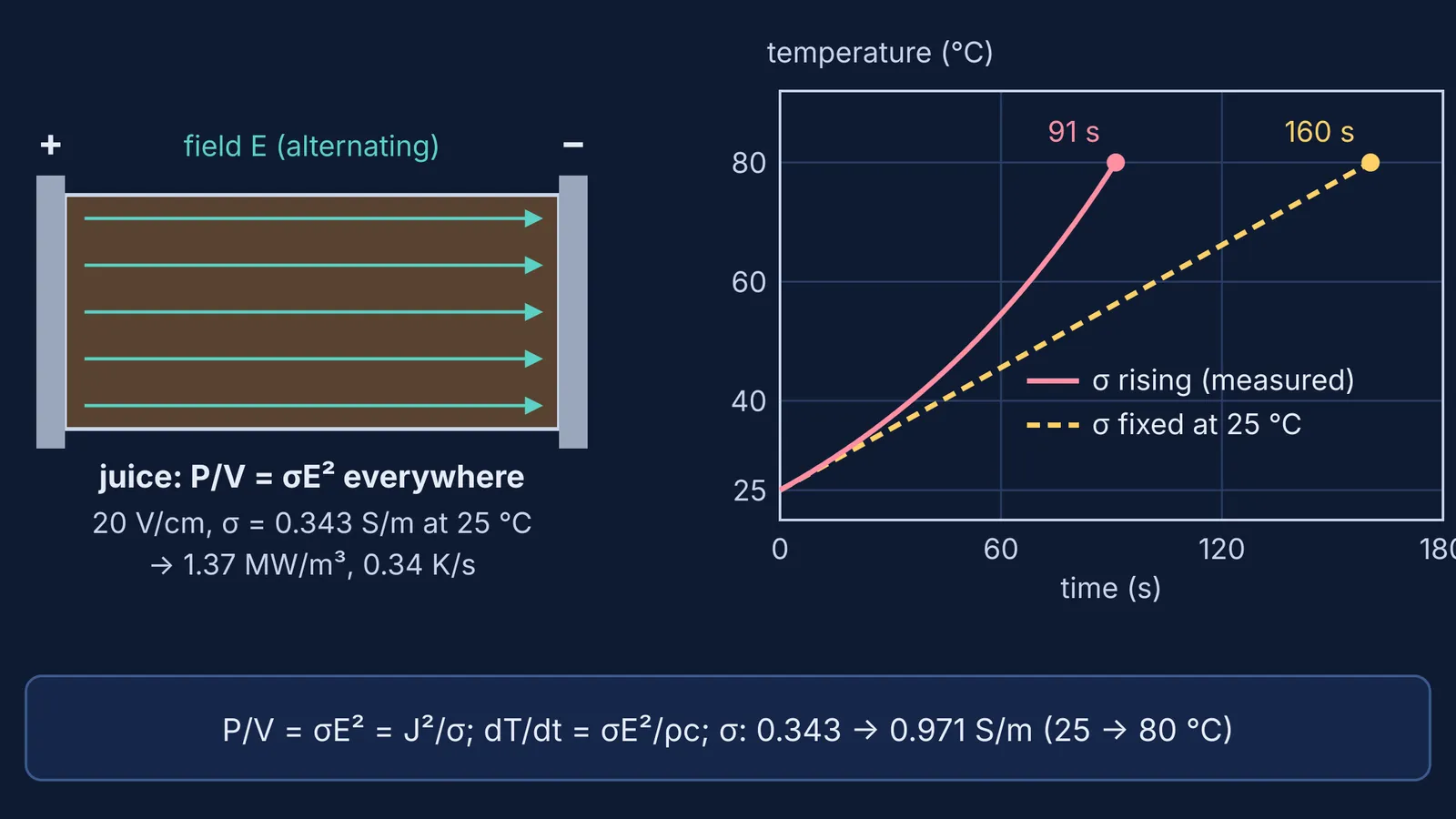
Heating rate at the start. σE² = 0.343 × (2,000)² = 1.37 × 10⁶ W/m³. Divide by ρc: 1.37 × 10⁶/4.0 × 10⁶ = 0.343 K/s.
If σ stayed at 0.343 S/m. 55 K/0.343 K/s = 160 s.
But σ rises. Its slope is (0.971 − 0.343)/55 = 0.0114 S/m per K, about 3.3% of the 25 °C value for each kelvin. So write σ = σ₀ + b(T − 25) with b = 0.0114 S/(m K).
Solve the rate equation. dT/dt = [σ₀ + b(T − 25)]E²/ρc. Separate and integrate: t = [ρc/(bE²)] ln(σ_final/σ_start) = [4.0 × 10⁶/(0.0114 × 4 × 10⁶)] × ln(0.971/0.343) = 87.6 × 1.041 = 91 s. A step-by-step numerical sum in python gives the same 91 s.
Heating rate at the end. 0.971 × 4 × 10⁶/4.0 × 10⁶ = 0.97 K/s, almost three times the starting rate.
Current. J = σE = 686 A/m² at the start and 1,940 A/m² at the end. In a pipe 5 cm across (A = 1.96 × 10⁻³ m²) with electrodes 10 cm apart, that is 200 V driving 1.3 A at first and 3.8 A at 80 °C.
So, with these illustrative numbers, the juice goes from 25 °C to 80 °C in about a minute and a half, and the middle heats as fast as the edge.
Why does ohmic heating avoid the slow middle?
A stove heats by conduction from the outside. Heat diffusing into the centre of a piece of food of half-thickness L takes a time of order L²/α, where α is the thermal diffusivity. For a 2 cm cube of vegetable, with α ≈ 1.4 × 10⁻⁷ m²/s (close to water's), L²/α = (0.01)²/(1.4 × 10⁻⁷) ≈ 710 s, as an order of magnitude. Why cutting things smaller helps is covered in why small pieces cook faster.
Ohmic heating does not wait for diffusion. A microwave oven also heats inside the food, but by making water molecules jostle in an oscillating field, and the waves weaken as they go deeper; see how a microwave oven heats food from the inside. In ohmic heating the current itself flows through the whole path between the electrodes.
What goes wrong with ohmic heating?
The same formula explains the problems.
Fat barely heats. The Varghese review notes that non-polar constituents such as fats and lipids lower conductivity. Low σ means low σE², so fatty parts of a mixture lag behind.
Hot spots and runaway. Because σ rises with temperature, a region that gets a little hotter conducts better. If it sits in parallel with cooler regions across the same field, it draws more current, heats even faster and pulls further ahead. The review calls this "runaway heating, or formation of hot spots", and gives a striking case: frozen shrimp has about 100 times lower conductivity than thawed shrimp.
Electrolysis at the electrodes. Direct current would split water and corrode the plates. The review notes that even 50 or 60 Hz alternating current can cause hydrogen and oxygen evolution, and that higher frequencies, about 10 kHz from a pulsed supply, can remove the corrosion effect.
Industrial systems are designed and controlled to manage these effects. This post covers only the physics of the heating, not whether any particular process makes food safe; that is for food-safety regulators and the studies themselves.
Never try this at home. Ohmic heating puts mains-level voltages across an exposed conducting liquid, and a person touching it becomes another parallel path for the current.
To see how heating rate depends on σ and E, or why parallel and series paths behave differently, the Concept Library covers every concept in physics, chemistry, biology, mathematics and computing.
Quick checklist
The food is the resistor: P/V = σE² = J²/σ, in W/m³.
Temperature rises at dT/dt = σE²/ρc, everywhere at once in a uniform food.
Orange juice: σ ≈ 0.343 S/m at 25 °C rising linearly to 0.971 S/m at 80 °C (Lamsal and Jindal).
At 20 V/cm, 25 °C to 80 °C takes about 91 s, against 160 s if σ stayed constant.
Parallel paths: higher σ heats more. Series paths: lower σ heats more.
Fats conduct poorly; rising σ can cause runaway hot spots; AC limits electrolysis.


