

On this page
Ask why nitrogen gas is so unreactive and the textbook answer comes back at once: N₂ has a triple bond, and breaking it takes 946 kJ/mol. That answer earns the marks, and you should write it. But it cannot be the whole story, because carbon monoxide has an even stronger bond and is a reactive molecule. The fuller reason is about the first step of a reaction, not the total bond energy.
What does the textbook say about why N₂ is unreactive?
The standard answer, set out in why nitrogen gas is unreactive at room temperature, is that the N≡N bond is short and very strong, the molecule is nonpolar, and so a large amount of energy is needed before it reacts.
The 946 kJ/mol figure is solid. From the NIST Chemistry WebBook (CODATA values), ΔfH of a gaseous N atom is 472.68 kJ/mol, so D(N≡N) = 2 × 472.68 ≈ 945 kJ/mol at 298 K.
If the N≡N bond is so strong, why is CO reactive?
Use the same NIST data for CO: ΔfH of C(g) is 716.68, of O(g) is 249.18 and of CO(g) is −110.53 kJ/mol. So:
D(C≡O) = 716.68 + 249.18 − (−110.53) ≈ 1076 kJ/mol
That is about 130 kJ/mol more than N₂, and OpenStax's table of average bond energies agrees (C≡O 1080, N≡N 946). Yet CO burns in air (2CO + O₂ → 2CO₂), reduces iron ore in the blast furnace, and binds metals tightly in carbonyls such as Ni(CO)₄, as explained in synergic bonding in metal carbonyls. N₂ does none of this under ordinary conditions.
So "strongest bond, least reactive" fails. Total bond energy tells you how much energy it takes to pull the atoms completely apart. Reactions almost never do that in one go.
Why does the first π bond matter more than the total?
A triple bond is one σ bond and two π bonds. When a molecule reacts by addition, it breaks one π bond first. What matters is how much that first step costs.
Subtract the average bond energies from the OpenStax table (approximate, since they are averages over many molecules):
Nitrogen: N≡N 946, N=N 418, N–N 160 kJ/mol. First π bond: 946 − 418 = 528. Second π bond: 418 − 160 = 258.
Carbon: C≡C 837, C=C 611, C–C 345 kJ/mol. First π bond: 837 − 611 = 226. Second π bond: 611 − 345 = 266.
In ethyne, the first π bond is the weaker one, so addition starts easily. In N₂ it is the reverse: the first π bond is about twice as strong as the second and more than twice as strong as ethyne's first. Once N₂ is partly reduced, the rest comes easily. The hard part is the start.
Worked example: hydrogenating N₂ and C₂H₂ step by step
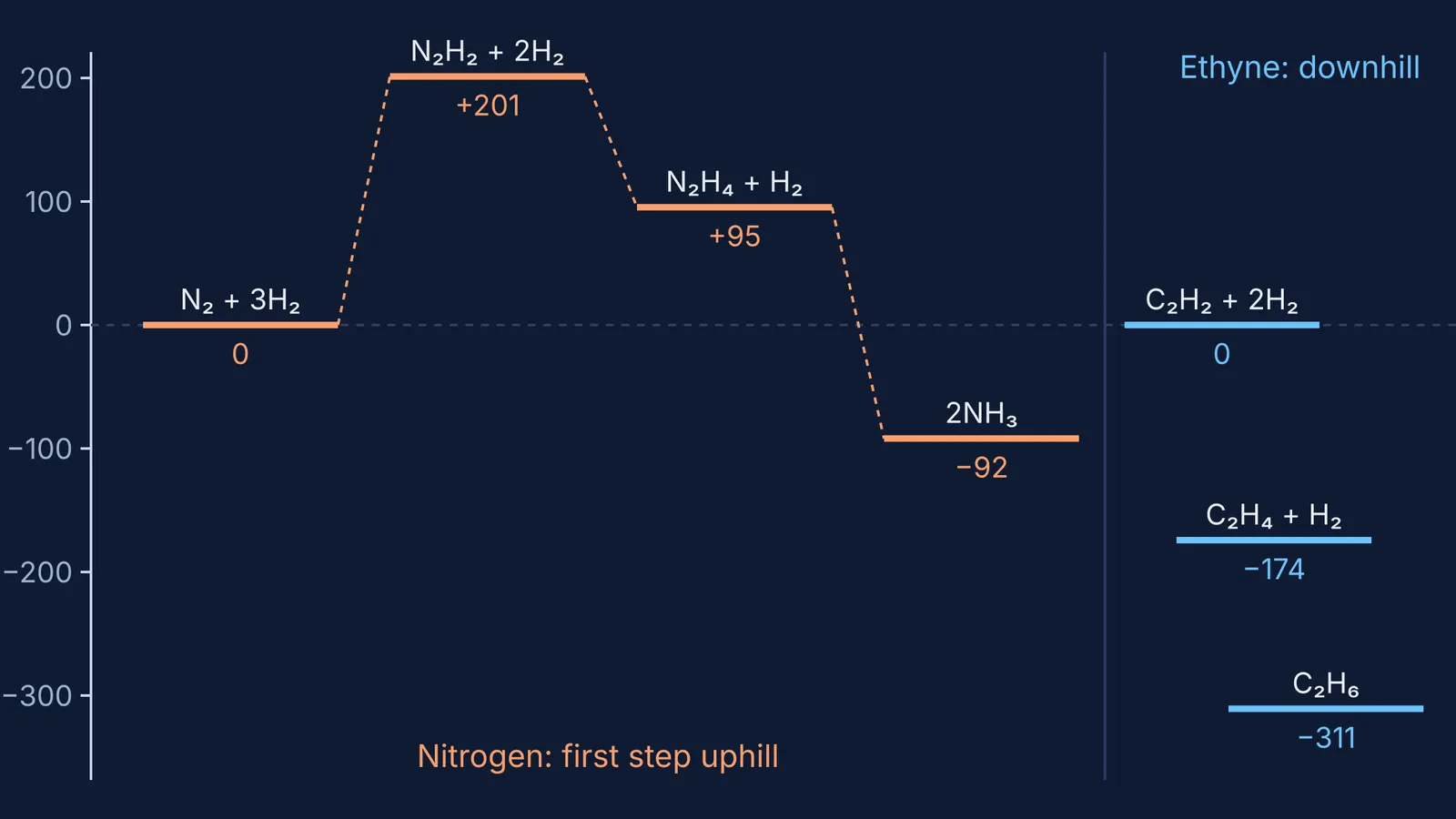
Use Hess's law with gas-phase ΔfH values at 298 K (kJ/mol): C₂H₂ +226.7, C₂H₄ +52.5, C₂H₆ −84.0, N₂H₄ +95.4 and NH₃ −45.9 from the NIST Chemistry WebBook. Diazene (HN=NH) is a short-lived molecule with no NIST entry; take trans-diazene as about +201 kJ/mol from high-level calculations by Matus, Arduengo and Dixon (2006). The cis form in NIST-JANAF is about +213, so treat the diazene step as approximate. ΔfH of N₂ and H₂ is zero.
C₂H₂ + H₂ → C₂H₄: ΔH = 52.5 − 226.7 = −174 kJ/mol. Downhill.
C₂H₄ + H₂ → C₂H₆: ΔH = −84.0 − 52.5 = −136 kJ/mol. Downhill again.
N₂ + H₂ → HN=NH: ΔH = +201 − 0 − 0 = +201 kJ/mol. Strongly uphill.
HN=NH + H₂ → H₂N–NH₂: ΔH = 95.4 − 201 = −106 kJ/mol. Downhill.
H₂N–NH₂ + H₂ → 2NH₃: ΔH = 2(−45.9) − 95.4 = −187 kJ/mol. Downhill.
Add steps 3 to 5: +201 − 106 − 187 = −92 kJ/mol for N₂ + 3H₂ → 2NH₃, which is 2 × (−45.9). Per mole of ammonia, ½N₂ + 3/2H₂ → NH₃ has ΔH = −46 kJ/mol.
Check step 3 with bond energies: break N≡N and H–H (946 + 436 = 1382), form N=N and two N–H (418 + 2 × 390 = 1198), so ΔH ≈ +184 kJ/mol. That is close to +201 and confirms the sign.
The overall reaction is downhill. But the first step climbs about 200 kJ/mol, and a step's activation energy can never be smaller than its ΔH when it is uphill. Ethyne's first step goes 174 kJ/mol down. That contrast, not the 946, is why N₂ sits unreacted while ethyne adds hydrogen readily over a catalyst.
What else makes N₂ inert compared with CO?
Bond energy steps are not the only difference. The electrons themselves are harder to use.
Tightly held electrons. NIST gives the ionisation energy of N₂ as 15.58 eV and of CO as 14.01 eV. N₂'s highest filled orbital lies lower, and its lowest empty orbital (π*) lies high, so the HOMO–LUMO gap is large.
Nonpolar and symmetric. N₂ has no dipole and no end that an electrophile or nucleophile prefers. In CO, the highest filled orbital is a lone pair concentrated on carbon.
Poor σ donor. NIST lists the proton affinity of CO as 594 kJ/mol against 494 kJ/mol for N₂. A molecule that binds H⁺ more weakly also donates its lone pair to a metal more weakly.
Poor π acceptor. CO's π* orbital is larger on carbon and lower in energy, so a metal can push electrons into it. N₂'s π* is shared equally between two atoms and sits higher, so back-bonding is weaker. N₂ complexes of metals do exist, but they are far fewer and less stable than carbonyls.
How do industry and nature get round the first step?
They avoid making free diazene. In the Haber process, N₂ sticks to an iron surface, which weakens and finally breaks the N≡N bond on the metal, so hydrogen atoms add to surface-bound nitrogen instead. The temperature and pressure choices are covered in why the Haber process uses 450 °C and 200 atm. Nitrogenase enzymes in bacteria also bind N₂ to metal atoms and feed in electrons and protons in small steps.
If you want to practise more Hess's law chains like the one above, the Fermi Problem Library has a step-by-step solver that explains the reasoning.
Quick checklist
Exam answer: triple bond, 946 kJ/mol, small and nonpolar.
CO's bond is stronger (about 1076 kJ/mol) yet CO is reactive, so total bond energy is not enough.
First π bond: about 528 kJ/mol in N₂ against about 226 in ethyne (average bond energies).
N₂ + H₂ → HN=NH is about +200 kJ/mol; C₂H₂ + H₂ → C₂H₄ is −174 kJ/mol.
Full reduction to NH₃ is downhill: −46 kJ/mol per mole of NH₃.
N₂ also has a large HOMO–LUMO gap and is a poor σ donor and π acceptor compared with CO.


