

On this page
You have probably done this reaction in the Class 12 lab: add dimethylglyoxime (DMG) and ammonia to a solution of a nickel salt and a rosy red solid appears. The same reaction is used outside the lab, on a cotton bud, to check whether earrings, watch backs and belt buckles give off nickel. That matters because contact allergy to nickel is common worldwide, and piercings and jewellery have long been considered among its main causes (Nixon and colleagues, Contact Dermatitis). This post is about the chemistry of the test. It is not medical advice: if you think your skin reacts to metal, a doctor can test you properly.
How does the nickel spot test on jewellery work?
The reagent is the one from your practical file: about 1% DMG dissolved in ethanol, plus a few drops of dilute ammonia. The test goes like this:
Wet the tip of a cotton bud with a drop of the DMG solution and a drop of dilute ammonia.
Rub the bud firmly for about half a minute on the part of the item that touches skin.
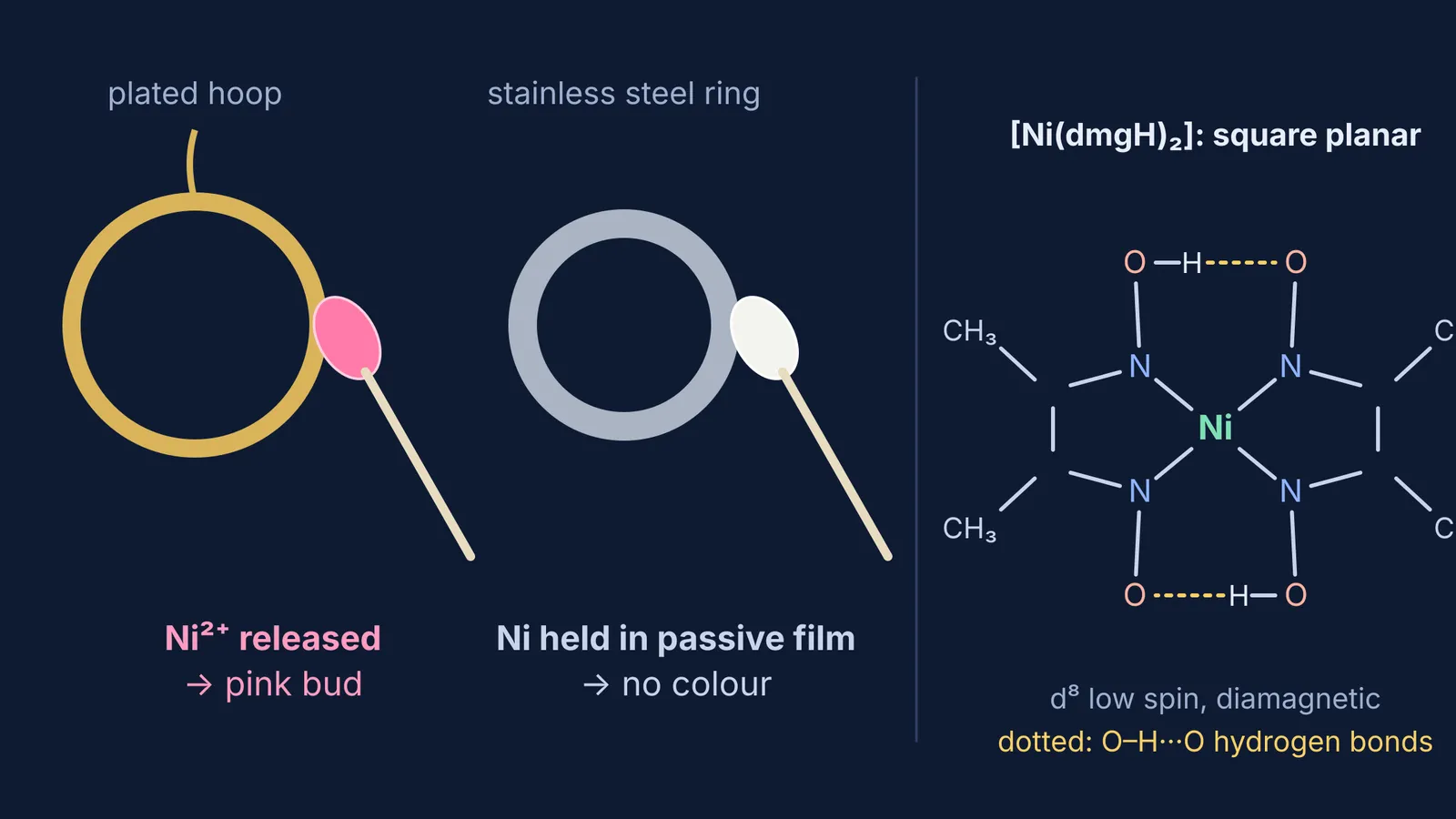
Look at the bud. Pink to red means nickel ions came off the metal. No colour means none were detected.
On the bud, the same equilibrium you met in group IV analysis is at work:
Ni²⁺ + 2 dmgH₂ ⇌ [Ni(dmgH)₂] + 2H⁺
Here dmgH₂ is neutral DMG, C₄H₈N₂O₂. Each one loses one H⁺ from an oxime O–H group and binds nickel through its two nitrogens, giving neutral [Ni(dmgH)₂], not Ni(dmg)₂²⁻. Check the charges: +2 on the left, 0 + 2(+1) = +2 on the right.
Wear gloves: the solution is flammable ethanol, and ammonia irritates the eyes.
Why does the DMG test need ammonia?
Every nickel ion captured releases two H⁺ ions. If those protons pile up, the equilibrium shifts back to the left and the red complex dissolves. Ammonia mops them up:
NH₃ + H⁺ → NH₄⁺
Removing a product pulls the equilibrium to the right, by Le Chatelier's principle. That is why the test fails in acid, and why the group IV test is done in an ammoniacal solution. Skin sweat is mildly acidic, so the ammonia on the bud also matters for the spot test.
Why is Ni(dmgH)₂ red, flat and insoluble?
Ni²⁺ is d⁸. With the strong field of the four nitrogen donors it is low spin, square planar and diamagnetic (dsp² in valence bond language). Two O–H···O hydrogen bonds join the oxygen atoms of the two ligands and close a large flat ring, and the flat molecules stack tightly in the solid. That stacking is why it comes out of water as a solid. The full structure story is in the dimethylglyoxime test for nickel and its red precipitate. To compare it with nickel's tetrahedral and other complexes, see how nickel complexes switch between sp³ and dsp² hybridisation.
How much nickel is in the red precipitate? A worked example
The same reaction is a classic gravimetric method, because the precipitate is heavy compared with the nickel in it.
Problem: A 0.500 g sample of a nickel silver alloy (copper, zinc and nickel) is dissolved in acid. Excess DMG and ammonia are added, and the dried red precipitate weighs 0.3650 g. What is the percentage of nickel in the alloy?
Step 1. Find the molar mass of Ni(dmgH)₂. The formula is C₈H₁₄N₄NiO₄. Using C = 12.011, H = 1.008, N = 14.007, O = 15.999 and Ni = 58.693:
8(12.011) + 14(1.008) + 4(14.007) + 4(15.999) + 58.693 = 288.9 g mol⁻¹
Step 2. Find the gravimetric factor. One mole of complex holds one mole of nickel, so the mass fraction of nickel is:
58.69 ÷ 288.9 = 0.2032
Turned around, 1 mg of nickel gives 288.9 ÷ 58.69 = 4.92 mg of red precipitate.
Step 3. Find the mass of nickel. 0.3650 g × 0.2032 = 0.07415 g of nickel.
Step 4. Find the percentage. (0.07415 ÷ 0.500) × 100 = 14.8% nickel.
That fits nickel silver, which typically holds about 10–20% nickel. Notice why the method is precise: a weighing error of 0.1 mg in the precipitate is only 0.1 × 0.2032 = 0.02 mg of nickel. For more problems of this kind, the Fermi Problem Library has a step-by-step solver that explains the reasoning, so you can see where each factor comes from.
Why can stainless steel contain nickel and still not turn the bud pink?
Common stainless steel such as grade 304 contains roughly 8–10% nickel. Yet a test on it often shows little or nothing. The reason is the passive film: chromium in the steel forms a thin, continuous layer of Cr₂O₃ that keeps the metal underneath from dissolving. You may know it from why stainless steel does not rust. The same film that keeps out water and oxygen also keeps nickel in.
In one study in acidic artificial sweat, nickel-plated samples released about 100 µg of nickel per cm² per week. Low-sulphur stainless steels released under 0.03 µg per cm² per week, and a sulphur-containing free-machining grade (303) released about 1.5 µg (Haudrechy and colleagues, Contact Dermatitis). For comparison, the EU limit for items in direct and prolonged skin contact is 0.5 µg cm⁻² per week, and 0.2 µg cm⁻² per week for posts inserted into pierced ears, measured by the EN 1811 sweat test (entry 27 of Annex XVII to the EU REACH Regulation, summarised in Wikipedia's Nickel Directive article).
So what matters for the skin, and what the test is meant to pick up, is nickel release, not nickel content.
Can the nickel spot test give a wrong answer?
Yes, in both directions, so it is a quick screen.
Missed nickel (false negatives). When earring parts were compared with the EN 1811 lab test, the spot test caught only 59.3% of the items that released nickel above the limit, while 97.5% of the items below the limit correctly gave no colour (Thyssen and colleagues, Contact Dermatitis). In plain terms, a pink bud is usually right, but a white bud misses about four in ten releasing items.
Release changes. Plating wears off, sweat varies and scratches expose fresh metal, so a negative item may release more later.
Colour from iron (false positives). Fe²⁺ in ammonia also forms a red-brown complex with DMG, so iron and steel objects can colour the bud. Adding a few drops of citric acid turns the iron complex into a colourless soluble one, while the nickel colour stays (ChemEd X).
Bulk versus surface. Some researchers argue the opposite risk too: on certain steels the test may react to nickel in the metal rather than to how fast it dissolves (Haudrechy and colleagues).
The reference method is EN 1811, in which the item sits in artificial sweat for a week and the dissolved nickel is measured in a lab.
Quick checklist
Equation: Ni²⁺ + 2 dmgH₂ ⇌ [Ni(dmgH)₂] + 2H⁺, so write [Ni(dmgH)₂], not Ni(dmg)₂²⁻.
Ammonia removes H⁺ and pulls the equilibrium right; the test fails in acid.
The complex is square planar, low spin d⁸, diamagnetic, with two O–H···O hydrogen bonds.
Gravimetric factor: 58.69 ÷ 288.9 = 0.2032; 1 mg Ni gives 4.92 mg of precipitate.
The test detects nickel release, not nickel content; the Cr₂O₃ passive film holds nickel in.
A white bud is not proof of no nickel; iron can give a false red.


