

On this page
Put a rechargeable Ni–Cd AA cell next to an ordinary alkaline AA and a meter reads about 1.2 V for one and 1.5 V for the other. The NCERT Class 12 Electrochemistry chapter lists the nickel–cadmium cell as a secondary cell with a longer life than the lead storage cell, but more expensive to make, and gives one overall equation. This post fills in the rest: the two electrode reactions, why the voltage stays flat, how many grams of cadmium each ampere-hour needs, and why these cells are being phased out.
What reactions happen in a nickel–cadmium cell?
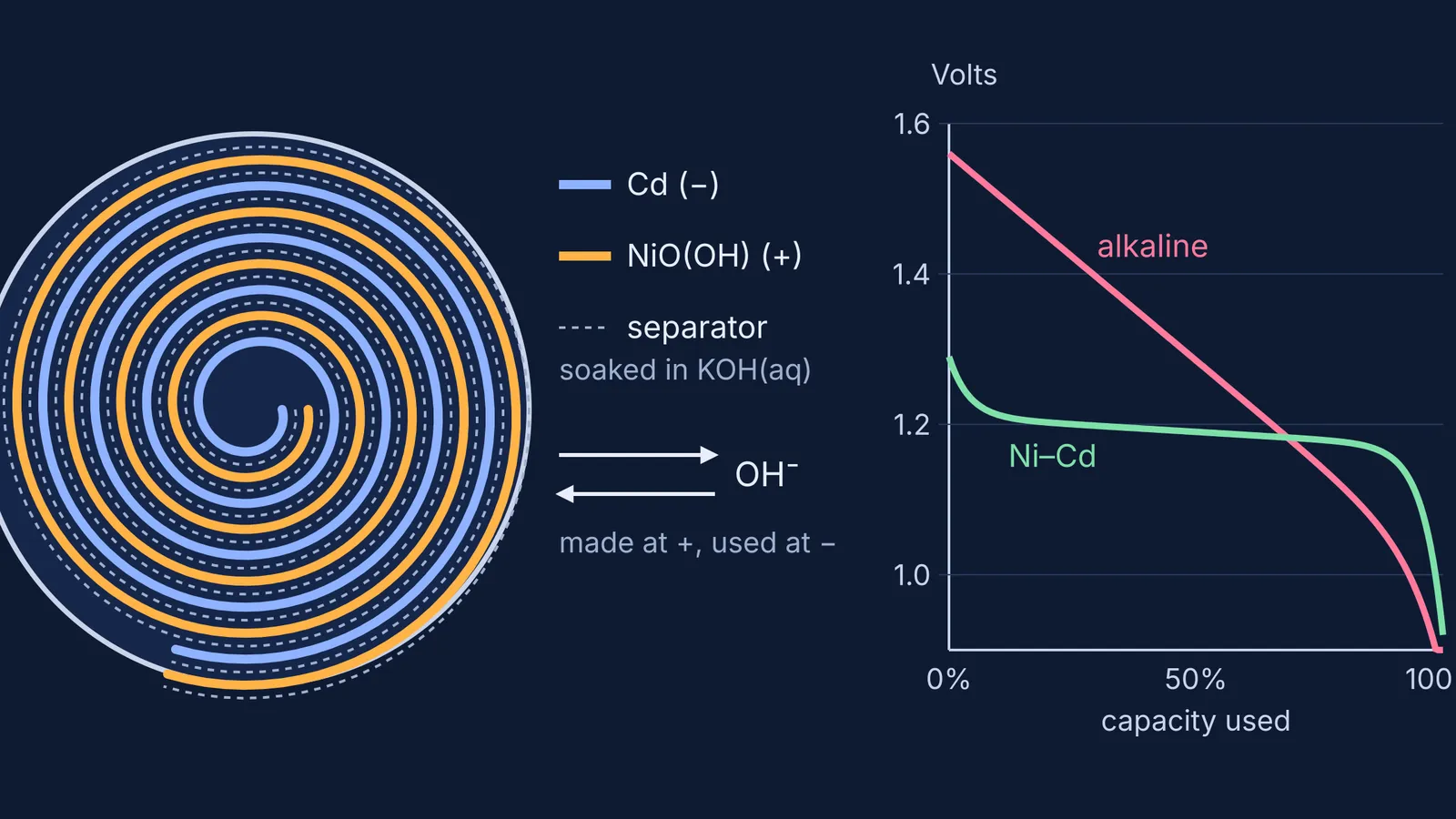
The cell has three parts:
Anode (negative): cadmium metal.
Cathode (positive): nickel oxyhydroxide, NiO(OH), on a nickel support.
Electrolyte: aqueous KOH held in a porous separator between the plates.
In a cylindrical cell the two plates and the separator are rolled up together like a swiss roll, which gives a large electrode area in a small can.
During discharge, the half-reactions given in OpenStax Chemistry 2e are:
Anode (oxidation): Cd + 2OH⁻ → Cd(OH)₂ + 2e⁻
Cathode (reduction): NiO(OH) + H₂O + e⁻ → Ni(OH)₂ + OH⁻
Double the cathode reaction so both involve two electrons, then add:
Overall: Cd + 2NiO(OH) + 2H₂O → Cd(OH)₂ + 2Ni(OH)₂
Check it. Cd: 1 and 1. Ni: 2 and 2. O: 4 + 2 = 6 on the left, 2 + 4 = 6 on the right. H: 2 + 4 = 6 on the left, 2 + 4 = 6 on the right. Charge: zero on both sides. When you charge the cell, the charger drives all three reactions backwards.
How does NCERT write the Ni–Cd reaction?
NCERT gives the overall discharge reaction as:
Cd(s) + 2Ni(OH)₃(s) → CdO(s) + 2Ni(OH)₂(s) + H₂O(l)
It balances too: Ni 2 and 2, O 6 and 6, H 6 and 6. It looks different from the modern version, but the redox change is the same. In both, cadmium goes from 0 to +2 and nickel goes from +3 to +2. Ni(OH)₃ is just an older way of writing the hydrated nickel(III) oxide, and CdO versus Cd(OH)₂ only differs by a water molecule. Write NCERT's version in board answers, and recognise the NiO(OH) version when it turns up in an MCQ.
Why does a Ni–Cd cell hold a steady 1.2 V?
Look at the OH⁻ in the two half-reactions. The cathode makes two OH⁻ for every two electrons, and the anode uses exactly two. They cancel, so the overall equation has only solids and water in it.
That matters because of the Nernst equation. The cell voltage moves away from E° only when the reaction quotient Q changes. Solids have activity 1, and the activity of water barely changes, so Q stays almost constant throughout discharge. The voltage therefore sits on a flat plateau until one electrode's active material runs low, and then it falls quickly. The nominal voltage is 1.2 V; a freshly charged cell reads a little higher on open circuit, about 1.3 V.
A small amount of water is used (one mole per mole of electrons), so the KOH gets slightly more concentrated as the cell discharges. No ions are consumed, though, which is the key point.
Compare the alkaline dry cell, whose voltage slides steadily from about 1.5 V as it is used. Why its starting value is 1.5 V is explained in why AA batteries are 1.5 volts.
How is a Ni–Cd cell different from a lead–acid cell?
In the lead storage battery the overall discharge reaction is Pb + PbO₂ + 2H₂SO₄ → 2PbSO₄ + 2H₂O. Sulphuric acid is used up and water is made, so the acid's density falls as the battery runs down. That is why a hydrometer reading tells you the state of charge of a car or inverter battery, and why you top it up with distilled water; see why only distilled water goes in an inverter battery.
A Ni–Cd cell has no equivalent. Its electrolyte barely changes, so you cannot read its charge from the electrolyte, and its voltage tells you little until it is nearly empty. Ni–Cd cells are sealed, survive many charge cycles and give high currents. For dry cells, lead–acid, fuel cells and lithium-ion side by side, read batteries and fuel cells, worked through.
How many grams of cadmium does a Ni–Cd cell need?
Question: How much cadmium and NiO(OH) must react to deliver 1.00 Ah? What is the minimum mass of cadmium in a 2.0 Ah AA cell? Use F = 96485 C mol⁻¹, Cd = 112.4 g mol⁻¹, NiO(OH) = 91.7 g mol⁻¹.
Charge. 1 Ah means 1 A for 1 hour: Q = 1 × 3600 = 3600 C.
Moles of electrons. n(e⁻) = 3600 / 96485 = 0.0373 mol.
Cadmium. Each Cd gives 2e⁻, so n(Cd) = 0.0373 / 2 = 0.01866 mol. Mass = 0.01866 × 112.4 = 2.10 g.
NiO(OH). Each Ni takes 1e⁻, so n(NiO(OH)) = 0.0373 mol. Mass = 0.0373 × 91.7 = 3.42 g.
Water used. One H₂O per electron: 0.0373 × 18.0 = 0.67 g.
Scale to 2.0 Ah. Cadmium = 2 × 2.10 = 4.19 g, about 4.2 g. NiO(OH) = 6.84 g.
Energy. 1.2 V × 2.0 Ah = 2.4 Wh.
These are minimums for the active material only. Real cells carry extra electrode material, plus the nickel supports, separator, electrolyte and steel can, so the whole cell weighs much more.
For comparison, 1 Ah from a lead–acid cell uses 0.01866 × 207.2 = 3.87 g of lead at the negative plate and 0.0373 × 98.1 = 3.66 g of H₂SO₄, which is the acid that disappears from the electrolyte.
If you want more Faraday's-law problems like this one, the Fermi Problem Library has a step-by-step solver that explains the reasoning at each step.
Why are Ni–Cd batteries being phased out?
Cadmium is a toxic heavy metal, and spent cells sent to landfill can release it. In the EU the Batteries Directive (Directive 2006/66/EC) restricts cadmium in portable batteries, with only limited exemptions, so Ni–Cd cells have been largely replaced in consumer use. Do not open or crush a Ni–Cd cell; take used ones to an e-waste or battery collection point.
The usual replacements are nickel–metal hydride (NiMH) cells, which keep the same NiO(OH) positive plate and the same 1.2 V but use a hydrogen-absorbing alloy instead of cadmium, and lithium-ion cells at about 3.7 V. Ni–Cd cells are also known for a "memory effect", a drop in voltage after many shallow discharges; it is real, but it is less common than its reputation suggests.
Ni–Cd checklist
Anode Cd (−), cathode NiO(OH) (+), electrolyte KOH.
Anode: Cd + 2OH⁻ → Cd(OH)₂ + 2e⁻. Cathode: NiO(OH) + H₂O + e⁻ → Ni(OH)₂ + OH⁻.
Overall: Cd + 2NiO(OH) + 2H₂O → Cd(OH)₂ + 2Ni(OH)₂.
NCERT form for boards: Cd + 2Ni(OH)₃ → CdO + 2Ni(OH)₂ + H₂O. Cd 0 → +2, Ni +3 → +2 in both.
OH⁻ cancels, no ions are used up, so the voltage stays near 1.2 V.
1 Ah = 0.0373 mol e⁻ = at least 2.10 g Cd and 3.42 g NiO(OH).
Lead–acid uses up H₂SO₄; Ni–Cd does not.
Cadmium is toxic: recycle, never open the cell.


