

On this page
In 2017 a team of physicists announced that the Great Pyramid of Khufu in Giza has a large empty space inside it that nobody knew about. They did not drill a hole or move a single block. They sat detectors inside the pyramid and counted cosmic-ray muons coming through the stone from different directions. More muons than expected came from one direction, so there had to be less stone along that line. This method is called muography, and you can work out the key numbers with physics from your syllabus.
What is muography?
Muography is imaging the inside of a large object with muons made by cosmic rays. Cosmic rays hit the upper atmosphere and make showers of particles. Most of what reaches the ground is muons: heavy cousins of the electron, about 207 times its mass, with a mean lifetime of 2.2 µs. Who found them and how time dilation lets them survive the trip down is covered in Anderson and Neddermeyer's discovery of the muon, so it is not repeated here.
The useful facts for imaging are these:
They arrive all the time, from every direction in the sky. A flat detector at sea level sees roughly one muon per square centimetre per minute (Particle Data Group, cosmic rays review).
Many have energies of several GeV or more (the mean at ground level is about 4 GeV, per the same review), so they can push through tens or hundreds of metres of rock.
They travel in nearly straight lines, so the direction a muon arrives from tells you the path it took.
A muon detector records each track and its direction. After weeks or months you have a count for every direction. Compare that count with what solid rock would allow, and you have a map of where the material is thinner or thicker.
How does a muon lose energy in rock?
This is the part most students get wrong. X-rays in a baggage scanner are absorbed exponentially: each centimetre removes the same fraction of the beam, as explained in how airport baggage scanners use absorption. Muons behave differently. A muon is a charged particle, and it loses energy steadily by ionising the atoms it passes. It slows down a little at every step and stops once its energy runs out.
For fast muons, that loss depends mainly on the mass of material crossed per unit area, not on the type of rock. So physicists measure thickness as density × length, in g/cm². The ionisation loss is about 2 MeV for every g/cm². The PDG table for standard rock gives 2.17 MeV per g/cm² at 10 GeV and 2.44 at 100 GeV, plus a small extra loss from radiation that grows with energy (PDG cosmic rays review, Table 30.2).
So every thickness of rock sets a threshold energy. Muons above it get through; muons below it stop inside. The image depends on how many muons in the cosmic-ray spectrum lie above that threshold.
Why does 100 m of rock need a 52 GeV muon?
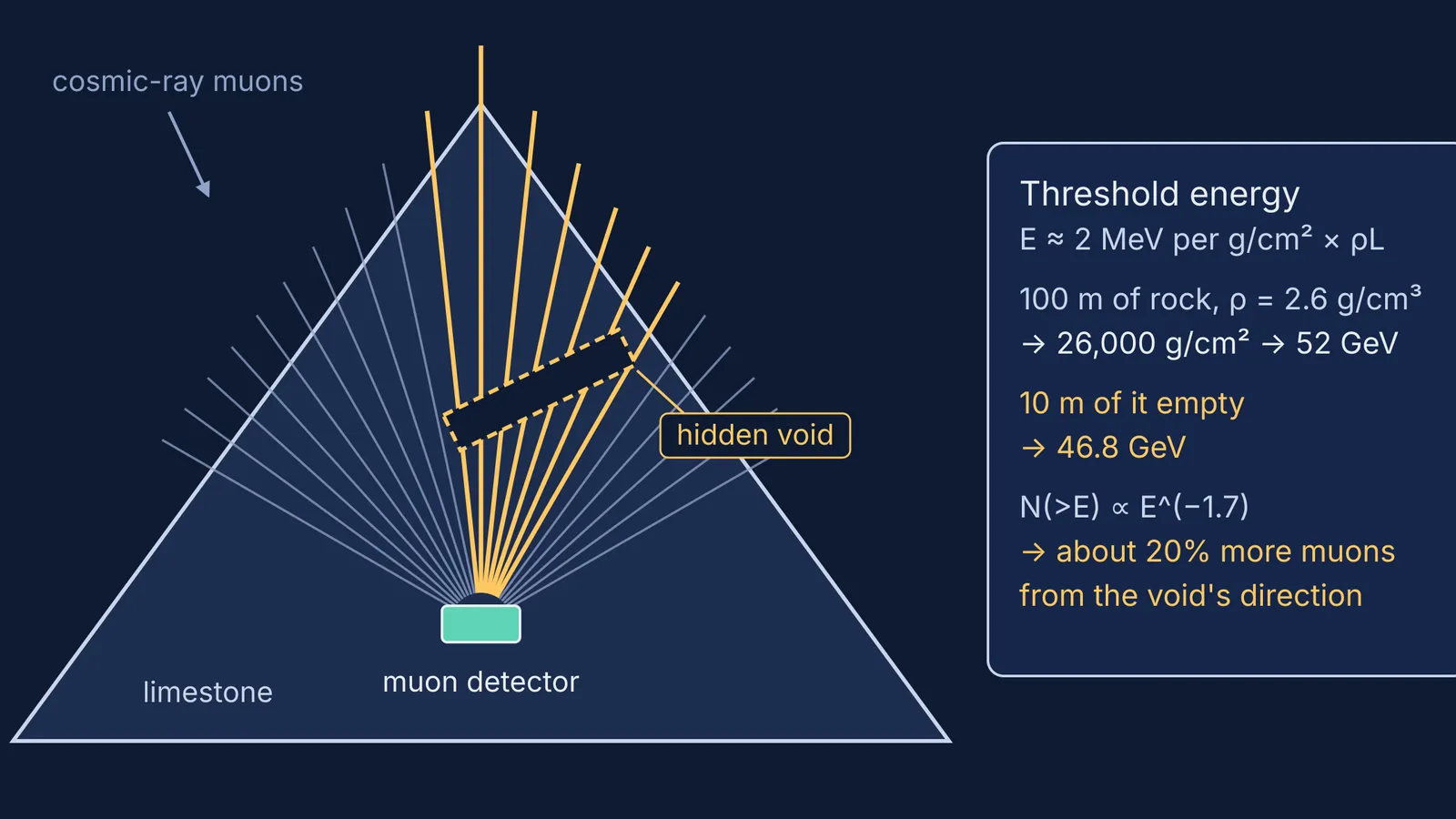
Here is the full worked example, using the round value of 2 MeV per g/cm² and an illustrative rock density of 2.6 g/cm³.
Convert the path to g/cm². 100 m = 10,000 cm. Mass per area = 2.6 g/cm³ × 10,000 cm = 26,000 g/cm².
Threshold energy. 2 MeV per g/cm² × 26,000 g/cm² = 52,000 MeV = 52 GeV. Only muons above about 52 GeV cross this path.
Put a void on the path. If 10 m of the 100 m is empty, only 90 m of rock remain: 2.6 × 9,000 = 23,400 g/cm², so the threshold falls to 46.8 GeV.
How many more muons? Above a few tens of GeV, the number of muons with energy above E falls roughly as E⁻¹·⁷, because the energy spectrum falls as E⁻²·⁷ (the PDG review gives this form). So the ratio is (46.8/52)⁻¹·⁷ = (0.9)⁻¹·⁷ = 1.196. About 20% more muons arrive from the direction of the void.
How long must you count? A count of N has a random spread of about √N. To see an excess of 0.2N at five standard deviations, you need 0.2N/√N = 5, so √N = 25 and N = 625 muons from that direction. A void giving only a 5% excess needs (5/0.05)² = 10,000 counts. Since few muons are energetic enough to cross so much stone, collecting that many from each direction takes weeks to months.
Does decay matter? A 52 GeV muon has γ = 52 / 0.1057 = 492. Its average decay length is γβcτ = 492 × 659 m ≈ 324 km. The rock is 100 m thick, so decay inside it does not matter.
With the PDG values instead of the round 2 MeV (about 2.3 MeV per g/cm² plus the radiation term), the threshold for 100 m comes out nearer 60 GeV and the void's threshold nearer 55 GeV. The excess stays close to 20%, because it depends on the ratio of the two thresholds.
What did muography find in the Great Pyramid?
The ScanPyramids team reported the result in Nature in 2017 (Morishima and colleagues, Nature 552, 386). They found a large void above the Grand Gallery, with a cross-section similar to the Gallery's and a length of at least 30 m. Three different detector types saw it independently: nuclear emulsion films and scintillator detectors placed in the Queen's Chamber, and gas detectors placed outside the pyramid. What the void was built for is still unknown.
The paper used the same idea as the worked example above: an expected count for each direction from a model of a solid pyramid, compared with the measured count. A direction with a significant excess points to missing stone.
Why does muography need long exposures and give blurry pictures?
Few high-energy muons. The steep spectrum means that, for thick objects, only a small share of the incoming muons get through, so counts build up slowly.
Scattering. Muons are deflected slightly by many small collisions with nuclei, which blurs the direction.
Threshold, not absorption. The method measures the total mass along each line. It cannot tell a thin dense layer from a thick light one without views from more than one place.
Limits of the simple rule. The steady 2 MeV per g/cm² picture works up to a few hundred GeV. In standard rock, radiation losses equal ionisation losses near 500 GeV, so for very thick rock, such as the 2.3 km under which M. G. K. Menon's group worked in the Kolar gold mines, you need the full a + bE formula.
If you want to revise how charged particles lose energy in matter, or how γ and decay length are linked, look them up in the Concept Library.
Quick checklist
Muons lose energy steadily, about 2 MeV per g/cm² of rock; they are not absorbed exponentially.
Convert thickness to g/cm² first: density × length.
Threshold energy = loss rate × g/cm². 100 m at 2.6 g/cm³ gives 52 GeV.
A void lowers the threshold, and the steep spectrum turns a 10% lower threshold into about 20% more muons.
Five-sigma detection of a fractional excess f needs about (5/f)² counts.
The 2017 Nature paper found a void at least 30 m long above the Grand Gallery.


